
We read your photo as:
Discuss which species concept would be most appropriate for bacteria, plants and animals and justify your choice.
ScanSolve AI Answer
Question 3: Discuss which species concept would be most appropriate for bacteria, plants and animals and justify your choice.
Here's a discussion of the most appropriate species concept for each group:
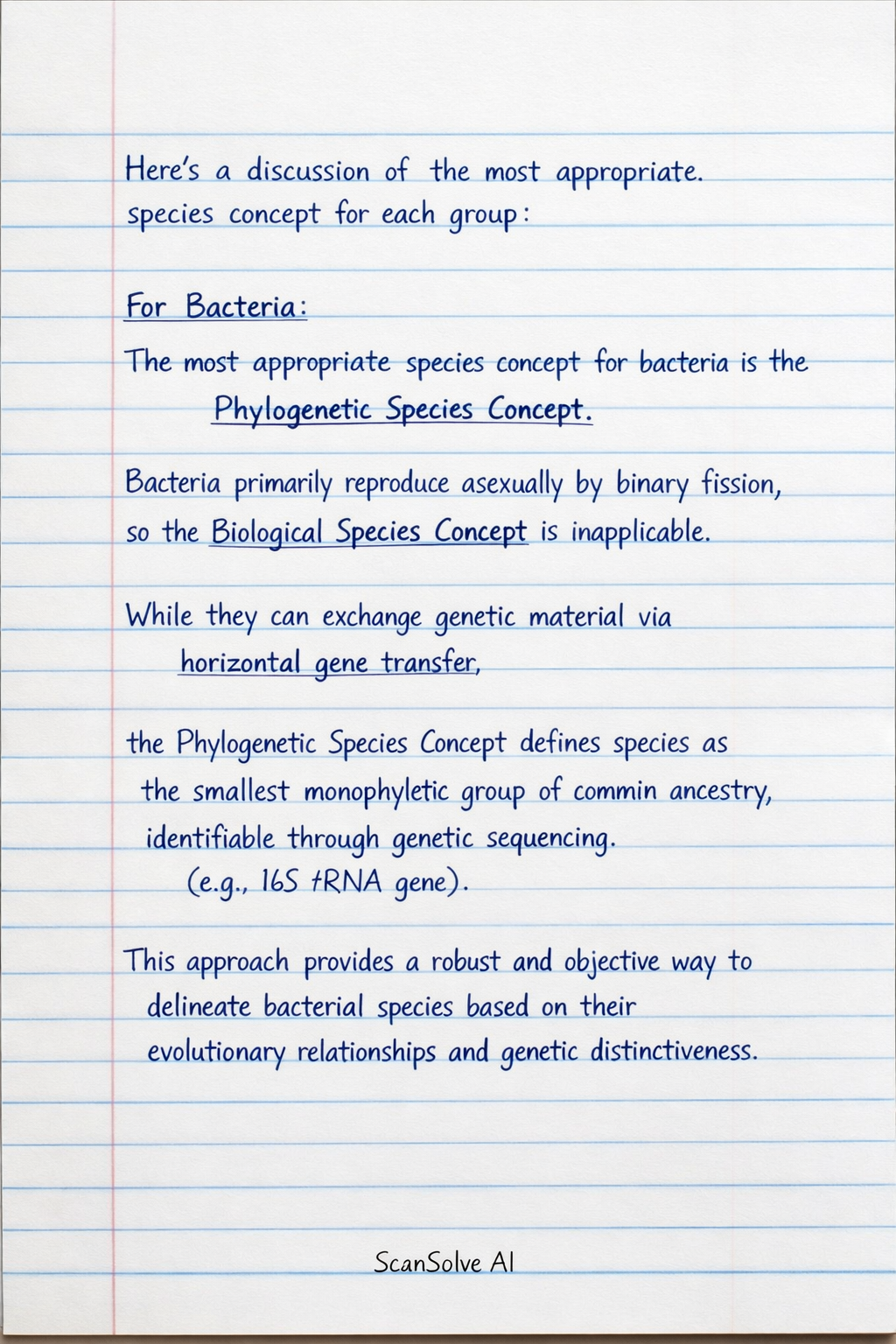
For Bacteria:
The most appropriate species concept for bacteria is the Phylogenetic Species Concept. Bacteria primarily reproduce asexually through binary fission, making the Biological Species Concept (which relies on interbreeding) inapplicable. While they can exchange genetic material via horizontal gene transfer, the Phylogenetic Species Concept defines species as the smallest monophyletic group of common ancestry, identifiable through genetic sequencing (e.g., 16S rRNA gene). This approach provides a robust and objective way to delineate bacterial species based on their evolutionary relationships and genetic distinctiveness.
For Plants:
The most appropriate species concept for plants is often considered the Phylogenetic Species Concept. The Biological Species Concept is frequently problematic in plants due to widespread hybridization between morphologically distinct species, which can produce fertile offspring. Asexual reproduction is also common. While the Morphological Species Concept is practical for identification, it can be subjective and fail to distinguish cryptic species. The Phylogenetic Species Concept, based on shared derived characteristics and genetic data, offers a more accurate reflection of evolutionary lineages and genetic isolation, providing a more consistent framework for defining plant species despite their reproductive complexities.
For Animals:
The most appropriate species concept for sexually reproducing animals is the Biological Species Concept. This concept defines a species as a group of individuals that can interbreed in nature and produce fertile offspring, and are reproductively isolated from other such groups. This concept is highly relevant for animals because reproductive isolation is a key mechanism that maintains distinct gene pools and prevents different species from merging. While it has limitations for asexual species, fossils, or species that hybridize in captivity, it remains the most widely accepted and applicable concept for the vast majority of animal species.
Still stuck on this one?
Ask a follow-up, and the answer starts from this question.
More Biology Questions
Handwritten Step-by-Step Solution
Get this as a handwritten image on WhatsApp — like a tutor wrote it for you.
Try on WhatsApp