
We read your photo as:
Draw a well labelled diagram of the internal anatomy of a Lancelets. Draw a well labelled diagram of the internal anatomy of a larva tunicate along with 6 characteristics feature of the organism; habitats; feeding etc. Well labelled diagram of the adult tunicate.
ScanSolve AI Answer
Step-by-step solution
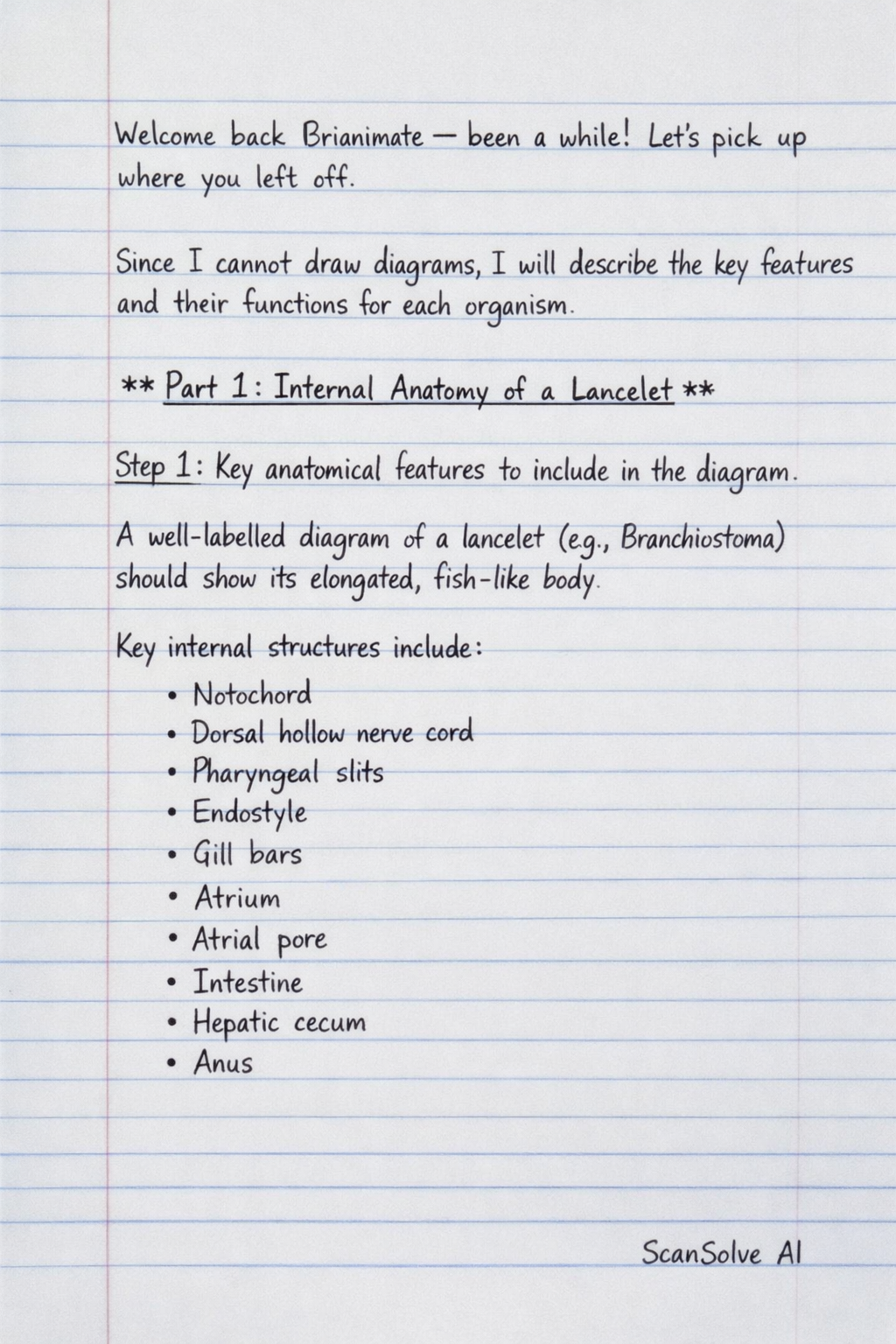
7 stepsSince I cannot draw diagrams, I will describe the key features and their functions for each organism.
Part 1· 2 steps
Internal Anatomy of a Lancelet
Key anatomical features to include in the diagram.
A well-labelled diagram of a lancelet (e.g., Branchiostoma) should show its elongated, fish-like body. Key internal structures include the notochord, dorsal hollow nerve cord, pharyngeal slits, endostyle, gill bars, atrium, atrial pore, intestine, hepatic cecum, and anus.
Functions of the labelled parts.
- Notochord: Provides skeletal support throughout life.
- Dorsal hollow nerve cord: Forms the central nervous system.
- Pharyngeal slits: Used for filter feeding and respiration.
- Endostyle: Produces mucus to trap food particles and is homologous to the thyroid gland.
- Gill bars: Support the pharyngeal slits and contain blood vessels for gas exchange.
- Atrium: A body cavity surrounding the pharynx, collecting filtered water.
- Atrial pore: Opening through which water exits the atrium.
- Intestine: Digests food.
- Hepatic cecum: A blind-ended diverticulum involved in digestion and absorption.
- Anus: Expels undigested waste.
Part 2· 3 steps
Internal Anatomy and Characteristics of a Larva Tunicate
Key anatomical features to include in the diagram.
A tunicate larva (e.g., ascidian tadpole larva) is free-swimming and resembles a tadpole. Essential labels include the notochord (in the tail), dorsal hollow nerve cord (in the tail and anterior body), pharynx with gill slits, adhesive papillae, otolith (statocyst), and ocellus (photoreceptor).
Functions of the labelled parts.
- Notochord: Provides support for the tail, aiding in swimming.
- Dorsal hollow nerve cord: Controls movement and sensory functions.
- Pharynx with gill slits: Involved in filter feeding and respiration.
- Adhesive papillae: Used for attachment to a substrate during metamorphosis.
- Otolith: A gravity-sensing organ, helping with orientation.
- Ocellus: A light-sensing organ, aiding in navigation.
Six characteristics of a larva tunicate.
Here are six characteristics:
- Feature: Possesses all four chordate characteristics (notochord, dorsal hollow nerve cord, pharyngeal slits, post-anal tail).
- Habitat: Marine, free-swimming in the water column.
- Feeding: Non-feeding; it is a dispersal stage.
- Locomotion: Propels itself using its muscular tail.
- Sensory organs: Has a light-sensitive ocellus and a gravity-sensing otolith.
- Metamorphosis: Undergoes dramatic metamorphosis to an sessile adult form.
Part 3· 2 steps
Internal Anatomy of an Adult Tunicate
Key anatomical features to include in the diagram.
An adult tunicate (e.g., sea squirt) is sessile and sac-like. Important labels include the incurrent siphon, excurrent siphon, pharynx (branchial basket) with numerous stigmata (gill slits), endostyle, atrium, stomach, intestine, gonads, and heart.
Functions of the labelled parts.
- Incurrent siphon: Draws water into the body for feeding and respiration.
- Excurrent siphon: Expels filtered water and waste products.
- Pharynx (branchial basket) with stigmata: Filters food particles from water and facilitates gas exchange.
- Endostyle: Produces mucus to trap food particles in the pharynx.
- Atrium: A large cavity surrounding the pharynx, collecting filtered water.
- Stomach: Digests food particles.
- Intestine: Absorbs nutrients and forms fecal pellets.
- Gonads: Reproductive organs, producing gametes.
- Heart: Circulates blood in an open circulatory system.
Still stuck on this one?
Ask a follow-up, and the answer starts from this question.
More Biology Questions
Handwritten Step-by-Step Solution
Get this as a handwritten image on WhatsApp — like a tutor wrote it for you.
Try on WhatsApp