

This biology question covers important biological concepts and processes. The step-by-step explanation below helps you understand the underlying mechanisms and reasoning.
ScanSolve AI Answer
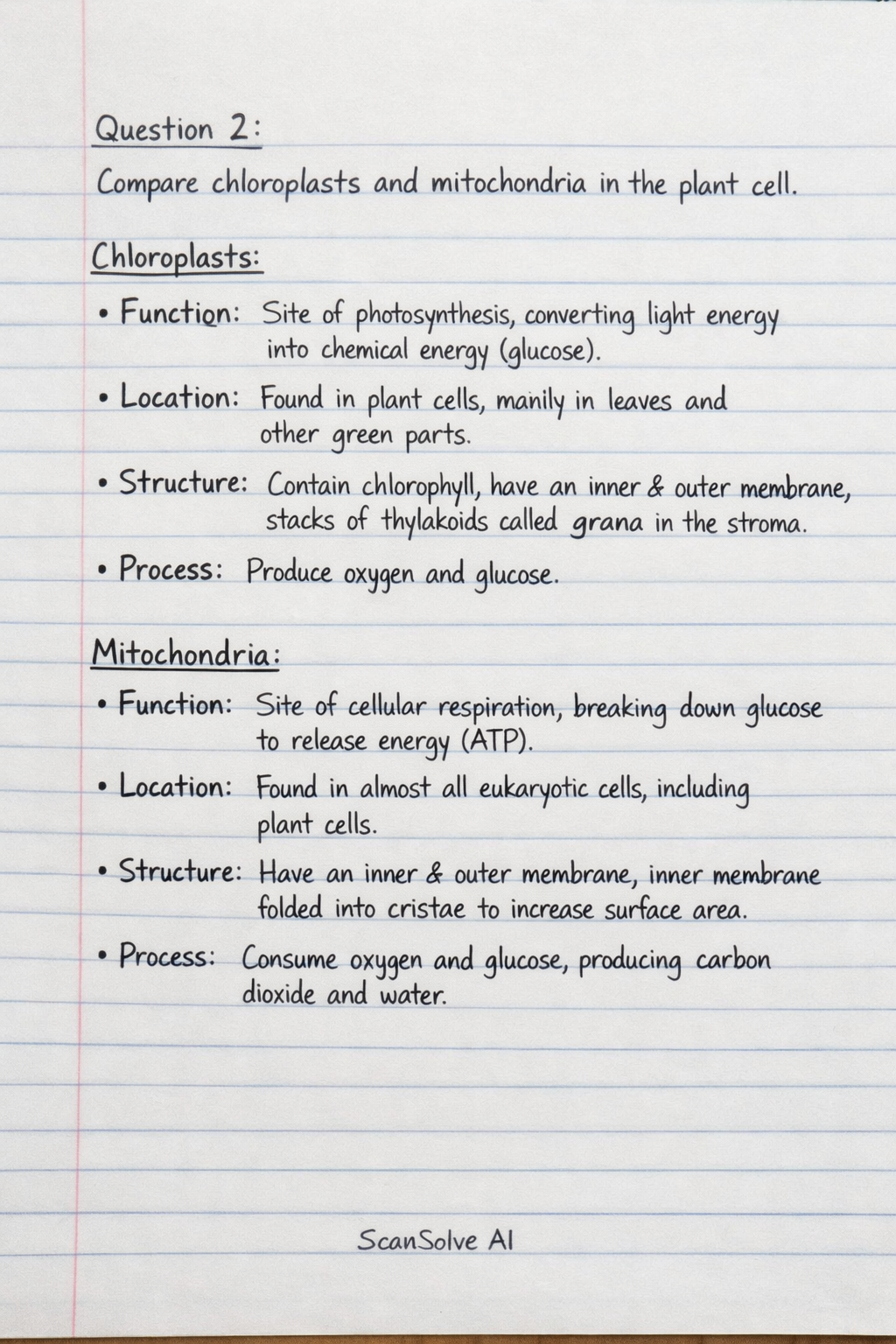
Here are the answers to the questions I could clearly decipher from the image. Question 2: Compare chloroplasts and mitochondria in the plant cell. Chloroplasts: Function: Site of photosynthesis, converting light energy into chemical energy (glucose). Location: Found in plant cells, primarily in the leaves and other green parts. Structure: Contain chlorophyll, have an inner and outer membrane, and stacks of thylakoids called grana within the stroma. Process: Produce oxygen and glucose. Mitochondria: Function: Site of cellular respiration, breaking down glucose to release energy (ATP). Location: Found in almost all eukaryotic cells, including plant cells. Structure: Have an inner and outer membrane, with the inner membrane folded into cristae to increase surface area for reactions. Process: Consume oxygen and glucose, producing carbon dioxide and water. Question 4: Discuss the following terms as they relate to plants: (i) Water potential (ii) Turgor pressure (i) Water potential (): Water potential is the potential energy of water per unit volume relative to pure water in reference conditions. It quantifies the tendency of water to move from one area to another due to osmosis, gravity, mechanical pressure, or matrix effects such as surface tension. Water always moves from an area of higher water potential to an area of lower water potential. (ii) Turgor pressure: Turgor pressure is the pressure exerted by the water inside a plant cell against its cell wall. When a plant cell absorbs water by osmosis, its vacuole swells, pushing the cell membrane against the rigid cell wall. This pressure helps maintain the plant's rigidity, supports non-woody parts, and is crucial for processes like stomatal opening.