
We read your photo as:
Describe the effect of pH on the enzyme by comparing the volumes and appearance of the filtered juice in measuring cylinders B and D. State two variables that were controlled in this investigation. Suggest two ways in which you could change this investigation to make the results more accurate.
Biology
ScanSolve AI Answer
Step-by-step solution
7 steps2. (e)
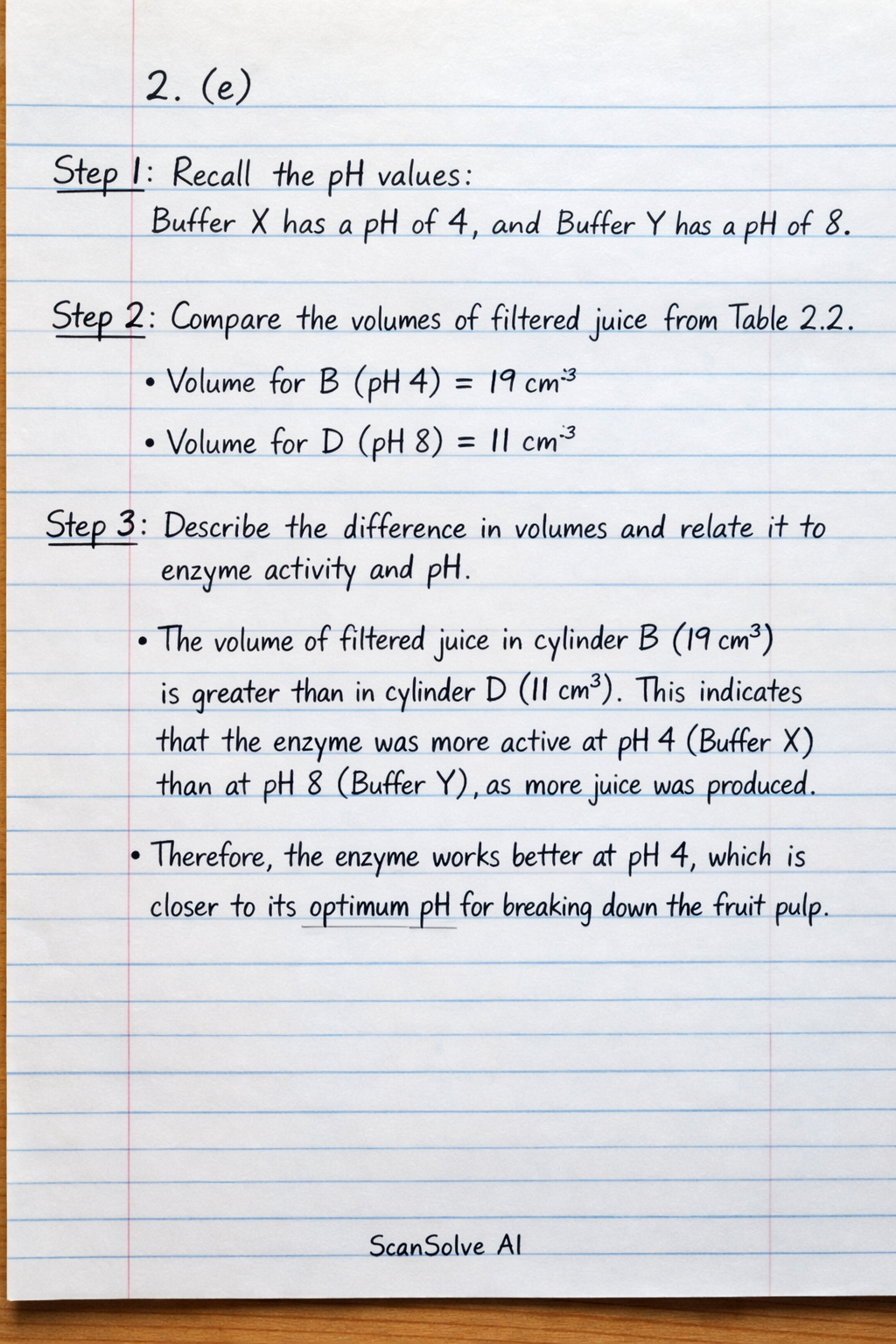
Recall the pH values for buffer X and buffer Y from part (a).
Buffer X has a pH of 4, and buffer Y has a pH of 8.
Compare the volumes of filtered juice for cylinders B and D from Table 2.2.
- Volume for B (with enzyme and buffer X, pH 4) is .
- Volume for D (with enzyme and buffer Y, pH 8) is .
Describe the difference in volumes and relate it to enzyme activity and pH.
- The volume of filtered juice in cylinder B () is greater than in cylinder D (). This indicates that the enzyme was more active at pH 4 (buffer X) than at pH 8 (buffer Y), as more juice was produced.
- Therefore, the enzyme works better at pH 4, which is closer to its optimum pH for breaking down the fruit pulp.
2. (f) (i)
Identify variables that were kept constant throughout the experiment to ensure a fair test.
- The volume of fruit pulp was in all cups.
- The volume of buffer (X or Y) was in all cups.
- The volume of enzyme solution (or water for control) was in all cups.
- The temperature was kept constant (implied by the setup, usually experiments are done at room temperature or controlled temperature).
- The type of fruit used was the same.
- The time allowed for the enzyme reaction was the same for all cups.
State two of these controlled variables.
- Volume of fruit pulp (or type of fruit)
- Volume of enzyme solution (or water)
2. (f) (ii)
Think about ways to improve the accuracy of experimental results in general.
- Repeat the experiment multiple times and calculate an average to reduce the impact of random errors.
- Use more precise measuring equipment (e.g., burettes or pipettes instead of measuring cylinders for smaller volumes).
- Use a wider range of pH values with smaller intervals to pinpoint the optimum pH more accurately.
- Maintain a more constant temperature using a water bath.
- Ensure thorough mixing of contents in each cup.
Suggest two specific ways to change this investigation for more accurate results.
- Repeat the experiment multiple times and calculate an average.
- Use a water bath to maintain a constant and precise temperature.
Was this helpful?
Still stuck on this one?
Ask a follow-up, and the answer starts from this question.
Got a different question?Ask your own question
More Biology Questions
QDesign and carry out an experiment to test your hypothesis about enzyme activity and pH, including…QDesign and carry out an experiment to test your hypothesis: If the pH deviates from the optimum…QDesign an experiment to investigate the effect of pH on catalase activity in a germinating bean…QA) How does pH affect the ability of enzymes to catalyse chemical reactions?QHow can one control the enzyme experiment?
Browse by topic:Biochemistry
Handwritten Step-by-Step Solution
Get this as a handwritten image on WhatsApp — like a tutor wrote it for you.
Try on WhatsApp