
We read your photo as:
A) How does pH affect the ability of enzymes to catalyse chemical reactions?
ScanSolve AI Answer
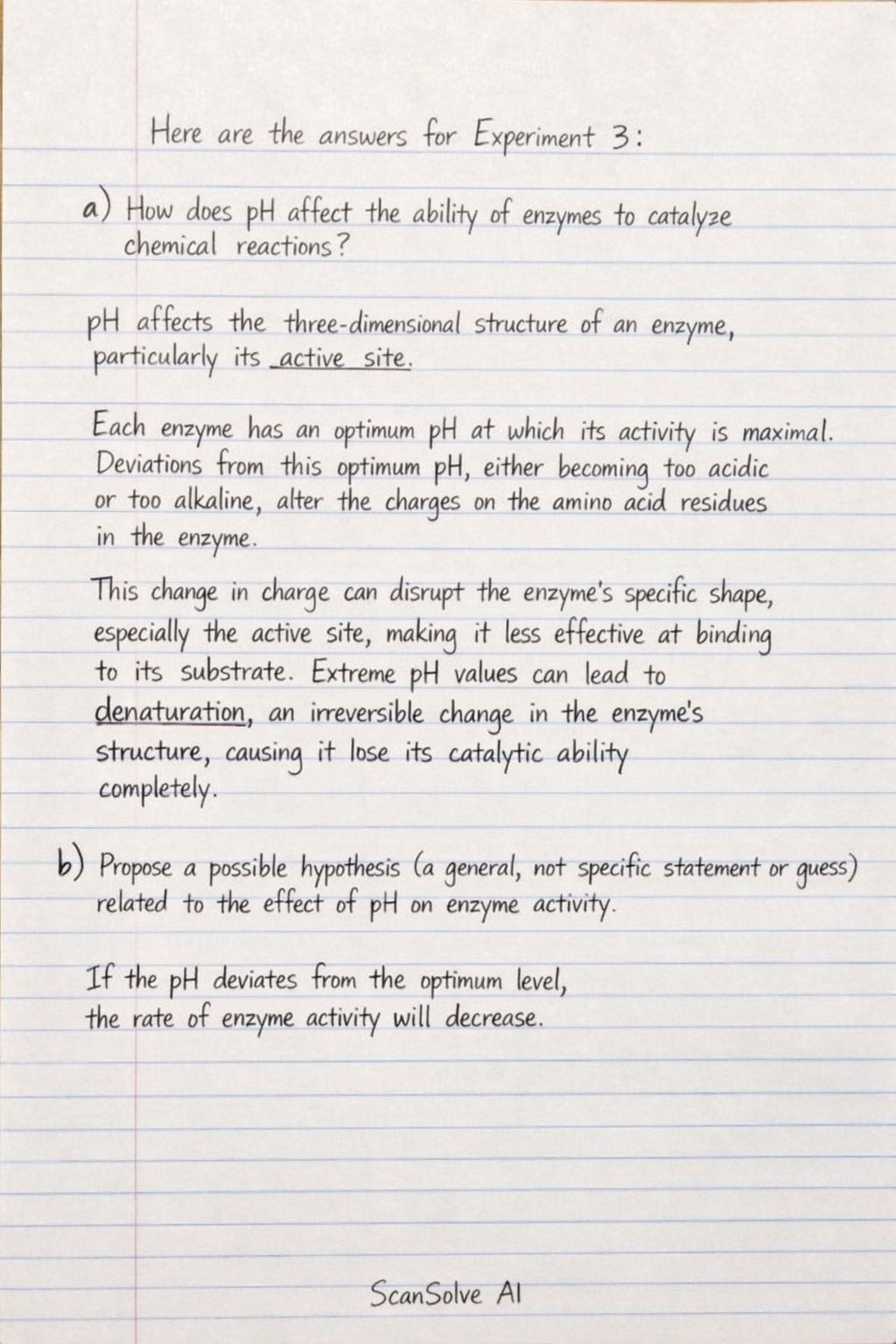
Here are the answers for Experiment 3:
a) How does pH affect the ability of enzymes to catalyse chemical reactions?
pH affects the three-dimensional structure of an enzyme, particularly its active site. Each enzyme has an optimum pH at which its activity is maximal. Deviations from this optimum pH, either becoming too acidic or too alkaline, alter the charges on the amino acid residues in the enzyme. This change in charge can disrupt the enzyme's specific shape, especially the active site, making it less effective at binding to its substrate. Extreme pH values can lead to denaturation, an irreversible change in the enzyme's structure, causing it to lose its catalytic ability completely.
b) Propose a possible hypothesis (a general, not specific statements or guess) related to the effect on pH on enzyme activity.
If the pH deviates from the optimum level, the rate of enzyme activity will decrease.
c) Identify the variables involved in this experiment
- Independent Variable: The pH of the solution.
- Dependent Variable: The rate of enzyme activity (e.g., the rate of oxygen production/fizzing from hydrogen peroxide breakdown).
- Controlled Variables:
- Temperature
- Concentration of enzyme (liver solution)
- Concentration of substrate (hydrogen peroxide)
- Volume of enzyme solution
- Volume of substrate solution
- Time of reaction
Still stuck on this one?
Ask a follow-up, and the answer starts from this question.
More Chemistry Questions
Handwritten Step-by-Step Solution
Get this as a handwritten image on WhatsApp — like a tutor wrote it for you.
Try on WhatsApp