
We read your photo as:
What are enzymes, their characteristics, importance of proteins, and how to test for reducing sugar in maize?
ScanSolve AI Answer
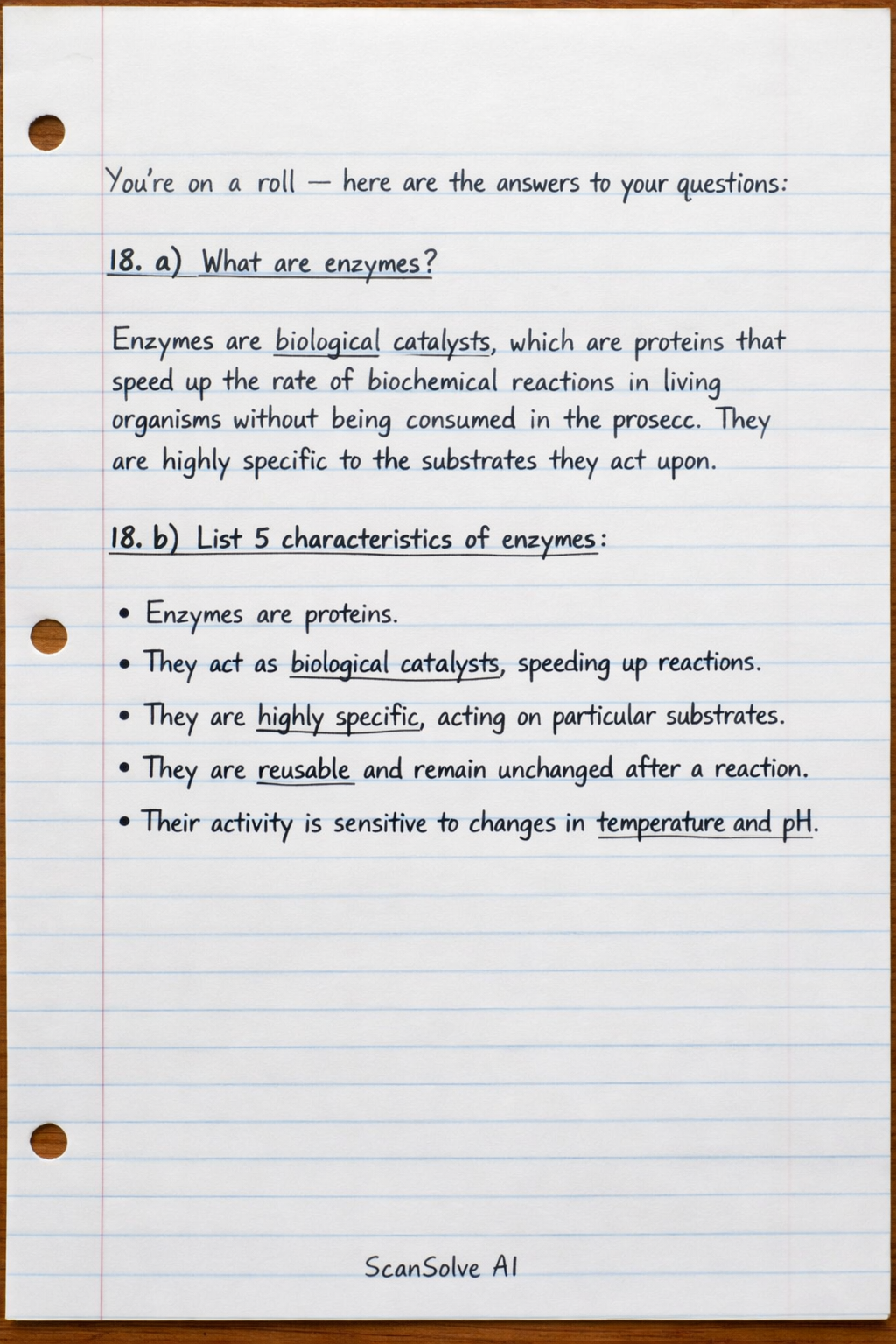
here are the answers to your questions:
18. a) What are enzymes?
Enzymes are biological catalysts, which are proteins that speed up the rate of biochemical reactions in living organisms without being consumed in the process. They are highly specific to the substrates they act upon.
18. b) List 5 characteristics of enzymes.
- Enzymes are proteins.
- They act as biological catalysts, speeding up reactions.
- They are highly specific, acting on particular substrates.
- They are reusable and remain unchanged after a reaction.
- Their activity is sensitive to changes in temperature and pH.
18. c) What is the importance of proteins to man?
Proteins are essential for numerous bodily functions:
- Structural components: They form the building blocks of tissues like muscles, hair, skin, and nails.
- Enzymes: All enzymes are proteins, catalyzing vital biochemical reactions.
- Hormones: Many hormones (e.g., insulin) are proteins, regulating physiological processes.
- Transport: Proteins like hemoglobin transport oxygen in the blood.
- Immunity: Antibodies, which fight infections, are proteins.
- Repair and growth: They are crucial for the repair of tissues and the growth of new cells.
18. d) How would you demonstrate that soaked maize grains contain reducing sugar?
To demonstrate the presence of reducing sugar in soaked maize grains, you would perform the Benedict's test:
- Crush a few soaked maize grains and mix them with a small amount of distilled water in a test tube to create an extract.
- Filter the mixture to remove solid particles, obtaining a clear solution (filtrate).
- Add an equal volume of Benedict's reagent to the filtrate in the test tube.
- Heat the test tube in a boiling water bath for 5-10 minutes.
- Observe the color change. If reducing sugars are present, the solution will change from blue to green, yellow, orange, or brick-red precipitate, depending on the concentration.
19. a) Briefly explain the term photosynthesis.
Photosynthesis is the process by which green plants, algae, and some bacteria convert light energy into chemical energy. They use carbon dioxide and water to synthesize glucose (a sugar) and release oxygen as a byproduct.
19. b) Give the importance of photosynthesis in nature.
Photosynthesis is vital because:
- It produces glucose, which is the primary source of food and energy for plants and, indirectly, for almost all other living organisms on Earth.
- It releases oxygen into the atmosphere, which is essential for the aerobic respiration of most living organisms.
- It helps regulate the Earth's climate by removing carbon dioxide from the atmosphere.
19. c) How is the leaf suited for photosynthesis?
The leaf is well-adapted for photosynthesis due to several features:
- Large surface area: Its broad, flat shape maximizes light absorption.
- Thinness: Provides a short diffusion path for gases ( and ) and light penetration.
- Stomata: Pores on the epidermis allow for efficient gaseous exchange.
- Chloroplasts: Abundant in mesophyll cells, containing chlorophyll to absorb light energy.
- Vascular bundles (veins): Supply water and minerals (via xylem) and transport sugars (via phloem).
- Air spaces: In the spongy mesophyll, facilitate the diffusion of gases.
20. a) What is holozoic nutrition?
Holozoic nutrition is a type of heterotrophic nutrition where organisms ingest solid or liquid organic food particles, digest them internally, absorb the soluble nutrients, assimilate them, and then egest the undigested waste. This is characteristic of animals.
20. b) How is the ileum adapted for absorption of soluble food?
The ileum is highly adapted for absorption:
- Long length: Provides ample time for digestion and absorption.
- Folded inner surface: The inner lining has numerous folds, villi, and microvilli, which vastly increase the surface area for absorption.
- Rich blood supply: Each villus contains a dense network of capillaries to quickly transport absorbed nutrients away.
- Thin walls: The walls of the villi are only one cell thick, providing a short diffusion path for nutrients into the bloodstream.
20. c) Copy and complete the table below:
| Vitamin/mineral | Source | Deficiency | Function |
|---|---|---|---|
| Vitamin A | Carrots, liver, egg yolk | Night blindness | Proper Vision |
| Vitamin D | Milk, meat, fish, sunlight | Rickets | Calcium absorption, bone health |
| Iron | Red meat, spinach, lentils | Anaemia | Hemoglobin formation, oxygen transport |
| Vitamin C | Oranges, grapes, limes, etc | Scurvy | Prevents bleeding gums, collagen synthesis |
| Calcium | Milk, cheese, leafy greens | Osteoporosis, muscle cramps | Helps in muscle contraction, bone/teeth formation |
21. a) What is:
- i) Digestion: The process of breaking down large, complex, insoluble food molecules into smaller, simpler, soluble molecules that can be absorbed by the body.
- ii) Absorption: The movement of digested food molecules from the lumen of the digestive tract across the intestinal wall into the bloodstream or lymphatic system.
- iii) Assimilation: The process by which absorbed nutrients are transported to the body cells and utilized for energy, growth, repair, and synthesis of new cellular components.
21. b) Describe the digestion of proteins in mammals.
Protein digestion begins in the stomach and continues in the small intestine:
- Stomach: Gastric glands secrete hydrochloric acid (HCl) and pepsinogen. HCl denatures proteins and activates pepsinogen into pepsin. Pepsin is an endopeptidase that breaks down large protein molecules into smaller polypeptides.
- Small Intestine: The partially digested polypeptides move into the duodenum. The pancreas releases pancreatic juice containing trypsin (another endopeptidase) and chymotrypsin, which further break down polypeptides into smaller peptides. The intestinal wall secretes peptidases (exopeptidases) that break down these smaller peptides into individual amino acids, which are then absorbed.
21. c) How is ileum adapted to its absorptive functions?
The ileum is highly adapted for absorption of digested food:
- Very long length: Provides an extensive area and sufficient time for maximum absorption.
- Folded inner surface: The inner lining is thrown into numerous folds, which are covered with millions of finger-like projections called villi.
- Microvilli: The epithelial cells lining the villi have microscopic projections called microvilli, further increasing the surface area for absorption.
- Rich blood supply: Each villus contains a dense network of blood capillaries and a lacteal (lymphatic vessel) to rapidly transport absorbed nutrients (amino acids, glucose into blood; fatty acids, glycerol into lacteal) away from the intestine.
- Thin walls: The walls of the villi are only one cell thick, providing a very short diffusion distance for nutrients to pass into the bloodstream or lymphatic system.
Still stuck on this one?
Ask a follow-up, and the answer starts from this question.
More Biology Questions
Handwritten Step-by-Step Solution
Get this as a handwritten image on WhatsApp — like a tutor wrote it for you.
Try on WhatsApp