Evaluate the expression inside the square root.

Biology
Evaluate the expression inside the square root.

ScanSolve AI Answer

Answer

12\frac{1}{2}

Welcome back Dalena — missed you this week.

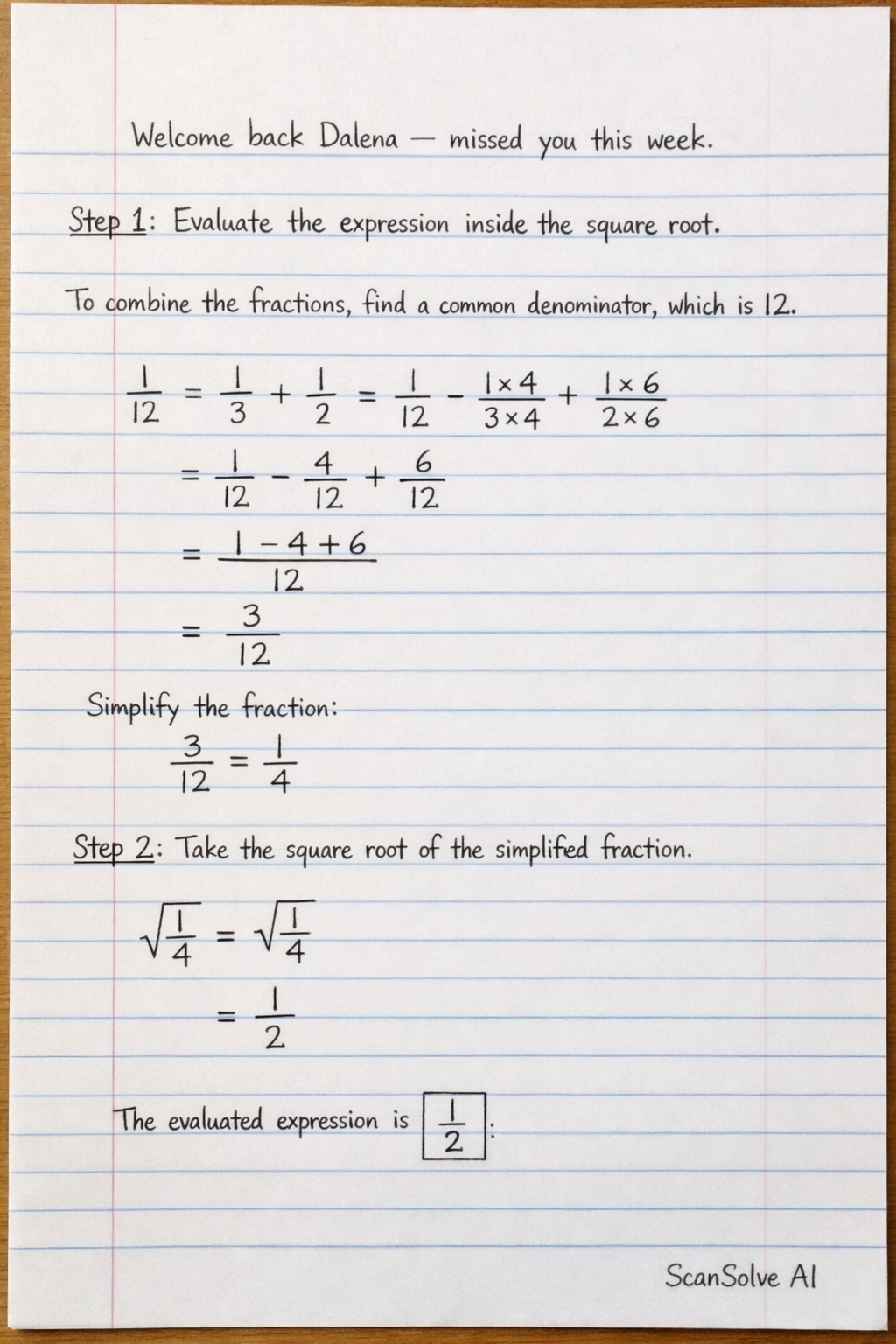
Step 1: Evaluate the expression inside the square root. To combine the fractions, find a common denominator, which is 12. 11213+12=1121×43×4+1×62×6\frac{1}{12} - \frac{1}{3} + \frac{1}{2} = \frac{1}{12} - \frac{1 \times 4}{3 \times 4} + \frac{1 \times 6}{2 \times 6} =112412+612= \frac{1}{12} - \frac{4}{12} + \frac{6}{12} =14+612= \frac{1 - 4 + 6}{12} =312= \frac{3}{12} Simplify the fraction: 312=14\frac{3}{12} = \frac{1}{4} Step 2: Take the square root of the simplified fraction. 14=14\sqrt{\frac{1}{4}} = \frac{\sqrt{1}}{\sqrt{4}} =12= \frac{1}{2} The evaluated expression is 12\boxed{\frac{1}{2}}.

Step 1: Calculate the new hourly rate. The original rate is Ksh. 210 per hour. The rate changed in the ratio 8:7, meaning the new rate is 87\frac{8}{7} times the old rate. Newrate=Ksh.210×87New rate = Ksh. 210 \times \frac{8}{7} Newrate=Ksh.(210÷7)×8New rate = Ksh. (210 \div 7) \times 8 Newrate=Ksh.30×8New rate = Ksh. 30 \times 8 Newrate=Ksh.240perhourNew rate = Ksh. 240 per hour Step 2: Convert the total working hours to an improper fraction. 1012hours=2×10+12hours=212hours10\frac{1}{2} hours = \frac{2 \times 10 + 1}{2} hours = \frac{21}{2} hours Step 3: Calculate the total earnings. Totalearnings=Newrate×TotalhoursTotal earnings = New rate \times Total hours Totalearnings=Ksh.240×212Total earnings = Ksh. 240 \times \frac{21}{2} Totalearnings=Ksh.(240÷2)×21Total earnings = Ksh. (240 \div 2) \times 21 Totalearnings=Ksh.120×21Total earnings = Ksh. 120 \times 21 Totalearnings=Ksh.2520Total earnings = Ksh. 2520 Baraka would earn Ksh.2520\boxed{Ksh. 2520}.

Step 1: Express all bases as powers of 2. The given equation is 43x×8=(132)2x14^{3x} \times 8 = \left(\frac{1}{32}\right)^{2x-1}. We know that 4=224 = 2^2, 8=238 = 2^3, and 32=2532 = 2^5. Therefore, 132=25\frac{1}{32} = 2^{-5}. Substitute these into the equation: (22)3x×23=(25)2x1(2^2)^{3x} \times 2^3 = (2^{-5})^{2x-1} Step 2: Apply the power rule (am)n=amn(a^m)^n = a^{mn}. 22×3x×23=25×(2x1)2^{2 \times 3x} \times 2^3 = 2^{-5 \times (2x-1)} 26x×23=210x+52^{6x} \times 2^3 = 2^{-10x + 5} Step 3: Apply the product rule am×an=am+na^m \times a^n = a^{m+n} on the left side. 26x+3=210x+52^{6x+3} = 2^{-10x + 5} Step 4: Since the bases are equal, equate the exponents. 6x+3=10x+56x + 3 = -10x + 5 Step 5: Solve the linear equation for xx. Add 10x10x to both sides: 6x+10x+3=56x + 10x + 3 = 5 16x+3=516x + 3 = 5 Subtract 3 from both sides: 16x=5316x = 5 - 3 16x=216x = 2 Divide by 16: x=216x = \frac{2}{16} x=18x = \frac{1}{8} The solution is x=18\boxed{x = \frac{1}{8}}.

Send me the next one 📸

Was this helpful?

Need help with your own homework?

Get instant step-by-step solutions to any question. Free to start.

Ask Your Question
Handwritten step-by-step solution preview

Handwritten Step-by-Step Solution

Get this as a handwritten image on WhatsApp — like a tutor wrote it for you.

Try on WhatsApp

Still have questions?

Quick Answer
  1. Welcome back Dalena — missed you this week.
  2. To combine the fractions, find a common denominator, which is 12.
  3. sqrt((1)/(4)) = sqrt(1)sqrt(4) = (1)/(2) The evaluated expression is (1)/(2).
  4. The original rate is Ksh.
Evaluate the expression inside the square root.
Biology

This biology question covers important biological concepts and processes. The step-by-step explanation below helps you understand the underlying mechanisms and reasoning.

ScanSolve AI Answer
Welcome back Dalena — missed you this week. Step 1: Evaluate the expression inside the square root. To combine the fractions, find a common denominator, which is 12. (1)/(12) - (1)/(3) + (1)/(2) = (1)/(12) - (1 × 4)/(3 × 4) + (1 × 6)/(2 × 6) = (1)/(12) - (4)/(12) + (6)/(12) = (1 - 4 + 6)/(12) = (3)/(12) Simplify the fraction: (3)/(12) = (1)/(4) Step 2: Take the square root of the simplified fraction. sqrt((1)/(4)) = sqrt(1)sqrt(4) = (1)/(2) The evaluated expression is (1)/(2). Step 1: Calculate the new hourly rate. The original rate is Ksh. 210 per hour. The rate changed in the ratio 8:7, meaning the new rate is (8)/(7) times the old rate. New rate = Ksh. 210 × (8)/(7) New rate = Ksh. (210 ÷ 7) × 8 New rate = Ksh. 30 × 8 New rate = Ksh. 240 per hour Step 2: Convert the total working hours to an improper fraction. 10(1)/(2) hours = (2 × 10 + 1)/(2) hours = (21)/(2) hours Step 3: Calculate the total earnings. Total earnings = New rate × Total hours Total earnings = Ksh. 240 × (21)/(2) Total earnings = Ksh. (240 ÷ 2) × 21 Total earnings = Ksh. 120 × 21 Total earnings = Ksh. 2520 Baraka would earn Ksh. 2520. Step 1: Express all bases as powers of 2. The given equation is 4^3x × 8 = ((1)/(32))^2x-1. We know that 4 = 2^2, 8 = 2^3, and 32 = 2^5. Therefore, (1)/(32) = 2^-5. Substitute these into the equation: (2^2)^3x × 2^3 = (2^-5)^2x-1 Step 2: Apply the power rule (a^m)^n = a^mn. 2^2 × 3x × 2^3 = 2^-5 × (2x-1) 2^6x × 2^3 = 2^-10x + 5 Step 3: Apply the product rule a^m × a^n = a^m+n on the left side. 2^6x+3 = 2^-10x + 5 Step 4: Since the bases are equal, equate the exponents. 6x + 3 = -10x + 5 Step 5: Solve the linear equation for x. Add 10x to both sides: 6x + 10x + 3 = 5 16x + 3 = 5 Subtract 3 from both sides: 16x = 5 - 3 16x = 2 Divide by 16: x = (2)/(16) x = (1)/(8) The solution is x = (1)/(8). Send me the next one 📸