
We read your photo as:
Describe the external structure of an Agama lizard. 1. (b) How are birds adapted to their mode of feeding?
ScanSolve AI Answer
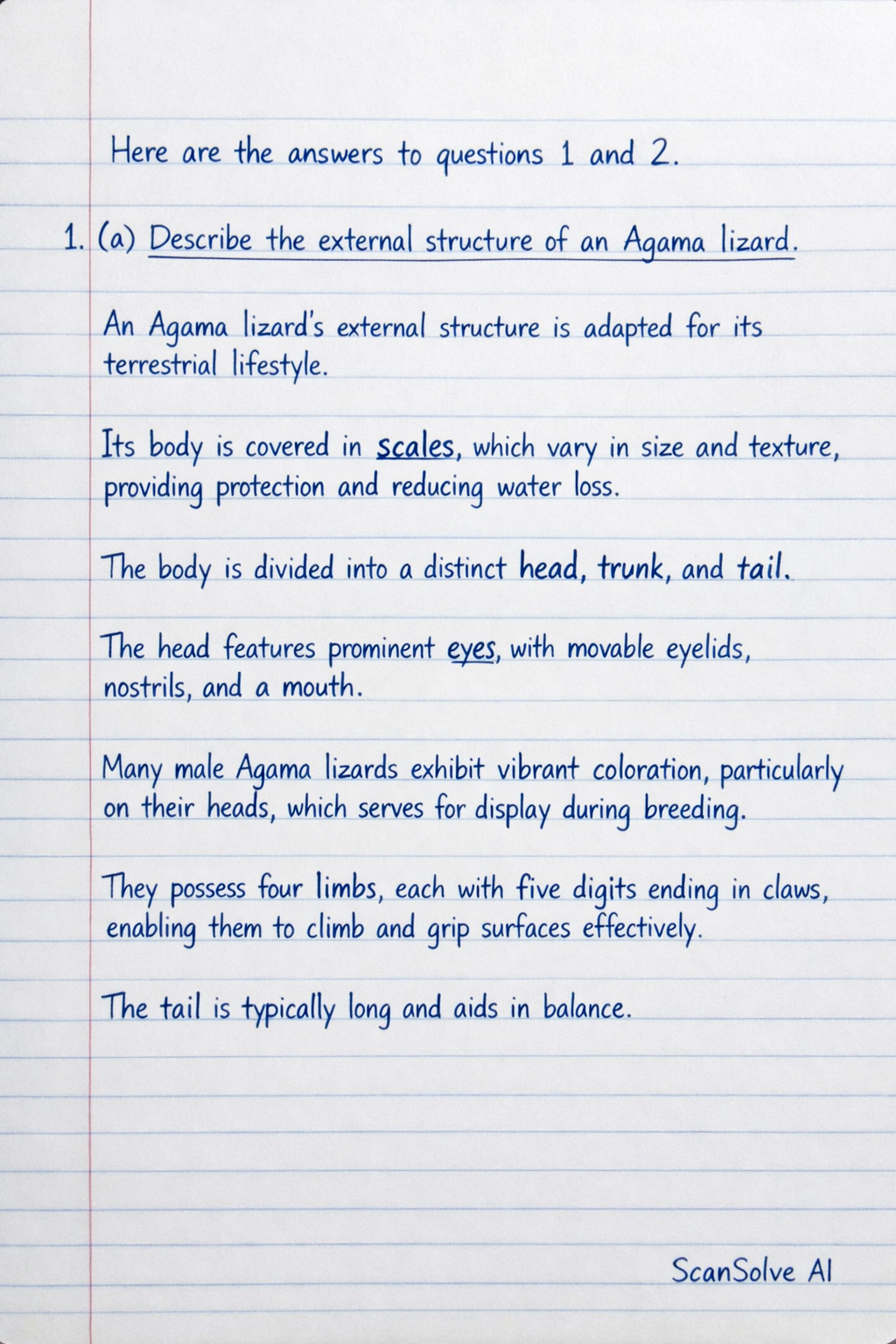
Here are the answers to questions 1 and 2.
1. (a) Describe the external structure of an Agama lizard.
An Agama lizard's external structure is adapted for its terrestrial lifestyle. Its body is covered in scales, which vary in size and texture, providing protection and reducing water loss. The body is divided into a distinct head, trunk, and tail. The head features prominent eyes with movable eyelids, nostrils, and a mouth. Many male Agama lizards exhibit vibrant coloration, particularly on their heads, which serves for display during breeding. They possess four limbs, each with five digits ending in claws, enabling them to climb and grip surfaces effectively. The tail is typically long and aids in balance.
1. (b) How are birds adapted to their mode of feeding?
Birds exhibit diverse adaptations for feeding, primarily through their specialized beaks and feet.
- Beaks: The shape and size of a bird's beak are highly specialized for its diet. For instance, seed-eaters have short, conical beaks for cracking seeds, while insectivores possess thin, pointed beaks for catching insects. Raptors have sharp, hooked beaks for tearing flesh, and filter-feeders like flamingos have unique beaks for straining food from water.
- Feet: Their feet are also adapted for feeding. Raptors have strong talons for grasping and holding prey, whereas wading birds have long legs and spread toes to walk in shallow water without sinking.
- Tongue: Some birds, like woodpeckers, have specialized barbed tongues for extracting insects from crevices.
- Digestive System: Many birds have a crop for temporary food storage and a muscular gizzard for grinding food, especially prominent in seed-eating species.
1. (c) How is water important to plants?
Water is essential for plants in several critical ways:
- Photosynthesis: It is a vital raw material for photosynthesis, where it is split to provide electrons and protons for the process.
- Transport: Water acts as a solvent and the primary medium for transporting dissolved mineral nutrients from the soil to various parts of the plant, and for moving sugars produced during photosynthesis from leaves to other tissues.
- Turgidity: It maintains turgor pressure within plant cells, which provides structural rigidity, keeping the plant upright and its leaves firm.
- Temperature Regulation: Through transpiration (the evaporation of water from leaves), plants can cool themselves, preventing overheating.
- Seed Germination: Water is necessary for the imbibition of seeds, which activates enzymes and initiates the germination process.
2. (a) Define:
(i) Seed dispersal.
Seed dispersal is the process by which seeds are moved away from the parent plant. This mechanism helps to reduce competition between parent and offspring, facilitates the colonization of new habitats, and enhances the overall survival rate of the species.
(ii) Gestation.
Gestation is the period of development of an embryo or fetus inside the mother's womb, spanning from the moment of conception until birth.
2. (b) State the agents of seed dispersal.
The primary agents of seed dispersal include:
- Wind
- Water
- Animals (e.g., birds, mammals, insects)
- Explosive mechanisms (self-dispersal by the plant itself)
- Humans
2. (c) Differentiate between insect and wind pollinated flowers.
Here are the key differences between insect-pollinated and wind-pollinated flowers:
- Petals: Insect-pollinated flowers typically have large, brightly colored, and often scented petals to attract insects. Wind-pollinated flowers usually have small, dull, or absent petals.
- Nectaries: Insect-pollinated flowers possess nectaries that produce nectar to reward pollinators. Wind-pollinated flowers lack nectaries.
- Pollen: Insect-pollinated flowers produce a smaller quantity of pollen that is often sticky, heavy, and sometimes spiky to adhere to insects. Wind-pollinated flowers produce a large quantity of light, smooth, and non-sticky pollen, easily carried by wind.
- Stamens: In insect-pollinated flowers, stamens are usually enclosed within the flower, with firm anthers. In wind-pollinated flowers, stamens often hang outside the flower, with large, loosely attached anthers to release pollen easily.
- Stigma: Insect-pollinated flowers have small, sticky, and often lobed stigmas, usually enclosed within the flower. Wind-pollinated flowers have large, feathery, or branched stigmas that hang outside the flower to catch airborne pollen.
- Scent: Insect-pollinated flowers often have a strong, sweet scent to attract pollinators. Wind-pollinated flowers are typically unscented.
2. (d) How is the human embryo protected?
The human embryo is protected within the mother's uterus through several mechanisms:
- Amniotic Fluid: The embryo is suspended in amniotic fluid within the amniotic sac. This fluid acts as a shock absorber, cushioning the embryo from physical impacts and sudden movements, and helps maintain a stable temperature.
- Uterine Wall: The thick, muscular wall of the uterus provides a strong physical barrier against external forces.
- Placenta: The placenta acts as a selective barrier, preventing many harmful substances and pathogens from reaching the embryo, while facilitating the exchange of nutrients and waste products.
- Cervix: The cervix remains tightly closed during pregnancy, forming a protective seal that prevents infections from entering the uterus.
- Maternal Body: The mother's abdominal wall, muscles, and pelvic bones also offer external protection to the developing embryo.
Still stuck on this one?
Ask a follow-up, and the answer starts from this question.
More Biology Questions
Handwritten Step-by-Step Solution
Get this as a handwritten image on WhatsApp — like a tutor wrote it for you.
Try on WhatsApp