

This biology question covers important biological concepts and processes. The step-by-step explanation below helps you understand the underlying mechanisms and reasoning.
ScanSolve AI Answer
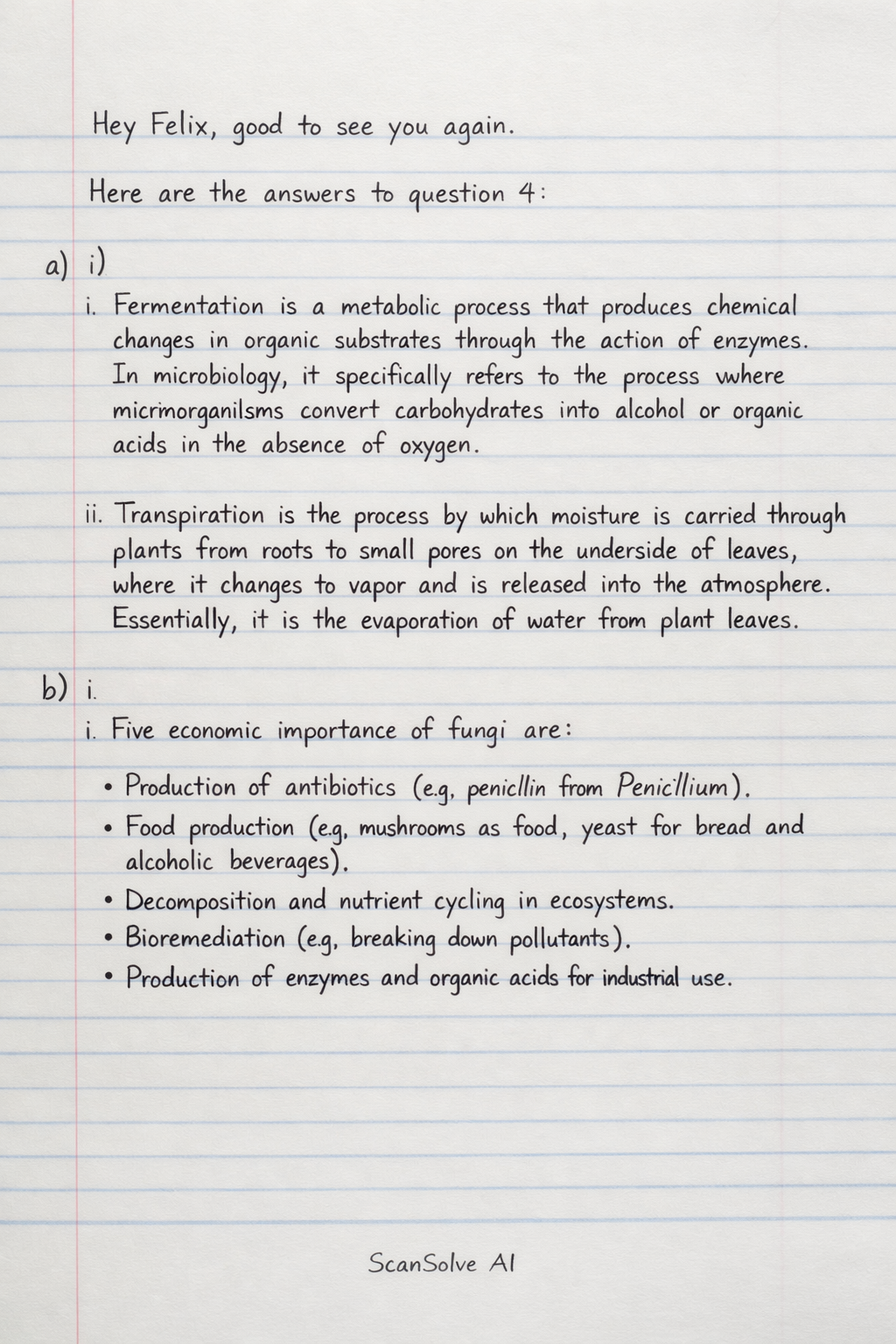
Here are the answers to question 4: a) i. Fermentation is a metabolic process that produces chemical changes in organic substrates through the action of enzymes. In microbiology, it specifically refers to the process where microorganisms convert carbohydrates into alcohol or organic acids in the absence of oxygen. ii. Transpiration is the process by which moisture is carried through plants from roots to small pores on the underside of leaves, where it changes to vapor and is released into the atmosphere. Essentially, it is the evaporation of water from plant leaves. b) i. Five economic importance of fungi are: • Production of antibiotics (e.g., penicillin from Penicillium). • Food production (e.g., mushrooms as food, yeast for bread and alcoholic beverages). • Decomposition and nutrient cycling in ecosystems. • Bioremediation (e.g., breaking down pollutants). • Production of enzymes and organic acids for industrial use. ii. The explosive mechanism of seed dispersal involves the fruit drying out and splitting open with considerable force, ejecting the seeds away from the parent plant. This mechanism relies on tension built up within the fruit wall as it dries. When the tension becomes too great, the fruit wall ruptures suddenly, flinging the seeds. Examples include pea pods, balsam, and touch-me-not plants. (Note: I cannot provide diagrams, but the description above explains the process.) c) i. Four conditions necessary for germination of seed are: • Water: To hydrate the seed and activate enzymes. • Oxygen: For aerobic respiration to provide energy for growth. • Suitable temperature: For optimal enzyme activity. • Light (for some seeds, though many germinate in darkness). ii. Three types of courtship behaviour in animals are: • Visual displays: Such as elaborate feather displays in peacocks or bright coloration. • Auditory signals: Such as bird songs, frog croaks, or insect chirps. • Chemical signals (pheromones): Releasing specific scents to attract mates. Send me the next one 📸