
We read your photo as:
What do understand by i) respiration ii) fermentation iii) breathing iv) gaseous exchange? Describe the mechanism by which oxygen is taken into the lungs and carried to the muscles of the leg. Describe an experiment to show that carbon dioxide is produced during the respiration of germinating seeds.
Biology
ScanSolve AI Answer
Step-by-step solution
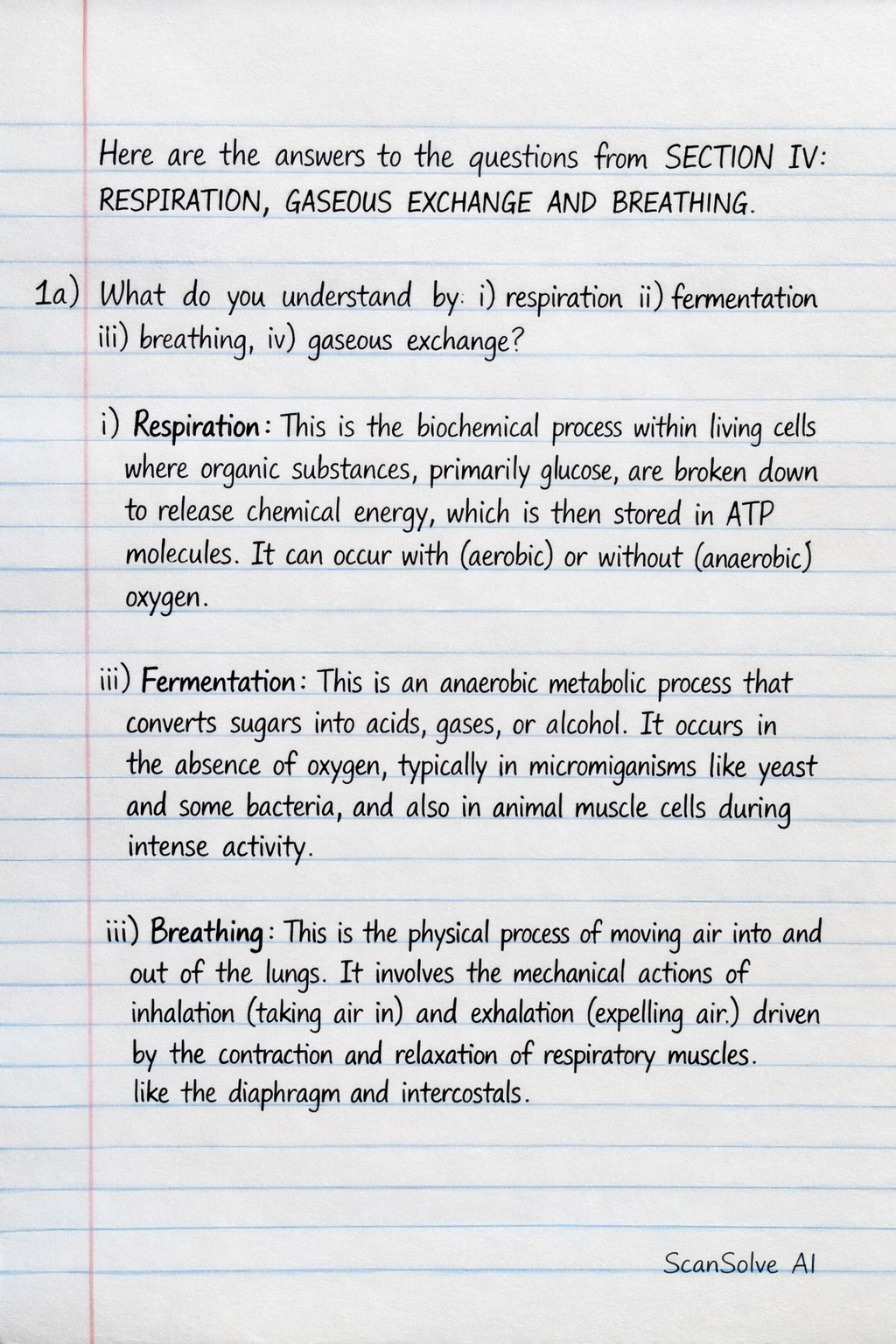
7 stepsHere are the answers to the questions from SECTION IV: RESPIRATION, GASEOUS EXCHANGE AND BREATHING.
1a) What do understand by i) respiration ii) fermentation iii) breathing iv) gaseous exchange?
- i) Respiration: This is the biochemical process within living cells where organic substances, primarily glucose, are broken down to release chemical energy, which is then stored in ATP molecules. It can occur with (aerobic) or without (anaerobic) oxygen.
- ii) Fermentation: This is an anaerobic metabolic process that converts sugars into acids, gases, or alcohol. It occurs in the absence of oxygen, typically in microorganisms like yeast and some bacteria, and also in animal muscle cells during intense activity.
- iii) Breathing: This is the physical process of moving air into and out of the lungs. It involves the mechanical actions of inhalation (taking air in) and exhalation (expelling air), driven by the contraction and relaxation of respiratory muscles like the diaphragm and intercostals.
- iv) Gaseous exchange: This is the process by which gases, specifically oxygen and carbon dioxide, move across a respiratory surface (like the alveolar-capillary membrane in the lungs) by diffusion, from an area of higher partial pressure to an area of lower partial pressure.
1b) Describe the mechanism by which oxygen is i) taken into the lungs and ii) carried to the muscles of the leg.
- i) Oxygen taken into the lungs (Inhalation):
The diaphragm contracts and flattens, while the external intercostal muscles contract, pulling the rib cage upwards and outwards.
These actions increase the volume of the thoracic cavity, which in turn decreases the pressure inside the lungs (intra-pulmonary pressure) below the atmospheric pressure.
Due to this pressure gradient, air, rich in oxygen, flows from the higher atmospheric pressure outside the body into the lungs until the pressures equalize.
- ii) Oxygen carried to the muscles of the leg:
After inhalation, oxygen diffuses from the alveoli in the lungs into the surrounding pulmonary capillaries, entering the bloodstream.
Within the red blood cells, oxygen binds reversibly with hemoglobin, forming oxyhemoglobin.
This oxygenated blood is then pumped by the heart through the arteries and arterioles to the capillaries that supply the leg muscles.
At the muscle tissue, where oxygen concentration is lower due to cellular respiration, oxygen dissociates from hemoglobin and diffuses from the capillaries into the muscle cells to be utilized.
Was this helpful?
Still stuck on this one?
Ask a follow-up, and the answer starts from this question.
Got a different question?Ask your own question
More Biology Questions
QWrite the balanced equation for aerobic respiration and describe an experiment to demonstrate heat…QIt was found that during germination of bean seeds, 9.2 cm³ of carbon IV Oxide was produced while…QIdentify and explain the biological processes and conditions described, including osmosis…QExplain the process of gaseous exchange and the adaptations of respiratory surfaces and stomata in…QWhat are the key aspects of plant respiration, including the gases involved and the differences…
Browse by topic:Anatomy
Handwritten Step-by-Step Solution
Get this as a handwritten image on WhatsApp — like a tutor wrote it for you.
Try on WhatsApp