
We read your photo as:
It was found that during germination of bean seeds, 9.2 cm³ of carbon IV Oxide was produced while 9.0 cm³ of oxygen was used up. (i) Calculate the respiratory quotient of the reaction:- (ii) Identify the substrate being met abolished:- In which part of the cell does glycolysis occur?
ScanSolve AI Answer
Step-by-step solution
3 steps6. It was found that during germination of bean seeds, of carbon IV Oxide was produced while of oxygen was used up.
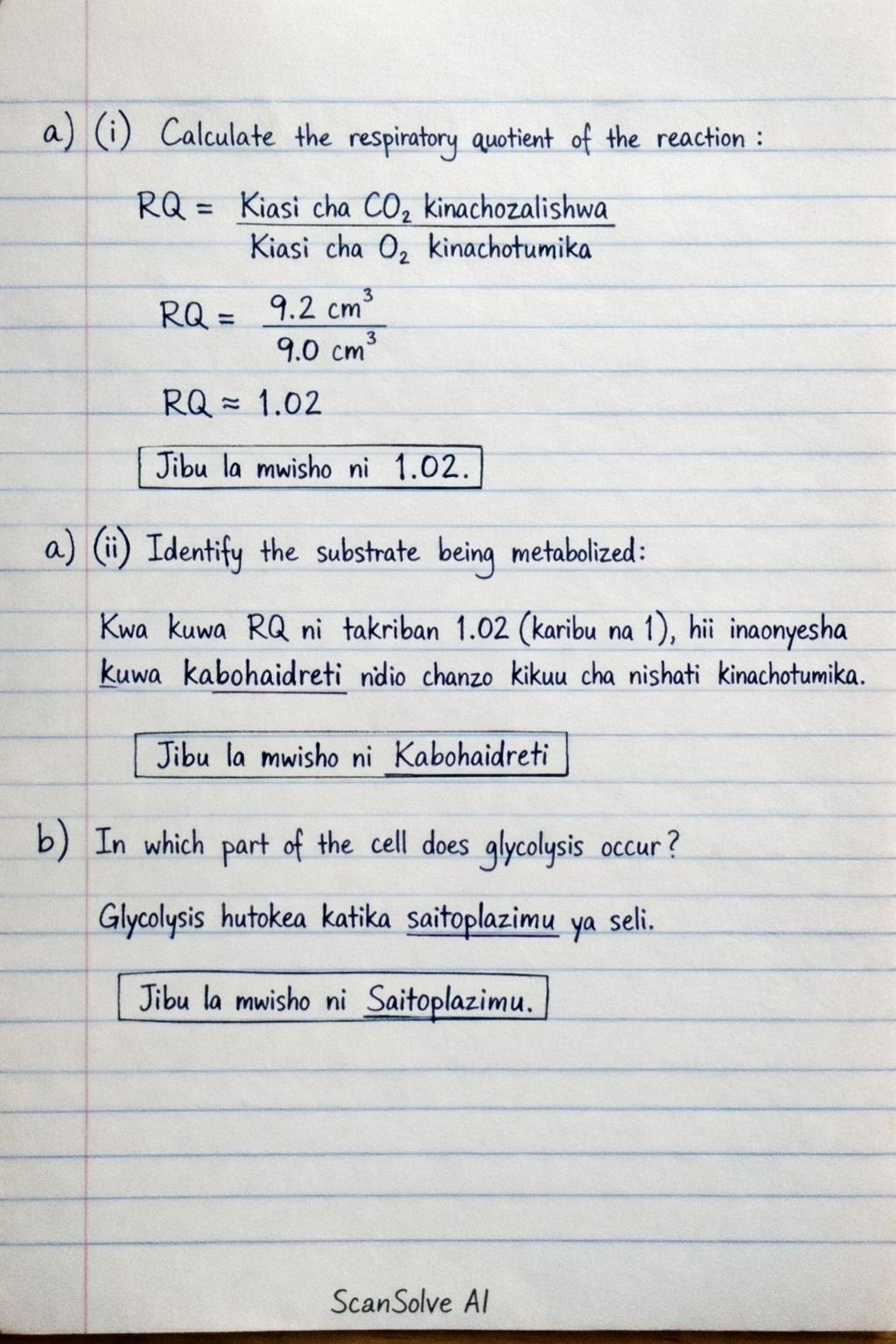
a) (i) Calculate the respiratory quotient of the reaction:-
Andika formula ya Respiratory Quotient (RQ).
Badilisha thamani zilizotolewa kwenye formula.
Kokotoa RQ.
Jibu la mwisho ni .
a) (ii) Identify the substrate being met abolished:-
Kwa kuwa RQ ni takriban 1.02 (karibu na 1), hii inaonyesha kuwa kabohaidreti ndio chanzo kikuu cha nishati kinachotumika.
Jibu la mwisho ni .b) In which part of the cell does glycolysis occur?
Glycolysis hutokea katika saitoplazimu ya seli.
Jibu la mwisho ni .7. State three functions of the mammalian blood other than transport.
Hizi hapa kazi tatu za damu ya mamalia mbali na usafirishaji:- Ulinzi dhidi ya vimelea (kupitia seli nyeupe za damu na kingamwili).
- Udhibiti wa joto la mwili (thermoregulation).
- Kuganda kwa damu (kuzuia kupoteza damu kupitia chembe sahani na protini za kuganda).
8. Other than sexual intercourse name the other ways by which HIV/AIDS is spread.
Njia zingine tatu ambazo VVU/UKIMWI huenea mbali na ngono ni:- Kushiriki sindano au vifaa vingine vyenye ncha kali vilivyochafuliwa na damu iliyoambukizwa.
- Kutoka kwa mama kwenda kwa mtoto wakati wa ujauzito, kujifungua, au kunyonyesha.
- Kuhamishwa kwa damu au bidhaa za damu zilizoambukizwa (ingawa hii ni nadra sana sasa kutokana na uchunguzi wa damu).
9. State three characteristics features of an efficient respiratory surface.
Sifa tatu za uso bora wa kupumua ni:- Eneo kubwa la uso: Ili kuongeza kiwango cha ubadilishanaji wa gesi.
- Nyembamba na inayopitisha gesi: Ili kuruhusu gesi kupita kwa urahisi na haraka.
- Unyevu: Ili gesi ziweze kuyeyuka kabla ya kusambaa kwenye utando.
- Ina mtandao mnene wa mishipa ya damu: Ili kudumisha tofauti kubwa ya mkusanyiko wa gesi.
10. State three environmental factors that affect the rate of stomatal transpiration.
Sababu tatu za kimazingira zinazoathiri kiwango cha upumuaji wa stomata ni:- Joto: Joto la juu huongeza kiwango cha uvukizi wa maji.
- Unyevu wa hewa: Unyevu mdogo wa hewa huongeza mteremko wa uwezo wa maji, na hivyo kuongeza upumuaji.
- Nguvu ya mwanga: Mwanga mkali husababisha stomata kufunguka, na kuongeza upumuaji.
- Kasi ya upepo: Upepo huondoa mvuke wa maji kutoka karibu na jani, na kudumisha mteremko mkali wa mkusanyiko, hivyo kuongeza upumuaji.
11. The cells shown below are adapted for transport in flowering plants.
(Kumbuka: Hakuna picha ya seli iliyotolewa. Majibu yafuatayo yanatokana na sifa za jumla za seli za usafirishaji (xylem na phloem) katika mimea inayotoa maua.)
Seli za usafirishaji katika mimea inayotoa maua zimebadilishwa kwa njia zifuatazo:- Huunda mirija inayoendelea: Seli za xylem (mishipa na trakeidi) na seli za phloem (mirija ya ungo) huunda njia zisizokatizwa kwa usafirishaji wa maji na chakula.
- Zina kuta nyembamba au zilizotobolewa: Kwa mfano, mirija ya ungo ya phloem ina sahani za ungo zenye matundu, na seli za xylem zina matundu (pits) kuruhusu mtiririko wa maji.
- Kuta zao zimeimarishwa (xylem): Kuta za xylem zimeimarishwa na lignini, kutoa msaada wa kimuundo na kuzuia kuporomoka wakati wa usafirishaji wa maji.
Still stuck on this one?
Ask a follow-up, and the answer starts from this question.
More Biology Questions
Handwritten Step-by-Step Solution
Get this as a handwritten image on WhatsApp — like a tutor wrote it for you.
Try on WhatsApp