
We read your photo as:
A heterogeneous reaction below took place in a 1000 cm³ sealed flask. C (s) + O₂ (g) ⇌ CO₂ (g). The reaction mixture initially contained 3.8 g of Carbon (C) and unknown mass of oxygen (O₂). When the equilibrium was reached, there were 0,292 mole of carbon.
ScanSolve AI Answer
Step-by-step solution
6 stepsHere's the solution to Question 3:
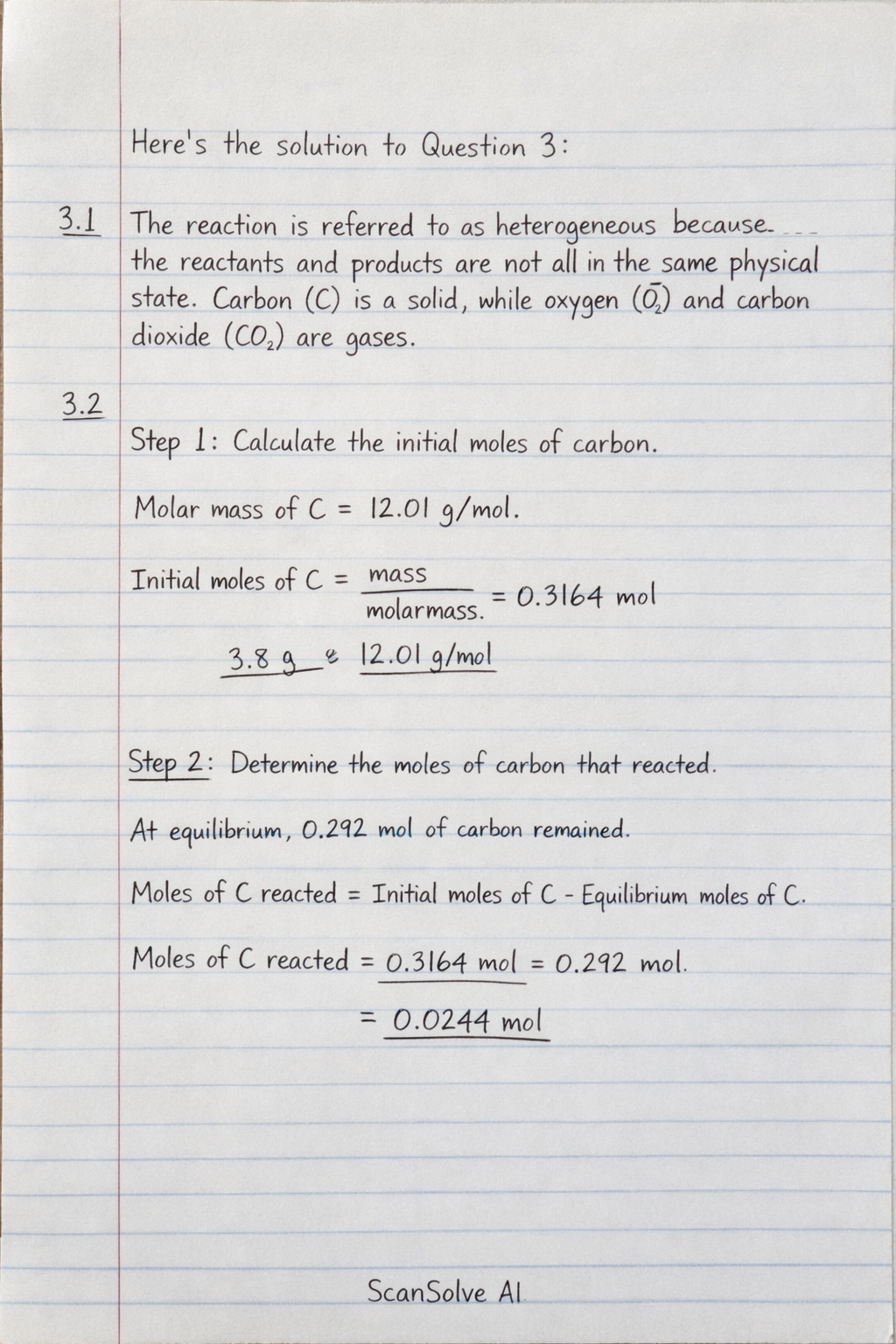
3.1 The reaction is referred to as heterogeneous because the reactants and products are not all in the same physical state. Carbon () is a solid, while oxygen () and carbon dioxide () are gases.
3.2
Calculate the initial moles of carbon.
Molar mass of C .
Determine the moles of carbon that reacted.
At equilibrium, of carbon remained.
Set up an ICE (Initial, Change, Equilibrium) table for moles.
The reaction is:
Let the initial moles of be . The volume of the flask is , so moles are equal to concentrations.Species Initial (mol) Change (mol) Equilibrium (mol) 0.3164 0.292 0 0.0244 Write the equilibrium constant expression and substitute values.
For heterogeneous reactions, solids are excluded from the expression.
Given .
Solve for (initial moles of ).
Calculate the initial mass of oxygen ().
Molar mass of .
Rounded to two decimal places:
The initial mass of oxygen () placed in the flask is .3.3.1 Le Chatelier's principle states that if a change of condition (such as temperature, pressure, or concentration) is applied to a system in equilibrium, the system will shift in a direction that relieves the stress and re-establishes a new equilibrium.
3.3.2 The equilibrium constant () only changes with temperature. Since the value increased, the condition that was changed is temperature.
3.3.3
The forward reaction is ENDOTHERMIC.
Explanation: An increase in the value indicates that the equilibrium shifted to the right, favoring the formation of products. According to Le Chatelier's principle, if the temperature of a system at equilibrium is increased, the system will shift in the direction that absorbs heat (the endothermic direction) to counteract the increase in temperature. Since the equilibrium shifted to the right (product side), the forward reaction must be endothermic.
Still stuck on this one?
Ask a follow-up, and the answer starts from this question.
More Chemistry Questions
Handwritten Step-by-Step Solution
Get this as a handwritten image on WhatsApp — like a tutor wrote it for you.
Try on WhatsApp