
We read your photo as:
Compare five properties of ionic compounds (like NaCl) with covalent compounds (like CO2). Present your answer in a table. Explain why sodium chloride conducts electricity when dissolved in water but carbon dioxide does not.
ScanSolve AI Answer
Step-by-step solution
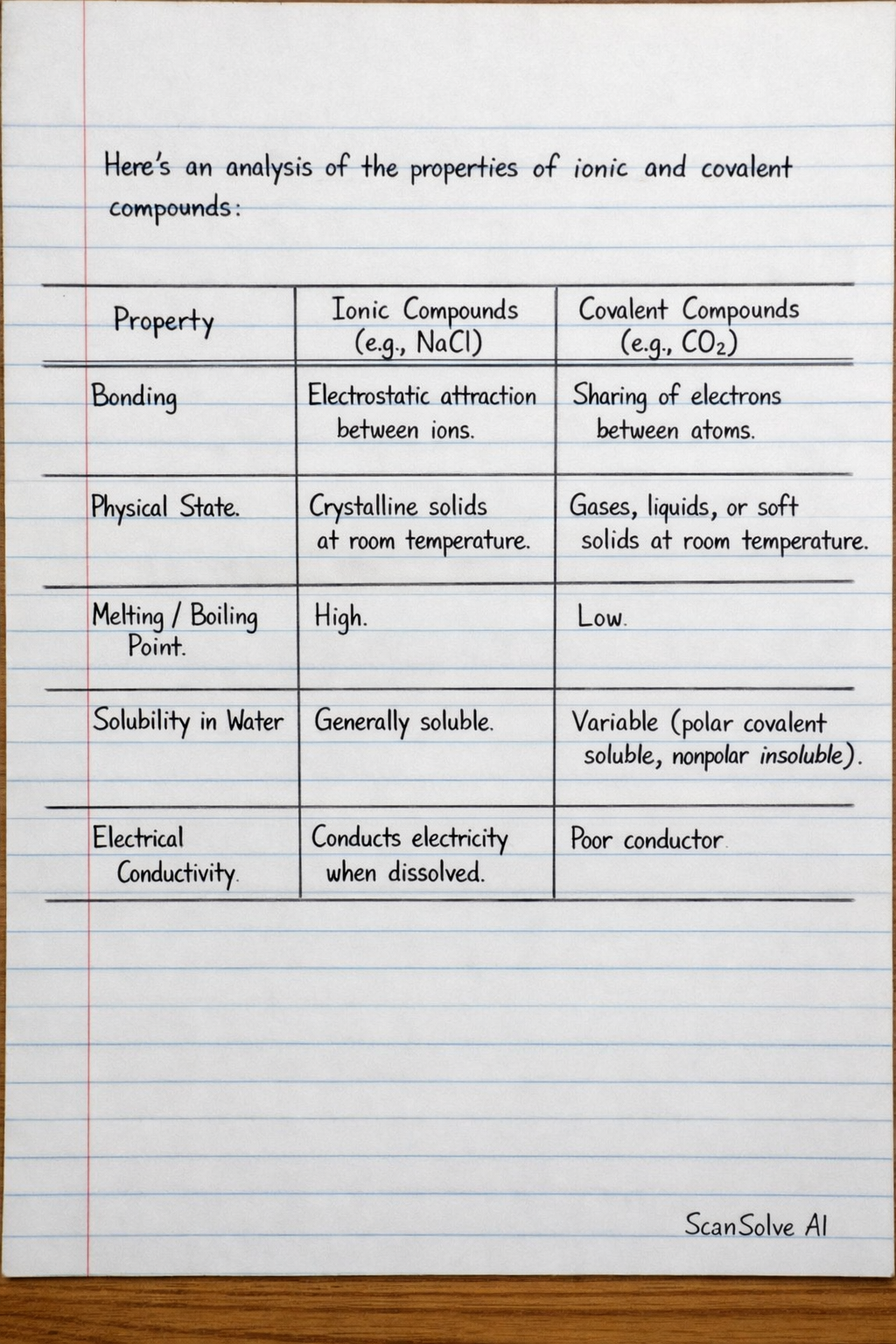
7 stepsc) Compare five properties of ionic compounds (like NaCl) with covalent compounds (like CO2). Present your answer in a table.
| Property | Ionic Compounds (e.g., NaCl) | Covalent Compounds (e.g., CO) |
|---|---|---|
| Bonding | Electrostatic attraction between ions | Sharing of electrons between atoms |
| Physical State | Crystalline solids at room temperature | Gases, liquids, or soft solids at room temperature |
| Melting/Boiling Point | High | Low |
| Solubility in Water | Generally soluble | Variable (polar covalent soluble, nonpolar insoluble) |
| Electrical Conductivity | Conducts electricity when molten or dissolved in water | Generally poor conductors (except for some network solids) |
d) Explain why sodium chloride conducts electricity when dissolved in water but carbon dioxide does not.
Sodium chloride (NaCl) is an ionic compound. When dissolved in water, it dissociates into mobile ions ( and ). These free-moving ions can carry electrical charge, allowing the solution to conduct electricity. Carbon dioxide (CO) is a covalent compound. When dissolved in water, it forms molecules, not ions. Since there are no free-moving charged particles, carbon dioxide solutions do not conduct electricity.
Question 4:
a) Define diffusion and osmosis, and explain two key differences between these two processes.
- Diffusion is the net movement of particles from a region of higher concentration to a region of lower concentration, down a concentration gradient.
- Osmosis is the net movement of water molecules across a partially permeable membrane from a region of higher water potential to a region of lower water potential.
Two key differences:
- Diffusion involves the movement of any type of particle (solute or solvent), while osmosis specifically involves the movement of water molecules.
- Diffusion can occur in any medium (gas, liquid, solid) and does not necessarily require a membrane, whereas osmosis requires a partially permeable membrane.
b) A student placed a potassium permanganate crystal in a beaker of water and observed the colour spread over time. Explain why the permanganate colour spreads throughout the beaker and describe three factors that would affect the rate of this diffusion.
The permanganate colour spreads due to diffusion. When the potassium permanganate crystal dissolves, its particles (ions) are in a high concentration at the bottom of the beaker. These particles possess kinetic energy and move randomly, colliding with water molecules and each other. Over time, they spread out from the region of high concentration to regions of lower concentration until they are evenly distributed throughout the water, making the entire solution purple.
Three factors that would affect the rate of this diffusion:
- Temperature: An increase in temperature increases the kinetic energy of both the permanganate ions and water molecules, leading to more frequent and energetic collisions, thus increasing the rate of diffusion.
- Concentration gradient: A steeper concentration gradient (a larger difference in concentration between two regions) will result in a faster rate of diffusion as there is a greater net movement of particles from high to low concentration.
- Particle size/mass: Smaller or lighter particles diffuse faster than larger or heavier particles because they can move more easily through the medium. Permanganate ions are relatively small.
c) A bicycle rider of mass 50000g rode a bike at an average speed of 15 m/s for 1 hour and 30 minutes before reaching his destination. [g = 9.8 m/s]
i) Calculate the distance covered by the rider after reaching his destination.
Convert the total time to seconds.
Calculate the distance using the formula distance = speed time.
The distance covered by the rider is 81000 m or 81 km.
ii) Calculate the speed at which he must ride the bike if he must cover the same distance in 40 minutes.
Convert the new time to seconds.
Calculate the new speed using the formula speed = distance / time.
The new speed required is 33.75 m/s.
Question 5:
a) Define force and explain why it is classified as a vector quantity.
Force is a push or a pull that can cause an object to accelerate, decelerate, change direction, or deform. It is classified as a vector quantity because it has both magnitude (how strong the push or pull is) and direction (the way it is applied).
b) A car accelerates from rest (0 m/s) to 25 m/s in 8 seconds. Calculate the acceleration of the car.
Identify the given values.
Initial velocity () =
Final velocity () =
Time () =Use the formula for acceleration.
Substitute the values and calculate.
The acceleration of the car is .
c) Explain the role of friction in allowing the car to move safely on the road.
Friction plays a crucial role in a car's movement by providing the necessary traction between the tires and the road surface. This frictional force allows the car to accelerate (by pushing against the road), brake (by resisting motion), and turn (by providing a centripetal force) without skidding, ensuring safe operation.
d) Explain three advantages of using solar panels to generate electricity in Ghana compared to relying on fossil fuels.
Three advantages of using solar panels:
- Renewable and Sustainable: Solar energy is an inexhaustible resource, unlike fossil fuels which are finite and depleting. This ensures a long-term, sustainable energy supply for Ghana.
- Environmental Benefits: Solar panels produce electricity without emitting greenhouse gases or air pollutants during operation, helping to combat climate change and improve air quality compared to burning fossil fuels.
- Energy Independence and Decentralization: Solar power reduces Ghana's reliance on imported fossil fuels, enhancing national energy security. It also allows for decentralized power generation, providing electricity to remote areas without extensive grid infrastructure.
e) Describe two disadvantages of solar energy that Ghana must address to increase its adoption.
Two disadvantages of solar energy:
- Intermittency: Solar power generation is dependent on sunlight, meaning it cannot produce electricity at night or during prolonged cloudy periods. Ghana would need to invest in robust energy storage solutions (like batteries) or reliable backup power systems to ensure a continuous supply.
- High Initial Cost: The upfront investment for purchasing and installing solar panels and associated infrastructure can be substantial. Ghana would need to implement financial incentives, subsidies, or accessible financing options to make solar energy more affordable for wider adoption.
Still stuck on this one?
Ask a follow-up, and the answer starts from this question.
More Chemistry Questions
Handwritten Step-by-Step Solution
Get this as a handwritten image on WhatsApp — like a tutor wrote it for you.
Try on WhatsApp