
We read your photo as:
Describe the states of matter, the position of Sodium on the periodic table, and the formation of Sodium Chloride. Classify compounds A, B, C, and D.
ScanSolve AI Answer
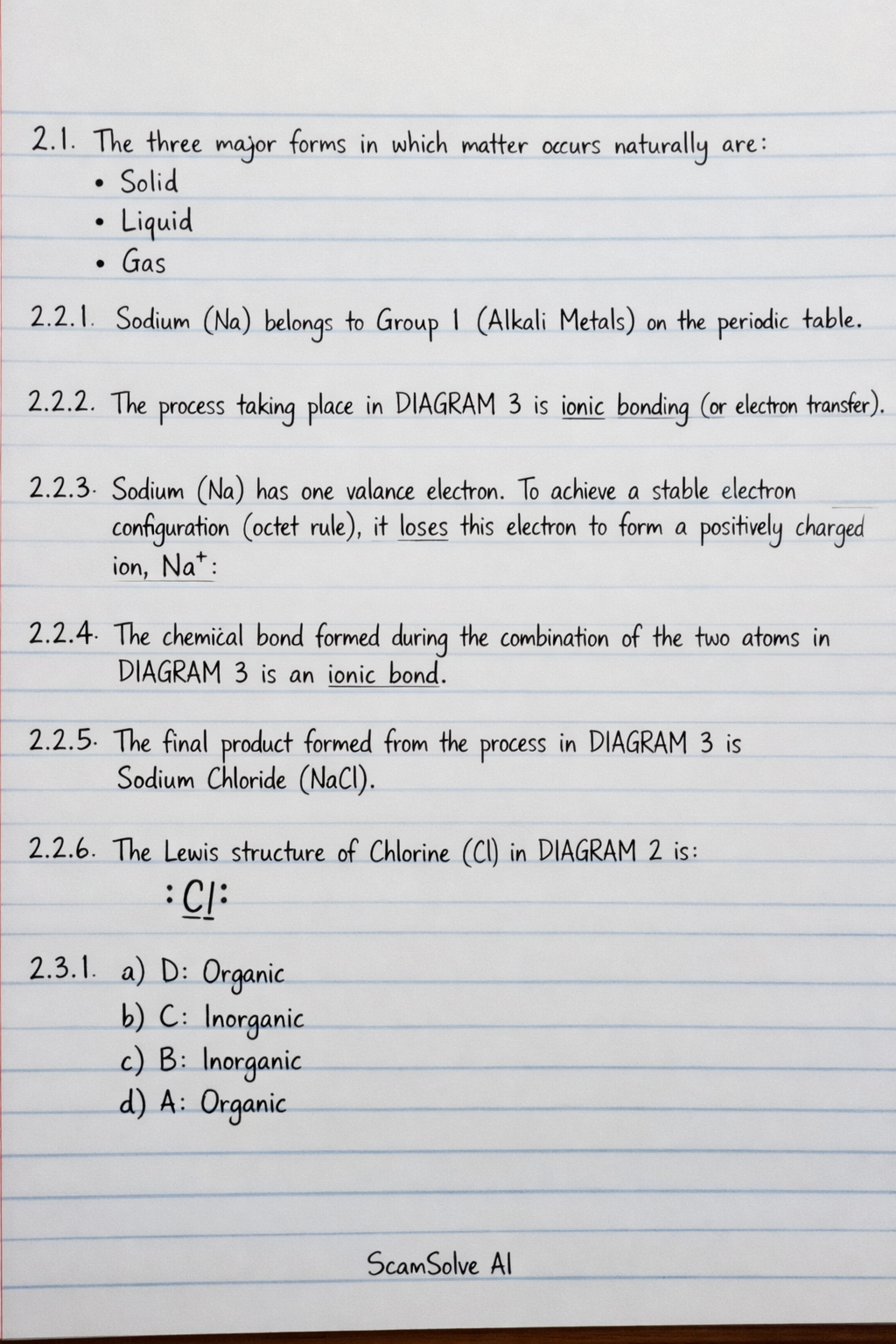
2.1
The three major forms in which matter occurs naturally are:
- Solid
- Liquid
- Gas
2.2.1
Sodium (Na) belongs to Group 1 (Alkali Metals) on the periodic table.
2.2.2
The process taking place in DIAGRAM 3 is ionic bonding (or electron transfer).
2.2.3
Sodium (Na) has one valence electron. To achieve a stable electron configuration (octet rule), it loses this electron to form a positively charged ion, .
2.2.4
The chemical bond formed during the combination of the two atoms in DIAGRAM 3 is an ionic bond.
2.2.5
The final product formed from the process in DIAGRAM 3 is Sodium Chloride ().
2.2.6
The Lewis structure of Chlorine (Cl) in DIAGRAM 2 is:
\text{:\ddot{Cl}:}
2.3.1
a) D: Organic
b) C: Inorganic
c) B: Inorganic
d) A: Organic
2.3.2
- Organic compounds (like A and D) are typically characterized by the presence of carbon atoms bonded to hydrogen atoms.
- Inorganic compounds (like B and C) generally do not contain carbon atoms, or if they do (e.g., ), they lack carbon-hydrogen bonds.
2.4.1
A: Butanoic acid (or a carboxylic acid)
B: Glucose (or a monosaccharide)
C: Triglyceride (or fat/oil)
2.4.2
The product formed by combining two molecules represented by B (e.g., two glucose molecules) is a disaccharide (e.g., maltose).
2.4.3
Two differences between saturated and unsaturated fatty acids are:
- Saturated fatty acids contain only single bonds between carbon atoms in their hydrocarbon chains, while unsaturated fatty acids contain one or more double or triple bonds between carbon atoms.
- Saturated fatty acids are typically solid at room temperature, whereas unsaturated fatty acids are typically liquid at room temperature.
Still stuck on this one?
Ask a follow-up, and the answer starts from this question.
More Chemistry Questions
Handwritten Step-by-Step Solution
Get this as a handwritten image on WhatsApp — like a tutor wrote it for you.
Try on WhatsApp