
We read your photo as:
Describe the formation, properties, and relationship between bonding and properties for ionic and covalent bonds, using NaCl and H2O as examples.
Chemistry
ScanSolve AI Answer
Here is the solution to your assignment:
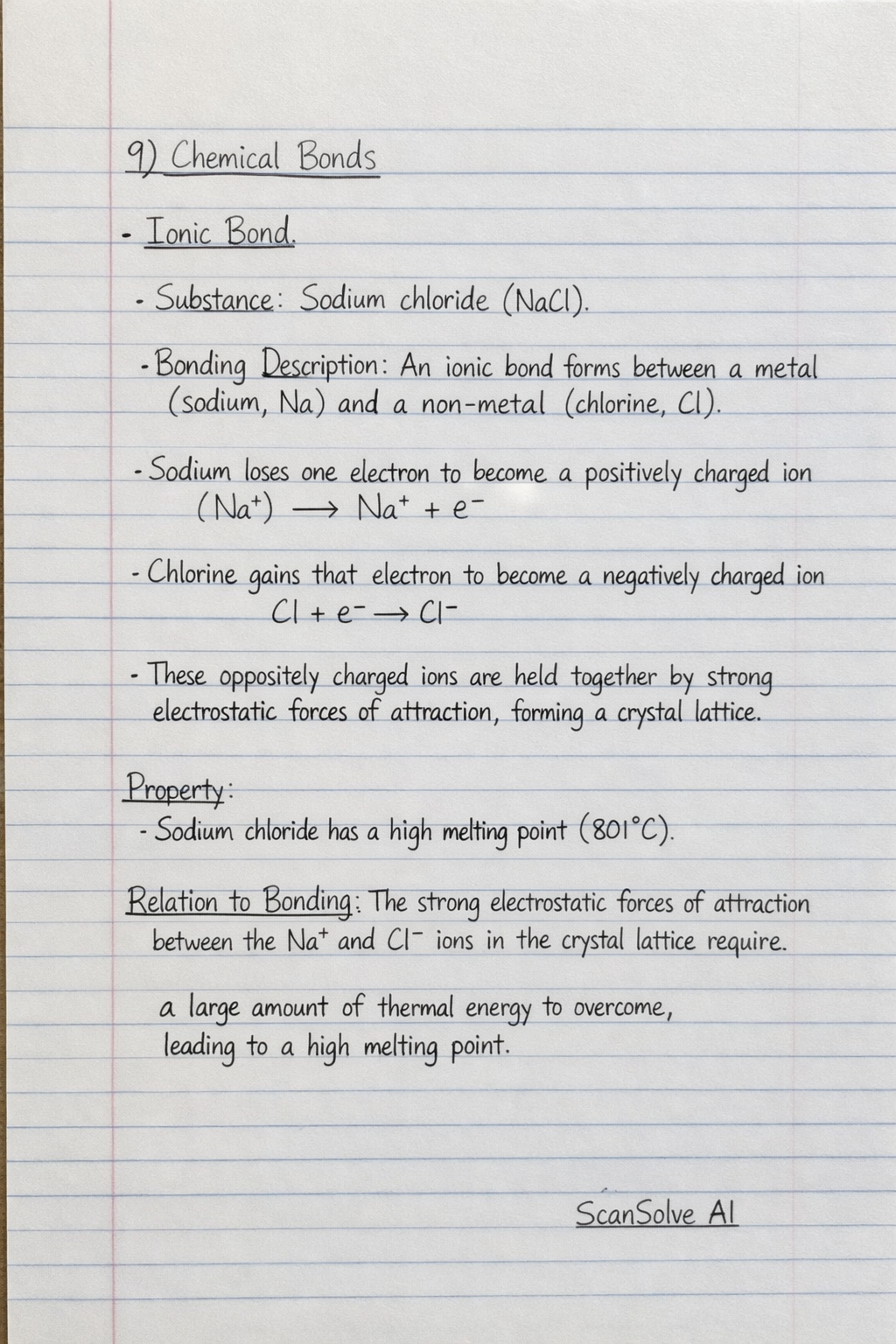
9) Chemical Bonds
-
Ionic Bond
- Substance: Sodium chloride (NaCl)
- Bonding Description: An ionic bond forms between a metal (sodium, Na) and a non-metal (chlorine, Cl). Sodium loses one electron to become a positively charged ion (), and chlorine gains that electron to become a negatively charged ion (). These oppositely charged ions are then held together by strong electrostatic forces of attraction, forming a crystal lattice.
- Property: Sodium chloride has a high melting point ().
- Relation to Bonding: The strong electrostatic forces of attraction between the and ions in the crystal lattice require a large amount of thermal energy to overcome, leading to a high melting point.
-
Covalent Bond
- Substance: Water ()
- Bonding Description: A covalent bond forms between two non-metal atoms (hydrogen, H, and oxygen, O). Each hydrogen atom shares one electron with the oxygen atom, and the oxygen atom shares one electron with each hydrogen atom. This sharing of electrons allows all atoms to achieve a stable electron configuration (duplet for hydrogen, octet for oxygen).
- Property: Water has a relatively low boiling point () compared to ionic compounds.
- Relation to Bonding: While the covalent bonds within a water molecule are strong, the forces of attraction between water molecules (intermolecular forces, specifically hydrogen bonds) are much weaker. Less energy is required to overcome these intermolecular forces, resulting in a lower boiling point.
-
Metallic Bond
- Substance: Copper (Cu)
- Bonding Description: A metallic bond occurs in metals. It involves a lattice of positively charged metal ions (copper ions, ) surrounded by a 'sea' of delocalized electrons. These valence electrons are not associated with any single atom or bond but are free to move throughout the entire metal structure.
- Property: Copper is an excellent electrical conductor.
- Relation to Bonding: The presence of delocalized electrons in the metallic structure allows them to move freely when an electric potential difference is applied. These mobile electrons can carry charge, making copper an excellent conductor of electricity.
Was this helpful?
Still stuck on this one?
Ask a follow-up, and the answer starts from this question.
Got a different question?Ask your own question
More Chemistry Questions
QDescribe the formation of ionic and simple covalent bonds, providing an example for ionic bonding.QExplain ionic, covalent, and metallic bonds, including their occurrence, properties, and…QCompare five properties of ionic compounds (like NaCl) with covalent compounds (like CO2). Present…QDescribe the type of bonding that exists in MgCl2, PCl3, and Ca. Give two properties of each and…QExplain ionic bonding and covalent bonding. (b) State two differences between ionic and covalent…
Handwritten Step-by-Step Solution
Get this as a handwritten image on WhatsApp — like a tutor wrote it for you.
Try on WhatsApp