
We read your photo as:
Write the balanced equation for aerobic respiration and describe an experiment to demonstrate heat production by germinating seeds during respiration.
Biology
ScanSolve AI Answer
Step-by-step solution
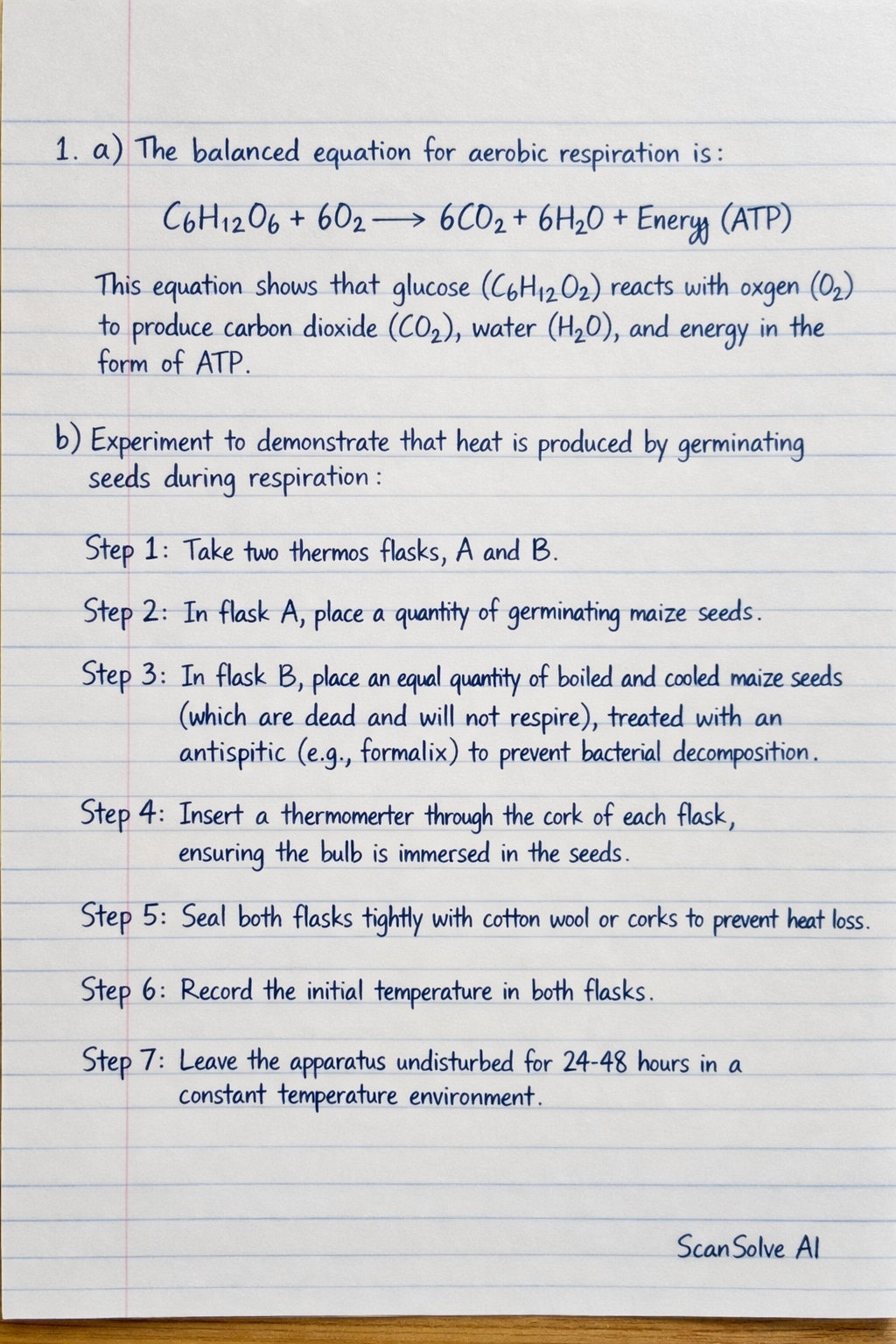
8 steps- a) The balanced equation for aerobic respiration is: This equation shows that glucose () reacts with oxygen () to produce carbon dioxide (), water (), and energy in the form of ATP.
Part b· 8 steps
Experiment to demonstrate that heat is produced by germinating seeds during respiration
Take two thermos flasks, A and B.
In flask A, place a quantity of germinating maize seeds.
In flask B, place an equal quantity of boiled and cooled maize seeds (which are dead and will not respire), treated with an antiseptic (e.g., formalin) to prevent bacterial decomposition.
Insert a thermometer through the cork of each flask, ensuring the bulb is immersed in the seeds.
Seal both flasks tightly with cotton wool or corks to prevent heat loss.
Record the initial temperature in both flasks.
Leave the apparatus undisturbed for 24-48 hours in a constant temperature environment.
After the incubation period, record the final temperature in both flasks.
Observation: The temperature in flask A (with germinating seeds) will show a significant rise, while the temperature in flask B (with dead seeds) will remain relatively constant or show a slight change due to ambient temperature fluctuations.
Conclusion: The rise in temperature in flask A indicates that heat is produced by the germinating seeds during the process of respiration.
Part c
Characteristics of a good respiratory surface
- Large surface area: To allow for efficient diffusion of gases (oxygen and carbon dioxide) across the surface. Examples include the alveoli in lungs or gill lamellae in fish.
- Thin walls: The respiratory surface must be very thin (often one cell thick) to minimize the diffusion distance for gases.
- Moist surface: Gases must dissolve in a thin film of water or mucus before they can diffuse across the membrane.
- Rich blood supply: A dense network of capillaries or blood vessels ensures a steep concentration gradient for gases, as absorbed oxygen is quickly transported away and carbon dioxide is brought to the surface for excretion.
- Ventilation mechanism: A system to maintain a constant flow of the respiratory medium (air or water) over the surface, ensuring a continuous supply of oxygen and removal of carbon dioxide.
Was this helpful?
Still stuck on this one?
Ask a follow-up, and the answer starts from this question.
Got a different question?Ask your own question
More Biology Questions
QWhat do understand by i) respiration ii) fermentation iii) breathing iv) gaseous exchange? Describe…QDescribe the variables and record hypothetical results for an experiment investigating catalase…QIt was found that during germination of bean seeds, 9.2 cm³ of carbon IV Oxide was produced while…QDesign an experiment to investigate the effect of pH on catalase activity in a germinating bean…QDescribe an experiment to demonstrate that living organisms in soil respire, including the title…
Handwritten Step-by-Step Solution
Get this as a handwritten image on WhatsApp — like a tutor wrote it for you.
Try on WhatsApp