
We read your photo as:
Combustion of 50 cm3 of carbon(II)oxide in 100 cm3 of oxygen. Calculate the volume of carbon(IV)oxide produced.
ScanSolve AI Answer
Answer
Step-by-step solution
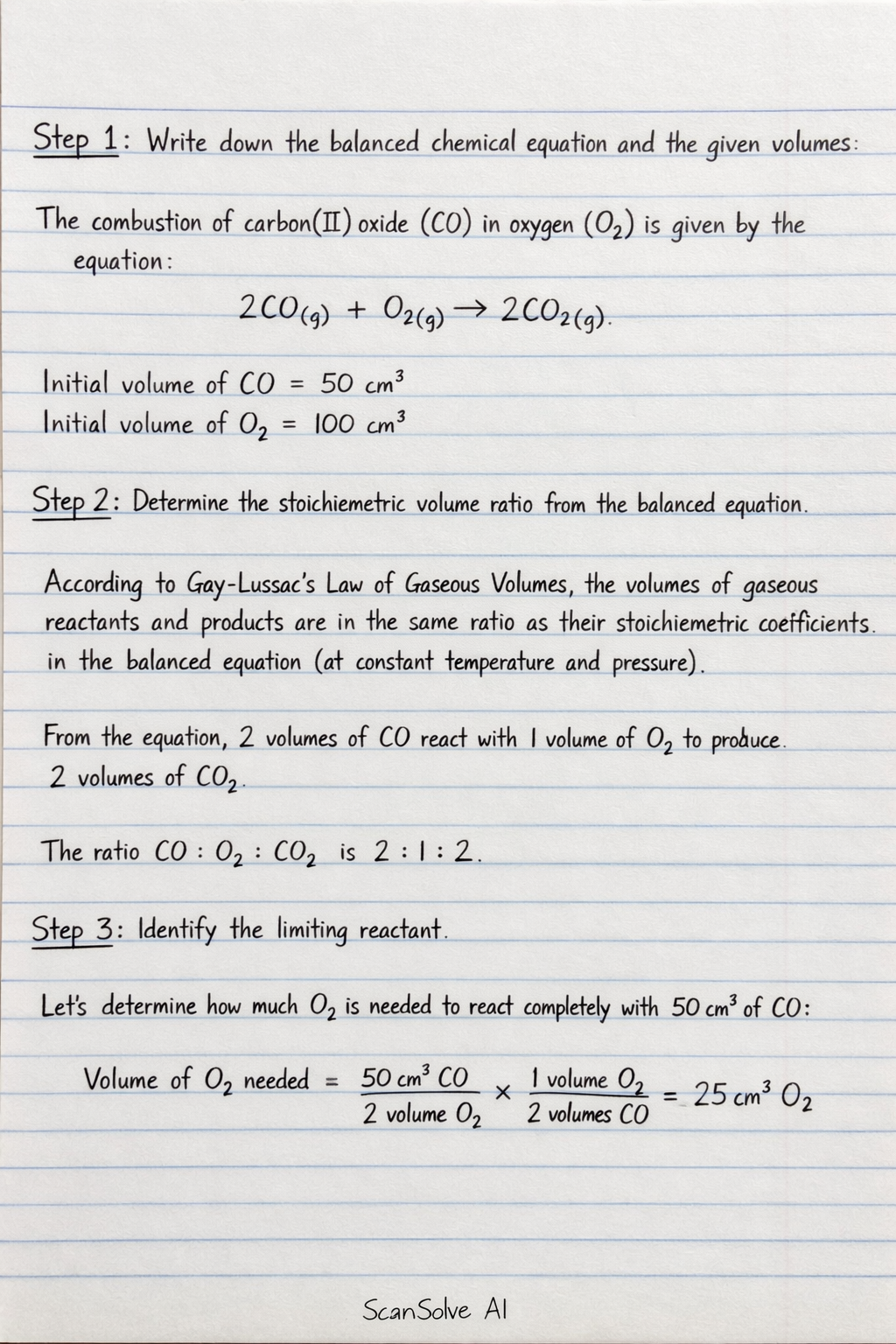
6 stepsWrite down the balanced chemical equation and the given volumes.
The combustion of carbon(II)oxide (CO) in oxygen (O) is given by the equation:
Initial volume of CO =
Initial volume of O =Determine the stoichiometric volume ratio from the balanced equation.
According to Gay-Lussac's Law of Gaseous Volumes, the volumes of gaseous reactants and products are in the same ratio as their stoichiometric coefficients in the balanced equation (at constant temperature and pressure).
From the equation, 2 volumes of CO react with 1 volume of O to produce 2 volumes of CO.
The ratio CO : O : CO is .Identify the limiting reactant.
Let's determine how much O is needed to react completely with of CO:
Volume of O needed =Since we have of O available, and only is needed, O is in excess.
Therefore, CO is the limiting reactant.Calculate the volume of product formed.
Since CO is the limiting reactant, the amount of product (CO) formed is determined by the initial amount of CO.
From the stoichiometric ratio, 2 volumes of CO produce 2 volumes of CO.
Volume of CO produced =Calculate the volume of excess reactant remaining.
Initial volume of O =
Volume of O reacted =
Volume of O remaining =Calculate the total volume of the resulting mixture.
The resulting mixture will consist of the product (CO) and the unreacted excess reactant (O).
Total volume of resulting mixture = Volume of CO produced + Volume of O remaining
Total volume =The final answer is .
Try one yourself
A new problem that tests the same skill.
Still stuck on this one?
Ask a follow-up, and the answer starts from this question.
More Chemistry Questions
Handwritten Step-by-Step Solution
Get this as a handwritten image on WhatsApp — like a tutor wrote it for you.
Try on WhatsApp