
We read your photo as:
Fig 1.1 shows the test-tubes after three minutes.
ScanSolve AI Answer
Step-by-step solution
4 stepsIdentify the enzyme and its function.
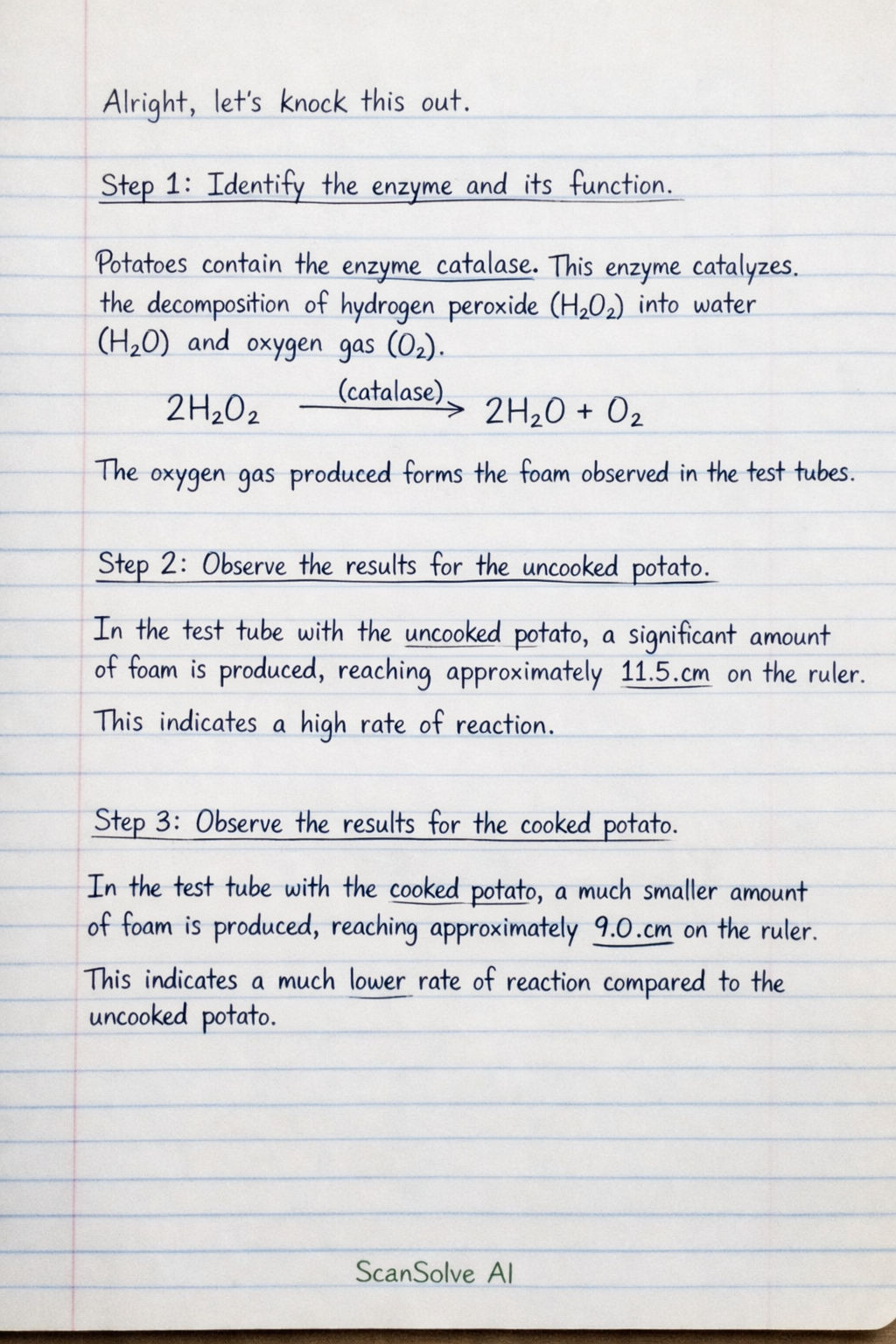
Potatoes contain the enzyme catalase. This enzyme catalyzes the decomposition of hydrogen peroxide () into water () and oxygen gas (). The oxygen gas produced forms the foam observed in the test tubes.
Observe the results for the uncooked potato.
In the test tube with the uncooked potato, a significant amount of foam is produced, reaching approximately on the ruler. This indicates a high rate of reaction.
Observe the results for the cooked potato.
In the test tube with the cooked potato, a much smaller amount of foam is produced, reaching approximately on the ruler. This indicates a much lower rate of reaction compared to the uncooked potato.
Explain the difference in foam levels.
Enzymes are proteins and are sensitive to temperature. Cooking the potato exposes the catalase enzyme to high temperatures, causing it to denature. Denaturation changes the three-dimensional shape of the enzyme, particularly its active site, making it unable to bind effectively with the hydrogen peroxide substrate. As a result, the denatured catalase in the cooked potato is less active or inactive, leading to a significantly reduced rate of hydrogen peroxide decomposition and thus less oxygen gas and less foam. The active catalase in the uncooked potato, however, rapidly breaks down the hydrogen peroxide, producing a large amount of foam.
Still stuck on this one?
Ask a follow-up, and the answer starts from this question.
More Biology Questions
Handwritten Step-by-Step Solution
Get this as a handwritten image on WhatsApp — like a tutor wrote it for you.
Try on WhatsApp