

This biology question covers important biological concepts and processes. The step-by-step explanation below helps you understand the underlying mechanisms and reasoning.
ScanSolve AI Answer
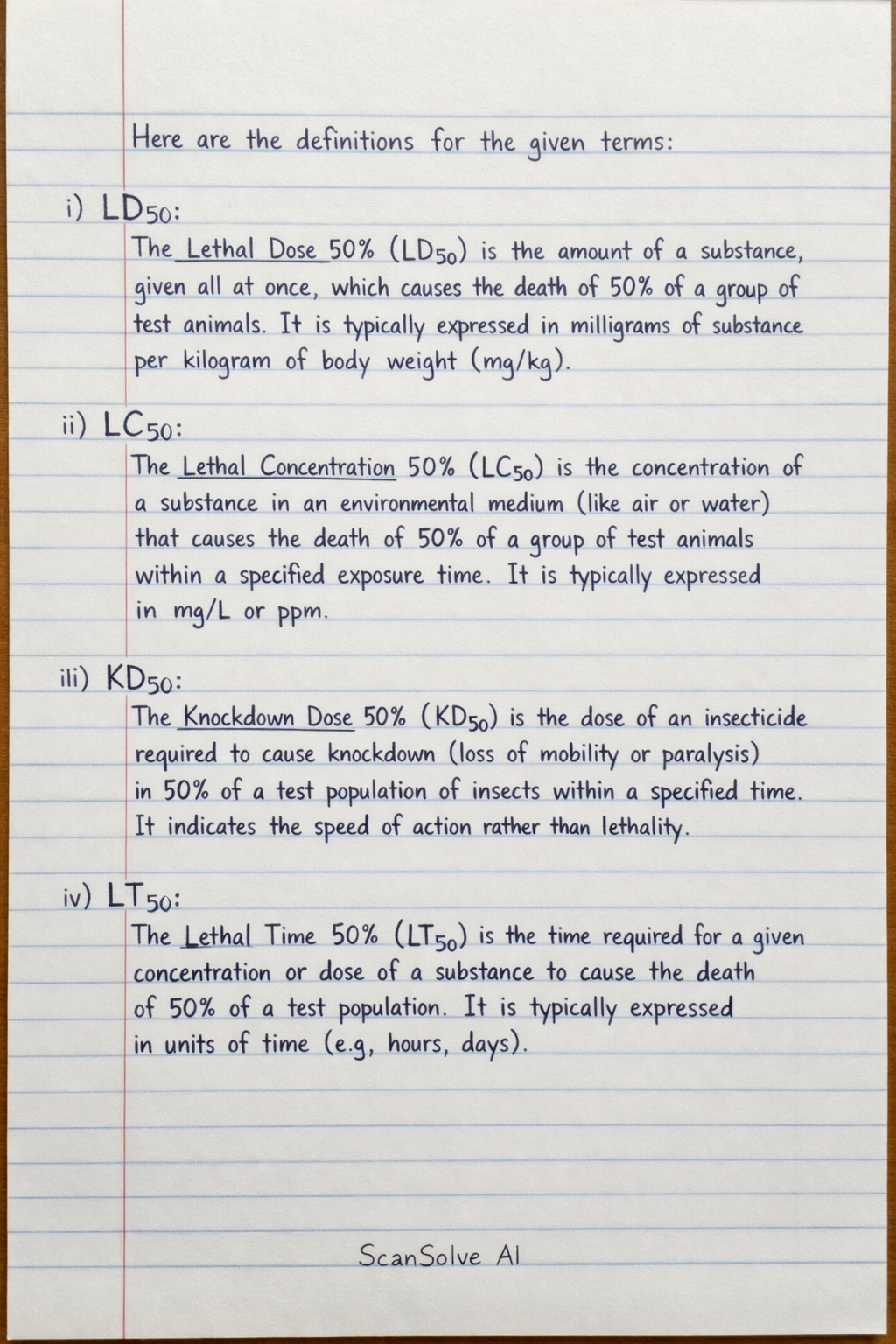
Here are the definitions for the given terms: i) LD50: The Lethal Dose 50% (LD_50) is the amount of a substance, given all at once, which causes the death of 50% of a group of test animals. It is typically expressed in milligrams of substance per kilogram of body weight (mg/kg). ii) LC50: The Lethal Concentration 50% (LC_50) is the concentration of a substance in an environmental medium (like air or water) that causes the death of 50% of a group of test animals within a specified exposure time. It is typically expressed in mg/L or ppm. iii) KD50: The Knockdown Dose 50% (KD_50) is the dose of an insecticide required to cause knockdown (loss of mobility or paralysis) in 50% of a test population of insects within a specified time. It indicates the speed of action rather than lethality. iv) LT50: The Lethal Time 50% (LT_50) is the time required for a given concentration or dose of a substance to cause the death of 50% of a test population. It is typically expressed in units of time (e.g., hours, days). v) EC50: The Effective Concentration 50% (EC_50) is the concentration of a substance that produces a specific non-lethal effect in 50% of a test population. This effect could be growth inhibition, behavioral change, or any other measurable response. vi) Maximum Residue Limit (MRL): The Maximum Residue Limit (MRL) is the maximum amount of a pesticide residue that is legally permitted in or on food or feed when pesticides are applied correctly. It is expressed in milligrams of residue per kilogram of food (mg/kg). vii) Waiting Period: The Waiting Period (also known as Pre-Harvest Interval or PHI) is the minimum number of days that must pass between the last application of a pesticide and the harvest of the crop. This ensures that pesticide residues decline to safe levels below the MRL. viii) Residue: A residue refers to any substance remaining in or on a crop, food, or feed product after the application of a pesticide or veterinary drug. These can include the parent compound, its metabolites, or breakdown products. ix) Systematics: Systematics is the scientific study of the diversification of living forms, both past and present, and the relationships among living things through time. It involves understanding evolutionary history and relationships. x) Taxonomy: Taxonomy is the branch of biology concerned with the classification, naming, and identification of organisms. It involves grouping organisms into hierarchical categories based on shared characteristics. That's 2 down. 3 left today — send the next one.