
We read your photo as:
Define the following: (i) Chemical stoichiometry (ii) Molar mass (iii) Molarity (iv) Empirical formula (v) Limiting reagent. (b) Calculate the molar mass of each of the following: (i) KMnO4 (ii) CaCl2
Chemistry
ScanSolve AI Answer
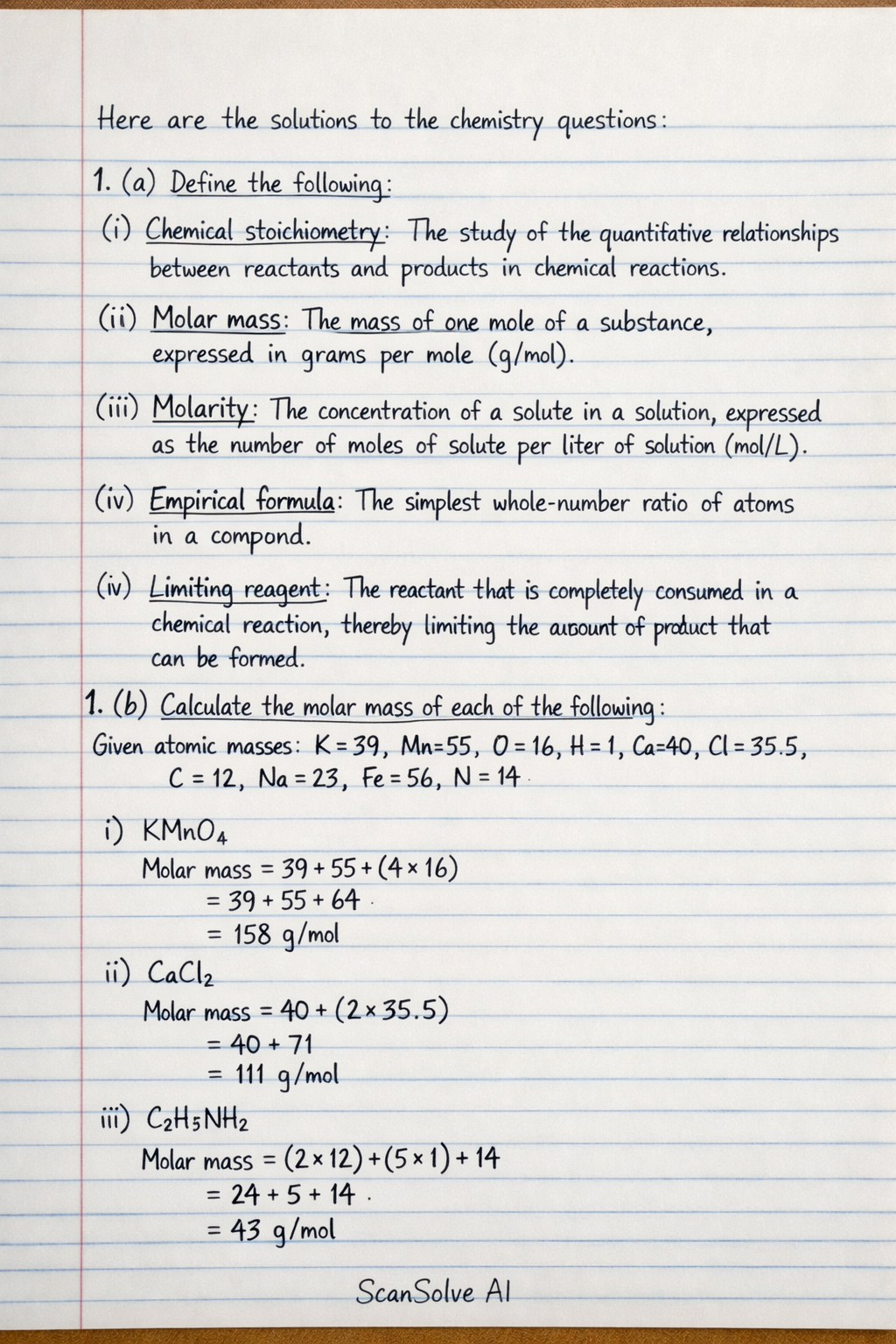
Here are the solutions to the chemistry questions:
1. (a) Define the following:
- (i) Chemical stoichiometry: The study of the quantitative relationships between reactants and products in chemical reactions.
- (ii) Molar mass: The mass of one mole of a substance, expressed in grams per mole ().
- (iii) Molarity: The concentration of a solute in a solution, expressed as the number of moles of solute per liter of solution ().
- (iv) Empirical formula: The simplest whole-number ratio of atoms in a compound.
- (v) Limiting reagent: The reactant that is completely consumed in a chemical reaction, thereby limiting the amount of product that can be formed.
1. (b) Calculate the molar mass of each of the following:
Given atomic masses: , , , , , , , , , .
- (i)
- **(ii) $\text{CaCl}_2 \cdot
Was this helpful?
Still stuck on this one?
Ask a follow-up, and the answer starts from this question.
Got a different question?Ask your own question
More Chemistry Questions
QWhat are the answers to the following chemistry questions? 1. Define molar mass. 2. Define mass…QCalculate the molar mass of the following compounds: CaCl2·2H2O, C6H12O6, Na2CO3, Fe2(SO4)3.QDefine Avogadro's constant, relative atomic mass, relative molecular mass, and empirical formula.QWhich of the following options correctly defines molar mass, mass number, and the reason for…QDefine the following terms: a. Neutral atom b. Element c. Molecule Give (3) examples of a. Element…
Handwritten Step-by-Step Solution
Get this as a handwritten image on WhatsApp — like a tutor wrote it for you.
Try on WhatsApp