
We read your photo as:
Write the chemical formula of the following: 1) Aluminium Sulphide 2) Magnesium tetraoxophosphate (V) 3) Mercury (II) oxide 4) Chromium (III) trioxosulphate (VI) Iron 5) Potassium tetraoxomanganate (VII)
ScanSolve AI Answer
Step-by-step solution
10 stepsHere are the chemical formulas for the given compounds:
1. Aluminium Sulphide
Identify the ions and their charges.
Aluminium is in Group 13, forming an ion.
Sulphide is from sulfur (Group 16), forming an ion.Balance the charges to form a neutral compound.
To balance the charge of and the charge of , we need 2 aluminium ions and 3 sulphide ions ( and ).
The chemical formula is:2. Magnesium tetraoxophosphate (V)
Identify the ions and their charges.
Magnesium is in Group 2, forming an ion.
Tetraoxophosphate (V) refers to the phosphate ion, , where phosphorus has an oxidation state of +5.Balance the charges to form a neutral compound.
To balance the charge of and the charge of , we need 3 magnesium ions and 2 phosphate ions ( and ).
The chemical formula is:3. Mercury (II) oxide
Identify the ions and their charges.
Mercury (II) indicates the ion.
Oxide is from oxygen (Group 16), forming an ion.Balance the charges to form a neutral compound.
The charge of and the charge of balance each other in a 1:1 ratio.
The chemical formula is:4. Chromium (III) trioxosulphate (VI) Iron
Identify the ions and their charges.
Chromium (III) indicates the ion.
Trioxosulphate (VI) refers to the sulfate ion, , where sulfur has an oxidation state of +6. (Note: "trioxo" is likely a typo for "tetraoxo" in this context, as sulfate has 4 oxygen atoms).
The word "Iron" at the end is ambiguous in this context. Assuming it is an extraneous word or a typo, we will provide the formula for Chromium (III) sulfate.Balance the charges to form a neutral compound.
To balance the charge of and the charge of , we need 2 chromium ions and 3 sulfate ions ( and ).
The chemical formula is:5. Potassium tetraoxomanganate (VII)
Identify the ions and their charges.
Potassium is in Group 1, forming a ion.
Tetraoxomanganate (VII) refers to the permanganate ion, , where manganese has an oxidation state of +7.Balance the charges to form a neutral compound.
The charge of and the charge of balance each other in a 1:1 ratio.
The chemical formula is:
Still stuck on this one?
Ask a follow-up, and the answer starts from this question.
More Chemistry Questions
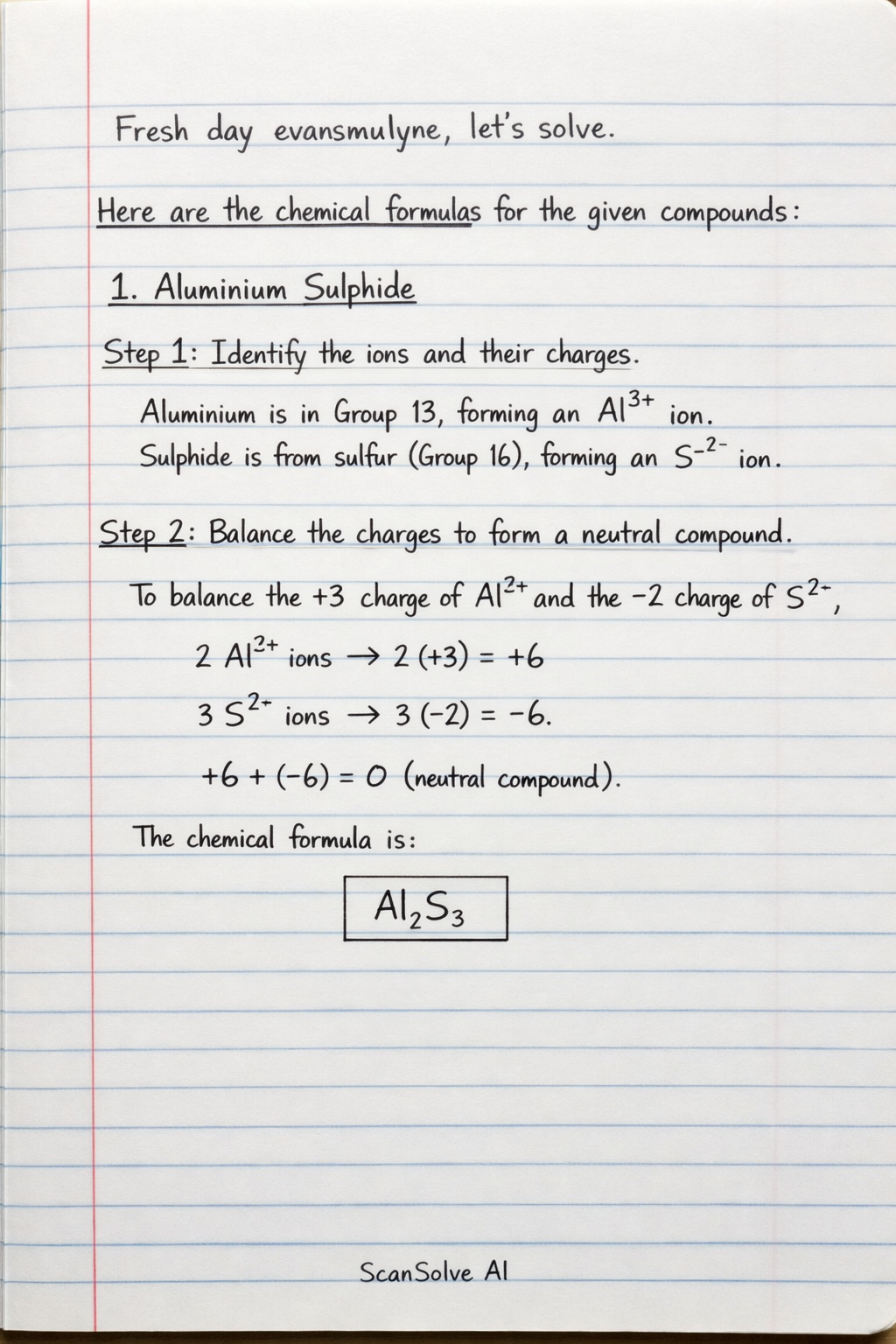
Handwritten Step-by-Step Solution
Get this as a handwritten image on WhatsApp — like a tutor wrote it for you.
Try on WhatsApp