
We read your photo as:
A) Write the electron arrangement (s and p notation) for Na and O. b) Write the formula for Magnesium chloride and Aluminium oxide using valency. c) Balance the chemical equation Fe + O2 -> Fe2O3. d)
Chemistry
ScanSolve AI Answer
Step-by-step solution
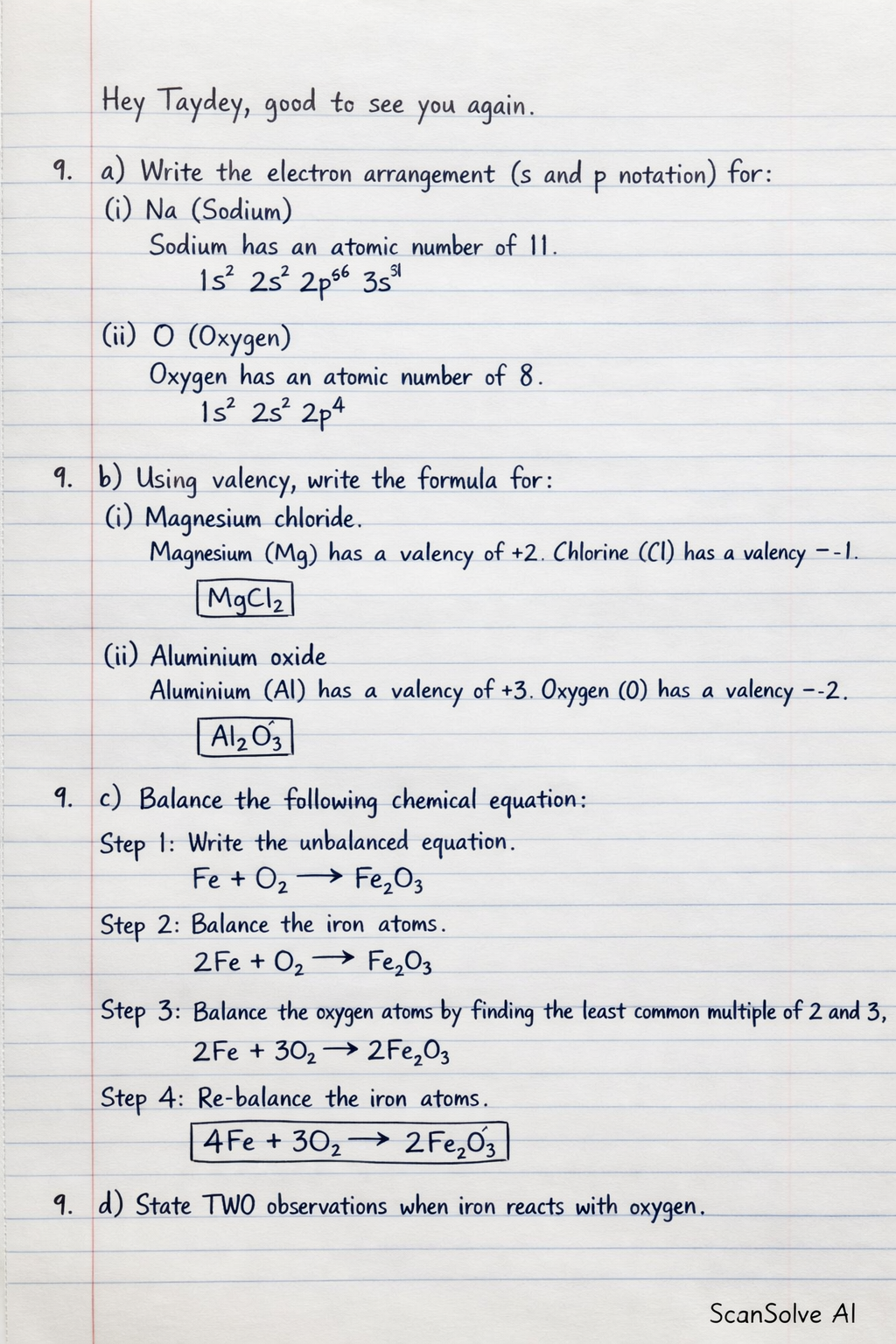
4 steps9. a) Write the electron arrangement (s and p notation) for:
- i) Na (Sodium) Sodium has an atomic number of 11.
- ii) O (Oxygen) Oxygen has an atomic number of 8.
9. b) Using valency, write the formula for:
- i) Magnesium chloride Magnesium (Mg) has a valency of +2. Chlorine (Cl) has a valency of -1.
- ii) Aluminium oxide Aluminium (Al) has a valency of +3. Oxygen (O) has a valency of -2.
9. c) Balance the following chemical equation:
Write the unbalanced equation.
Balance the iron atoms.
Balance the oxygen atoms by finding the least common multiple of 2 and 3, which is 6.
Re-balance the iron atoms.
9. d) State TWO observations when iron reacts with oxygen.
- i. Formation of a reddish-brown solid (rust).
- ii. The iron loses its metallic luster.
10. a) Explain TWO uses of isotopes in medicine and industry.
- i. In medicine, radioactive isotopes like Cobalt-60 are used in radiotherapy to treat cancer by targeting and destroying cancerous cells.
- ii. In industry, isotopes such as Strontium-90 are used in thickness gauging to measure and control the thickness of materials like paper or plastic sheets during manufacturing.
10. b) Describe TWO environmental applications of Chemistry in daily life.
- i. Water treatment: Chemical processes, such as chlorination and flocculation, are used to remove impurities and pathogens from water, making it safe for drinking.
- ii. Air pollution control: Catalytic converters in vehicles use chemical reactions to convert harmful pollutants like carbon monoxide and nitrogen oxides into less harmful substances such as carbon dioxide, nitrogen, and water vapor.
Was this helpful?
Still stuck on this one?
Ask a follow-up, and the answer starts from this question.
Got a different question?Ask your own question
More Chemistry Questions
QWrite the word equations for the following chemical equations: 1) NaCl + KF -> KCl + NaF 2) 2Al…QComplete the table with the formulae of stable oxides. Identify the element forming an amphoteric…QWrite the chemical formula for Aluminium Oxide and Magnesium Chloride. For Ca(OH)2, name the radical…QWrite the chemical formula of the following: 1) Aluminium Sulphide 2) Magnesium tetraoxophosphate…QBalance the following chemical equations and write the word equations for them: a) ZnO + HCl ->…
Handwritten Step-by-Step Solution
Get this as a handwritten image on WhatsApp — like a tutor wrote it for you.
Try on WhatsApp