
We read your photo as:
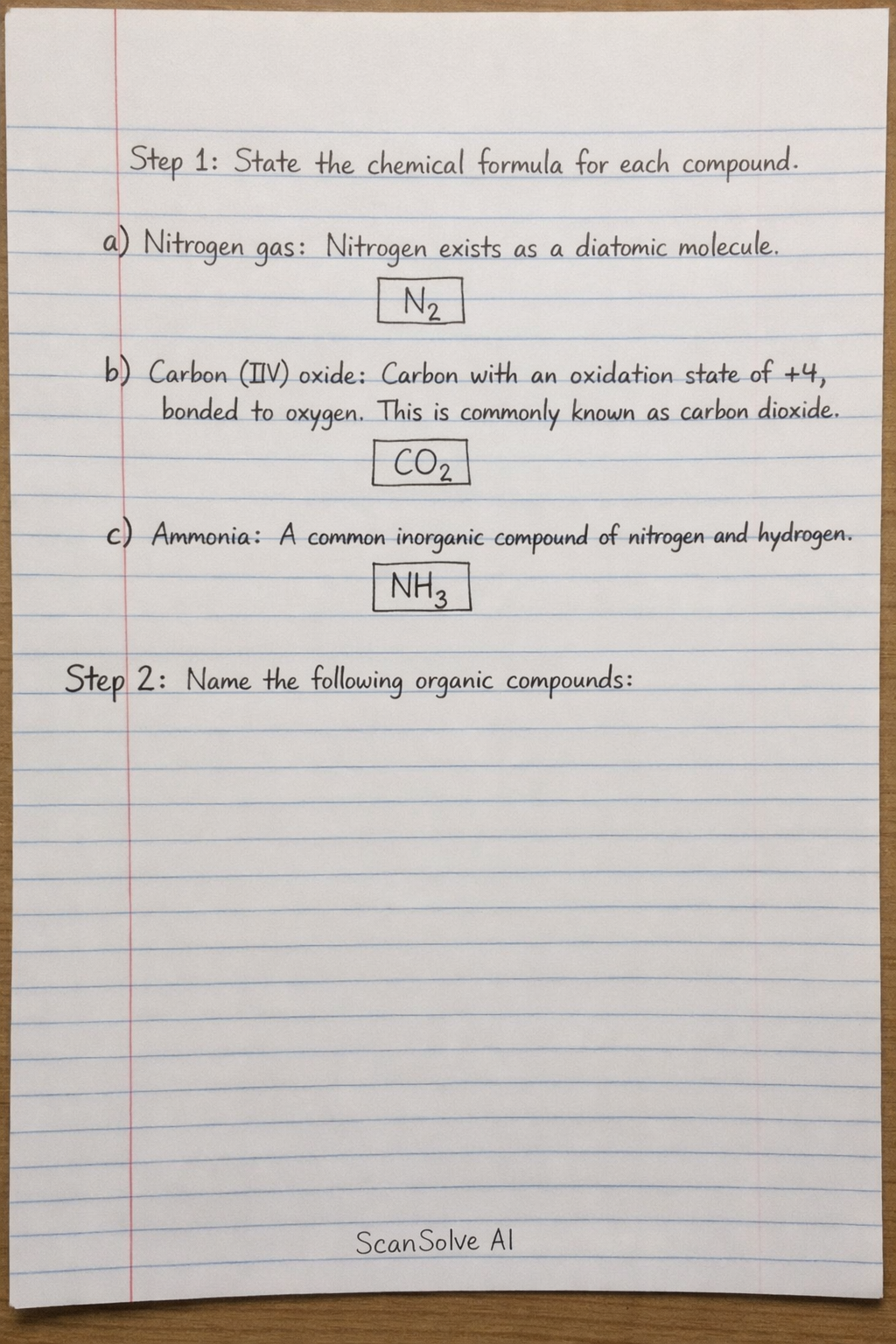
State the chemical formula for each compound.
Chemistry
ScanSolve AI Answer
Step-by-step solution
3 stepsState the chemical formula for each compound.
- a) Nitrogen gas: Nitrogen exists as a diatomic molecule.
- b) Carbon (IV) oxide: Carbon with an oxidation state of +4, bonded to oxygen. This is commonly known as carbon dioxide.
- c) Ammonia: A common inorganic compound of nitrogen and hydrogen.
Name the following organic compounds.
- i) This is an ester. The acid part is derived from ethanoic acid (2 carbons), and the alcohol part is derived from ethanol (2 carbons).
- ii) This is an ester. The acid part is derived from propanoic acid (3 carbons), and the alcohol part is derived from propanol (3 carbons).
- iii) This is a primary alcohol with a 4-carbon chain and the hydroxyl group on the first carbon.
Draw the structural isomers of .
The formula indicates that the compounds are either alkenes (containing one double bond) or cycloalkanes.
-
Alkenes:
- Pent-1-ene
- Pent-2-ene (cis and trans isomers exist, but only the structural isomer is shown)
- 2-Methylbut-1-ene
- 3-Methylbut-1-ene
- 2-Methylbut-2-ene
-
Cycloalkanes: 6. Cyclopentane 7. Methylcyclobutane 8. 1,1-Dimethylcyclopropane 9. 1,2-Dimethylcyclopropane (cis and trans isomers exist, but only the structural isomer is shown) 10. Ethylcyclopropane
-
Was this helpful?
Still stuck on this one?
Ask a follow-up, and the answer starts from this question.
Got a different question?Ask your own question
More Chemistry Questions
QGive the structural formulae and names of the compounds A to G.QWrite the chemical structural formulae for the following compounds. Write the functional group each…QProvide structural formulae and names for compounds B, C, D, and F.QDeduce the chemical formulas of the compounds below with reference to Tables 4.4 and 4.6:QFill in the table with the correct chemical formulas, names, and common names for the listed…
Handwritten Step-by-Step Solution
Get this as a handwritten image on WhatsApp — like a tutor wrote it for you.
Try on WhatsApp