
We read your photo as:
Balance the following redox equation: Cu + HNO3 -> Cu(NO3)2 + NO + H2O. Discuss the strength of the oxidizing and reducing agents.
ScanSolve AI Answer
Answers
2 partsHere are the answers to your questions:
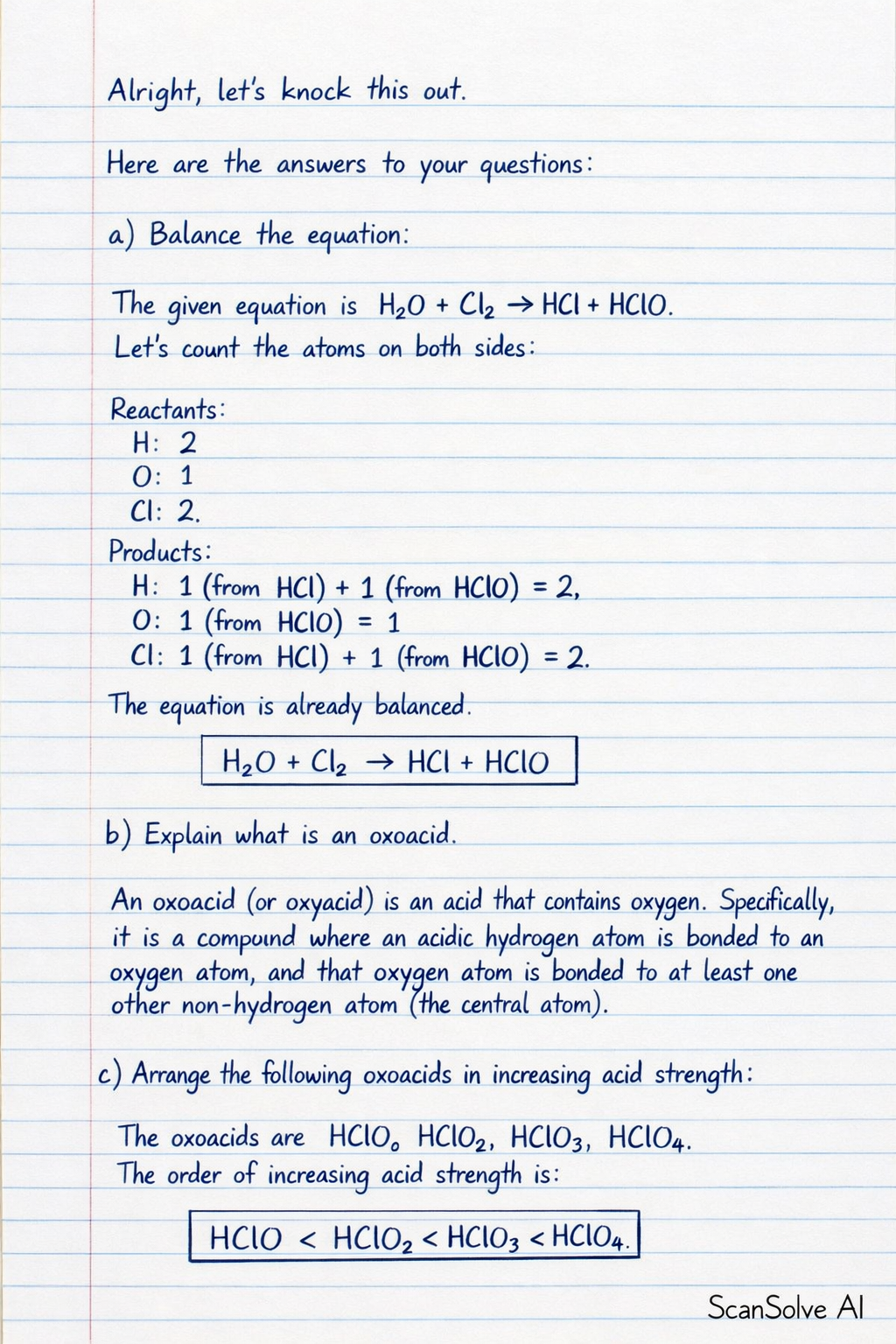
a) Balance the equation:
The given equation is .
Let's count the atoms on both sides:
Reactants:
H: 2
O: 1
Cl: 2
Products:
H: 1 (from HCl) + 1 (from HClO) = 2
O: 1 (from HClO) = 1
Cl: 1 (from HCl) + 1 (from HClO) = 2
The equation is already balanced.
b) Explain what is an oxoacid.
An oxoacid (or oxyacid) is an acid that contains oxygen. Specifically, it is a compound where an acidic hydrogen atom is bonded to an oxygen atom, and that oxygen atom is bonded to at least one other non-hydrogen atom (the central atom).
c) Arrange the following oxoacids in increasing acid strength:
The oxoacids are , , , .
The order of increasing acid strength is:
d) Explain why the acid strength increases in the following oxoacids.
The acid strength of oxoacids with the same central atom (chlorine in this case) increases as the number of oxygen atoms attached to the central atom increases. This is due to two main factors:
- Inductive Effect: Oxygen is a highly electronegative element. As more oxygen atoms are bonded to the central chlorine atom, they pull electron density away from the chlorine atom. This electron-withdrawing effect is transmitted through the chlorine atom to the O-H bond, making the O-H bond more polarized and weaker. A weaker O-H bond means the hydrogen ion () is more easily released, increasing the acid strength.
- Resonance Stabilization of Conjugate Base: When an oxoacid loses a proton, it forms a conjugate base. The more oxygen atoms present, the greater the extent of resonance stabilization of the negative charge in the conjugate base. This delocalization of the negative charge over more oxygen atoms makes the conjugate base more stable, which in turn makes the parent acid stronger. For example, the perchlorate ion () from is highly stabilized by resonance over four oxygen atoms, making a very strong acid.
Try one yourself
A new problem that tests the same skill.
Still stuck on this one?
Ask a follow-up, and the answer starts from this question.
More Chemistry Questions
Handwritten Step-by-Step Solution
Get this as a handwritten image on WhatsApp — like a tutor wrote it for you.
Try on WhatsApp