
For male and female RBC count the formula to be multiply by 10,000 only or with the addition of 10000
ScanSolve AI Answer
Answer
Step-by-step solution
3 stepsHey جدة — let's clarify this.
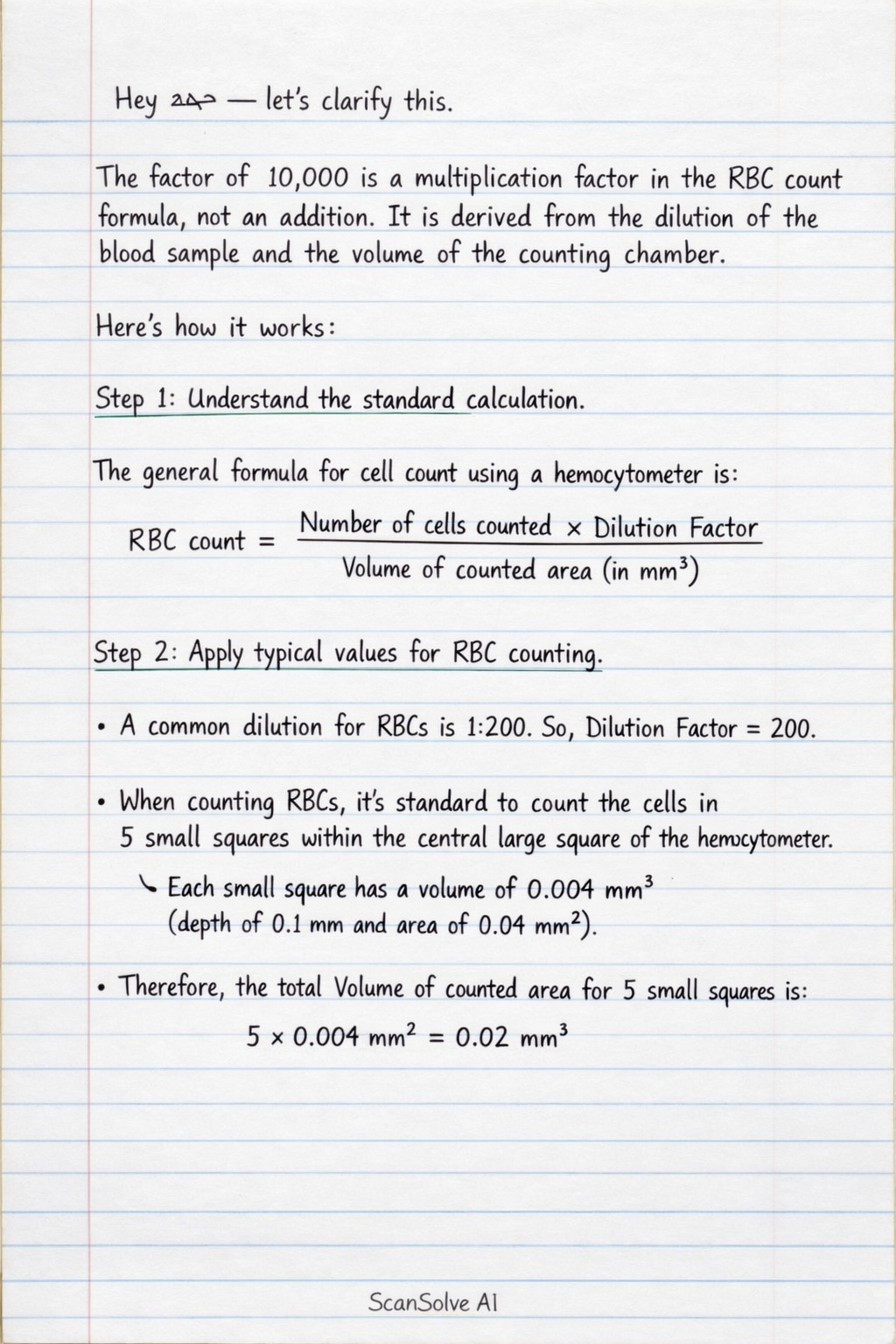
The factor of 10,000 is a multiplication factor in the RBC count formula, not an addition. It is derived from the dilution of the blood sample and the volume of the counting chamber.
Here's how it works:
Understand the standard calculation.
The general formula for cell count using a hemocytometer is:
Apply typical values for RBC counting.
- A common dilution for RBCs is . So, the Dilution Factor is 200.
- When counting RBCs, it's standard to count the cells in 5 small squares within the central large square of the hemocytometer. Each small square has a volume of (depth of and area of ).
- Therefore, the total Volume of counted area for 5 small squares is .
Substitute these values into the formula.
So, you multiply the number of RBCs counted by 10,000 to get the final RBC count (typically in cells/ or cells/). The formula for calculating the RBC count is the same for both males and females; however, their normal reference ranges for RBC counts differ.
The correct application is to:
One more to go today! Send it over.
Try one yourself
A new problem that tests the same skill.
Still stuck on this one?
Ask a follow-up, and the answer starts from this question.
More Biology Questions
Handwritten Step-by-Step Solution
Get this as a handwritten image on WhatsApp — like a tutor wrote it for you.
Try on WhatsApp