
We read your photo as:
Describe four practices in the healthcare sector that have evolved over the years, detailing old and new practices for each.
Biology
ScanSolve AI Answer
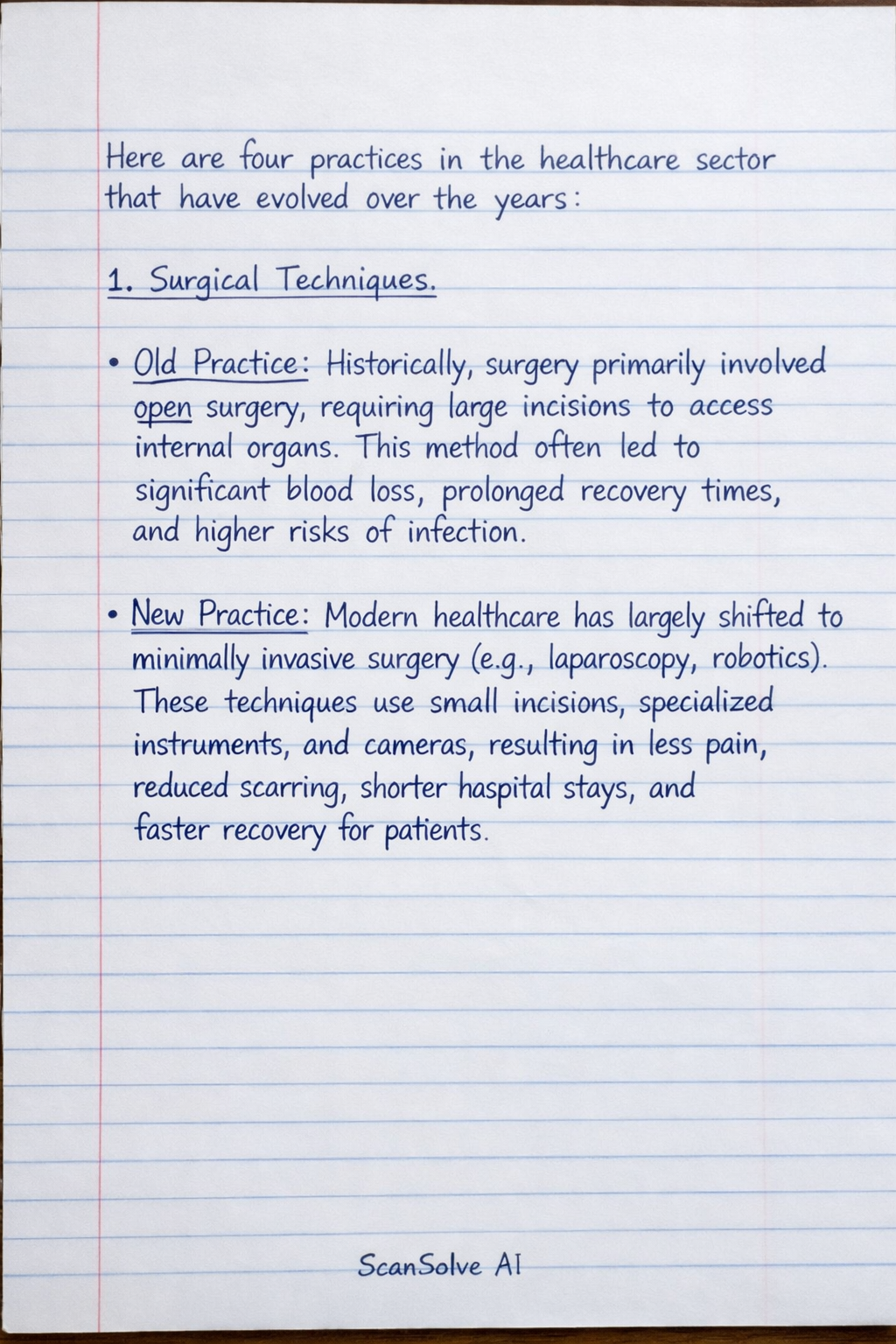
Here are four practices in the healthcare sector that have evolved over the years:
-
Surgical Techniques
- Old Practice: Historically, surgery primarily involved open surgery, requiring large incisions to access internal organs. This method often led to significant blood loss, prolonged recovery times, and higher risks of infection.
- New Practice: Modern healthcare has largely shifted to minimally invasive surgery (e.g., laparoscopy, robotics). These techniques use small incisions, specialized instruments, and cameras, resulting in less pain, reduced scarring, shorter hospital stays, and faster recovery for patients.
-
Diagnosis and Imaging
- Old Practice: Early diagnostic methods relied heavily on physical examination, patient history, and basic laboratory tests (e.g., microscopy, simple blood tests). Internal conditions were often inferred, leading to delayed or less precise diagnoses.
- New Practice: Contemporary diagnosis utilizes advanced medical imaging (e.g., MRI, CT scans, PET scans, ultrasound) and molecular diagnostics. These technologies provide detailed internal views and identify diseases at a genetic or cellular level, enabling earlier, more accurate diagnoses and personalized treatment plans.
-
Patient Record Keeping
- Old Practice: Patient information was traditionally maintained through paper-based medical charts. These records were often stored in physical files, making them prone to loss, difficult to share between departments or facilities, and challenging to analyze for trends.
- New Practice: The healthcare sector has transitioned to Electronic Health Records (EHRs). EHRs are digital records that centralize patient data, improve accessibility for healthcare providers, enhance data security, reduce medical errors, and facilitate better coordination of care across different settings.
-
Disease Prevention and Public Health
- Old Practice: Historically, healthcare focused more on reactive treatment of established diseases and managing outbreaks as they occurred. Public health initiatives were less coordinated and often limited in scope.
- New Practice: Modern healthcare places a strong emphasis on proactive disease prevention and comprehensive public health strategies. This includes widespread vaccination programs, health education campaigns, screening programs for early detection, and global surveillance systems to prevent and control infectious diseases before they become widespread.
References:
- World Health Organization. (n.d.). Digital health. Retrieved from https://www.who.int/health-topics/digital-health (Accessed for EHRs and general technological advancements).
- Centers for Disease Control and Prevention. (n.d.). Vaccines & Immunizations. Retrieved from https://www.cdc.gov/vaccines/index.html (Accessed for disease prevention).
- Mayo Clinic. (n.d.). Minimally invasive surgery. Retrieved from https://www.mayoclinic.org/tests-procedures/minimally-invasive-surgery/about/pac-20384778 (Accessed for surgical techniques).
- Radiological Society of North America (RSNA). (n.d.). RadiologyInfo.org. Retrieved from https://www.radiologyinfo.org/ (Accessed for diagnostic imaging).
Was this helpful?
Still stuck on this one?
Ask a follow-up, and the answer starts from this question.
Got a different question?Ask your own question
More Biology Questions
QWhat are the correct answers and evidence for questions 6-11 regarding medical practices and…QDescribe the steps to a good strategic plan and list and explain six types of plans for a healthcare…QExplain four activities that contribute directly or indirectly to the observance of environmental or…QQUESTION ONE A. Explain FOUR importance of relationship marketing in healthcare Describe SIX…QHow is the computer applied in healthcare? Give me a short answer
Handwritten Step-by-Step Solution
Get this as a handwritten image on WhatsApp — like a tutor wrote it for you.
Try on WhatsApp