

This biology question covers important biological concepts and processes. The step-by-step explanation below helps you understand the underlying mechanisms and reasoning.
ScanSolve AI Answer
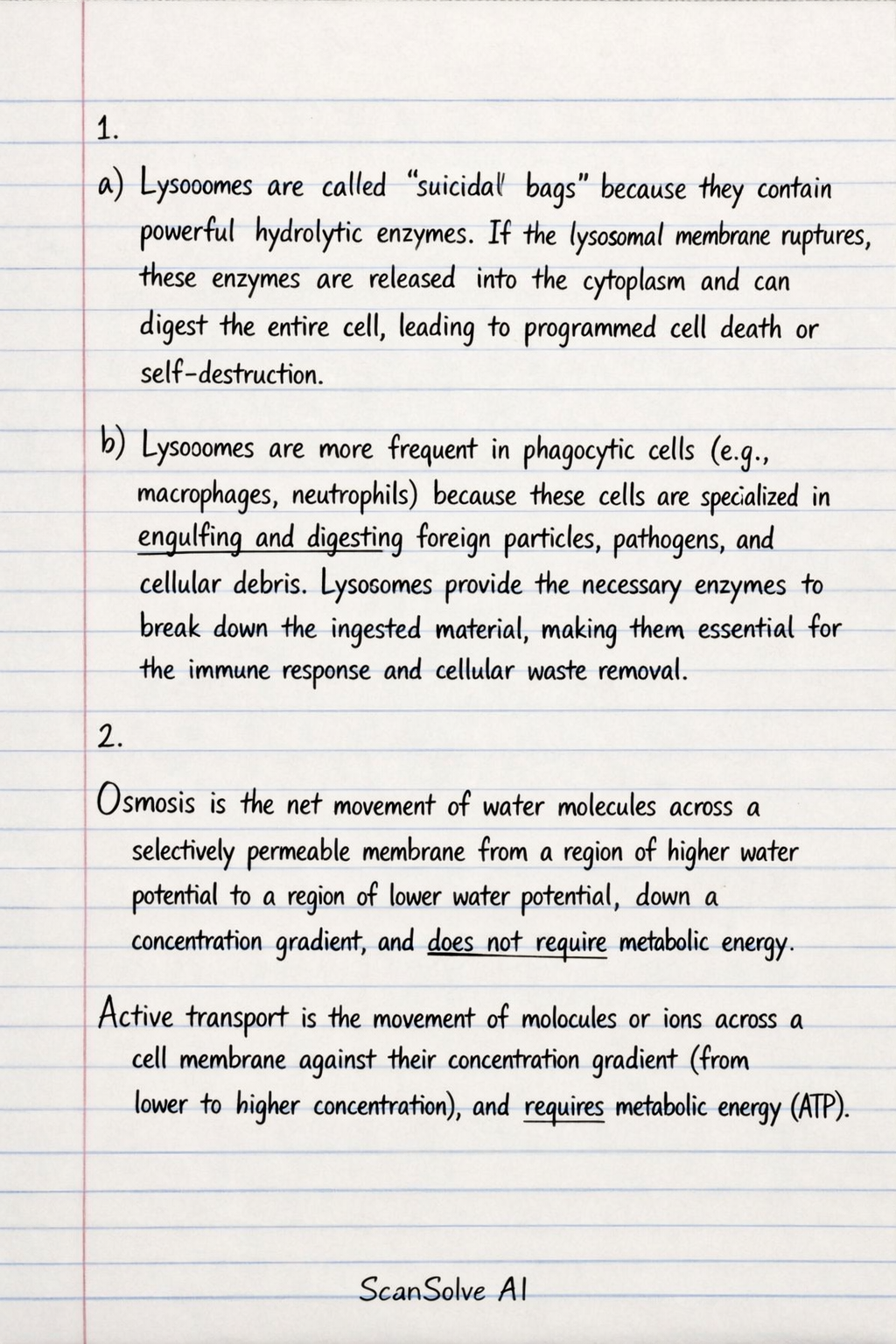
1. a) Lysosomes are called "suicidal bags" because they contain powerful hydrolytic enzymes. If the lysosomal membrane ruptures, these enzymes are released into the cytoplasm and can digest the entire cell, leading to programmed cell death or self-destruction. b) Lysosomes are more frequent in phagocytic cells (e.g., macrophages, neutrophils) because these cells are specialized in engulfing and digesting foreign particles, pathogens, and cellular debris. Lysosomes provide the necessary enzymes to break down the ingested material, making them essential for the immune response and cellular waste removal. 2. Osmosis is the net movement of water molecules across a selectively permeable membrane from a region of higher water potential to a region of lower water potential, down a concentration gradient, and does not require metabolic energy. Active transport is the movement of molecules or ions across a cell membrane against their concentration gradient (from lower to higher concentration), and requires metabolic energy (ATP). 3. a) The nucleic acid strand is DNA. Reason: The presence of the base Thymine (T) indicates it is DNA. RNA contains Uracil (U) instead of Thymine. b) The complementary RNA strand is: A-A-U-C-G-A-C-U 4. Three structural differences between biceps muscles and muscles of the gut: • Biceps muscles are striated (skeletal muscle), while gut muscles are smooth (visceral muscle). • Biceps muscles are voluntary, meaning their contraction is under conscious control, while gut muscles are involuntary. • Biceps muscles have multinucleated cells with peripheral nuclei, while gut muscles have uninucleated cells with centrally located nuclei. 5. a) The type of sugar detected was Glucose. b) The hormone likely to have been deficient is Insulin. c) The condition the person was suffering from is Diabetes mellitus. 6. The causative agent of the following human diseases: i) Pneumonia: Streptococcus pneumoniae (or other bacteria/viruses/fungi) ii) Cholera: Vibrio cholerae iii) Gonorrhoea: Neisseria gonorrhoeae 7. Two classes of phylum Arthropoda which have a cephalothorax: 1. Crustacea 2. Arachnida 8. Three adaptations of the proximal convoluted tubule to its function: • Numerous microvilli on the apical surface to increase the surface area for reabsorption. • Abundant mitochondria to provide ATP for active transport of substances like glucose, amino acids, and ions. • Extensive infoldings of the basal membrane to increase surface area for the placement of transport proteins and mitochondria. 9. a) A single circulatory system is one where blood flows through the heart only once in a complete circuit around the body, typically passing from the heart to respiratory organs (like gills), then to the rest of the body, and back to the heart. b) An organism with a single circulatory system is a Fish. c) The opening to the chamber of the heart of an insect is the Ostium. 10. a) The type of growth pattern shown on the graph is Intermittent growth or Step-wise growth. b) The process represented by X is Molting or Ecdysis. c) The hormone responsible for the process in (b) above is Ecdysone. 11. a) The meaning of the following terms used in floral biology: