
We read your photo as:
Define and give examples of polysaccharides, triacylglycerols, nucleotides, and nucleosides. Explain how to name nucleosides.
ScanSolve AI Answer
-
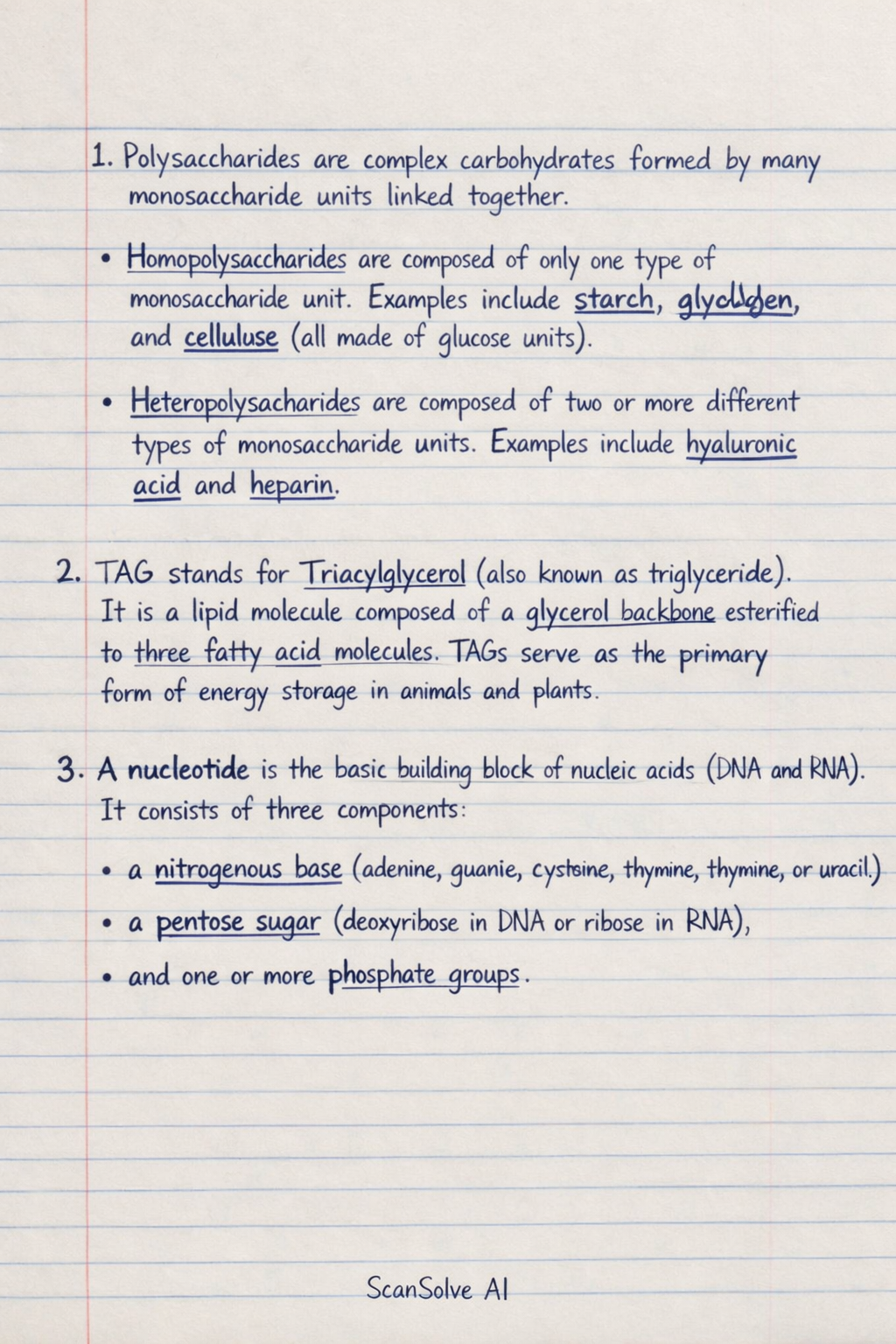
Polysaccharides are complex carbohydrates formed by many monosaccharide units linked together.
- Homopolysaccharides are composed of only one type of monosaccharide unit. Examples include starch, glycogen, and cellulose (all made of glucose units).
- Heteropolysaccharides are composed of two or more different types of monosaccharide units. Examples include hyaluronic acid and heparin.
-
TAG stands for Triacylglycerol (also known as triglyceride). It is a lipid molecule composed of a glycerol backbone esterified to three fatty acid molecules. TAGs serve as the primary form of energy storage in animals and plants.
-
A nucleotide is the basic building block of nucleic acids (DNA and RNA). It consists of three components: a nitrogenous base (adenine, guanine, cytosine, thymine, or uracil), a pentose sugar (deoxyribose in DNA or ribose in RNA), and one or more phosphate groups.
-
A nucleoside is a part of a nucleotide, consisting of a nitrogenous base covalently linked to a pentose sugar (deoxyribose or ribose), but without any phosphate groups.
-
Naming Nucleosides: The nitrogenous base's name is modified.
- For purine bases (Adenine, Guanine), the suffix "-osine" is added: Adenine becomes Adenosine, Guanine becomes Guanosine.
- For pyrimidine bases (Cytosine, Thymine, Uracil), the suffix "-idine" is added: Cytosine becomes Cytidine, Thymine becomes Thymidine, Uracil becomes Uridine.
Naming Nucleotides: Nucleotides are named by adding "monophosphate," "diphosphate," or "triphosphate" to the corresponding nucleoside name, indicating the number of phosphate groups attached.
- Example: Adenine Adenosine (nucleoside) Adenosine monophosphate (AMP), Adenosine diphosphate (ADP), Adenosine triphosphate (ATP).
- Similarly: Guanine Guanosine Guanosine monophosphate (GMP).
- Cytosine Cytidine Cytidine monophosphate (CMP).
- Thymine Thymidine Thymidine monophosphate (TMP).
- Uracil Uridine Uridine monophosphate (UMP).
-
A peptide bond is formed between two amino acids through a dehydration synthesis (or condensation) reaction. The carboxyl group of one amino acid reacts with the amino group of another amino acid. A molecule of water is removed, and a covalent bond forms between the carbon atom of the carboxyl group and the nitrogen atom of the amino group, resulting in a linkage.
Still stuck on this one?
Ask a follow-up, and the answer starts from this question.
More Biology Questions
Handwritten Step-by-Step Solution
Get this as a handwritten image on WhatsApp — like a tutor wrote it for you.
Try on WhatsApp