
We read your photo as:
Define glycosylation and differentiate between O- and N-linked oligosaccharides and State four (4) functional roles of oligosaccharides arising from their structure
ScanSolve AI Answer
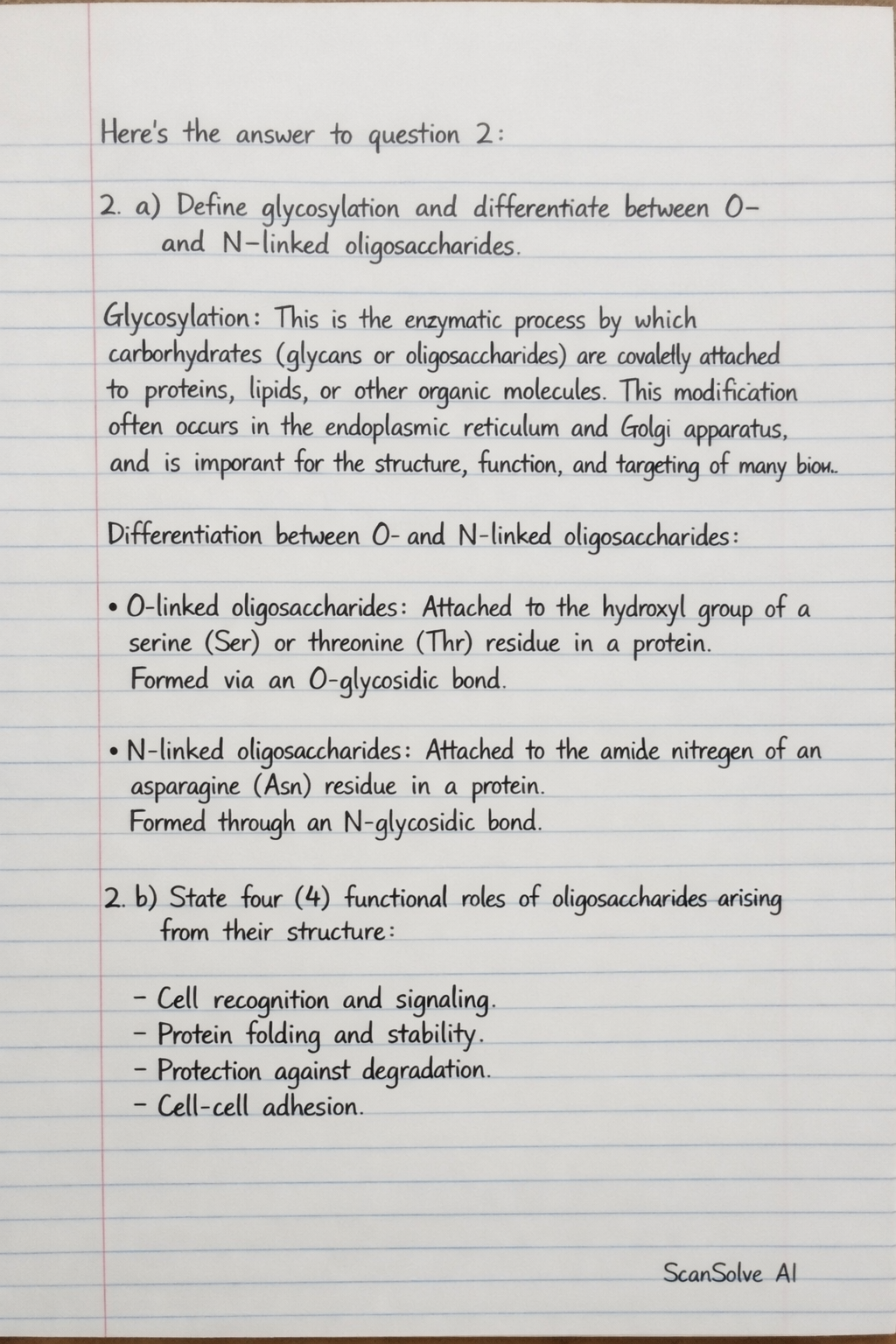
Here's the answer to question 2:
2. a) Define glycosylation and differentiate between O- and N-linked oligosaccharides
-
Glycosylation: This is the enzymatic process by which carbohydrates (glycans or oligosaccharides) are covalently attached to proteins, lipids, or other organic molecules. This modification often occurs in the endoplasmic reticulum and Golgi apparatus and is crucial for the structure, function, and targeting of many biomolecules.
-
Differentiation between O- and N-linked oligosaccharides:
- O-linked oligosaccharides: These are attached to the hydroxyl group of a serine () or threonine () residue in a protein. The linkage is typically formed through an O-glycosidic bond.
- N-linked oligosaccharides: These are attached to the amide nitrogen of an asparagine () residue in a protein. The linkage is formed through an N-glycosidic bond.
2. b) State four (4) functional roles of oligosaccharides arising from their structure
- Cell-cell recognition: Oligosaccharides on the cell surface act as specific markers, allowing cells to recognize and interact with each other.
- Cell adhesion: They mediate the binding of cells to the extracellular matrix or to other cells, playing a role in tissue formation and immune responses.
- Protein folding and stability: Glycans can influence the proper folding of proteins in the endoplasmic reticulum and protect proteins from degradation, thereby increasing their stability.
- Immune response: They serve as antigens (e.g., blood group antigens) or receptors for pathogens, playing a critical role in the immune system's ability to distinguish self from non-self.
2. c) How does the branching pattern of amylopectin affect starch's solubility and digestibility?
The highly branched structure of amylopectin significantly impacts its solubility and digestibility:
- Solubility: The extensive branching in amylopectin prevents the glucose chains from packing tightly together. This open, less crystalline structure allows more water molecules to interact with the numerous hydroxyl groups, increasing its ability to swell and disperse in water, forming a viscous paste rather than a true solution.
- Digestibility: The numerous -(16) branch points create many non-reducing ends. These ends are the primary sites where digestive enzymes like amylases (e.g., -amylase, glucoamylase) can begin to break down the polysaccharide. A higher number of accessible ends means a larger surface area for enzymatic attack, leading to faster and more efficient digestion of amylopectin compared to unbranched polysaccharides like amylose.
Still stuck on this one?
Ask a follow-up, and the answer starts from this question.
More Biology Questions
Handwritten Step-by-Step Solution
Get this as a handwritten image on WhatsApp — like a tutor wrote it for you.
Try on WhatsApp