
We read your photo as:
What is the chemical structure, functional groups, and ionization states of glycylglycine?
ScanSolve AI Answer
The image shows the chemical structure of a dipeptide.
1. Identification of the Molecule:
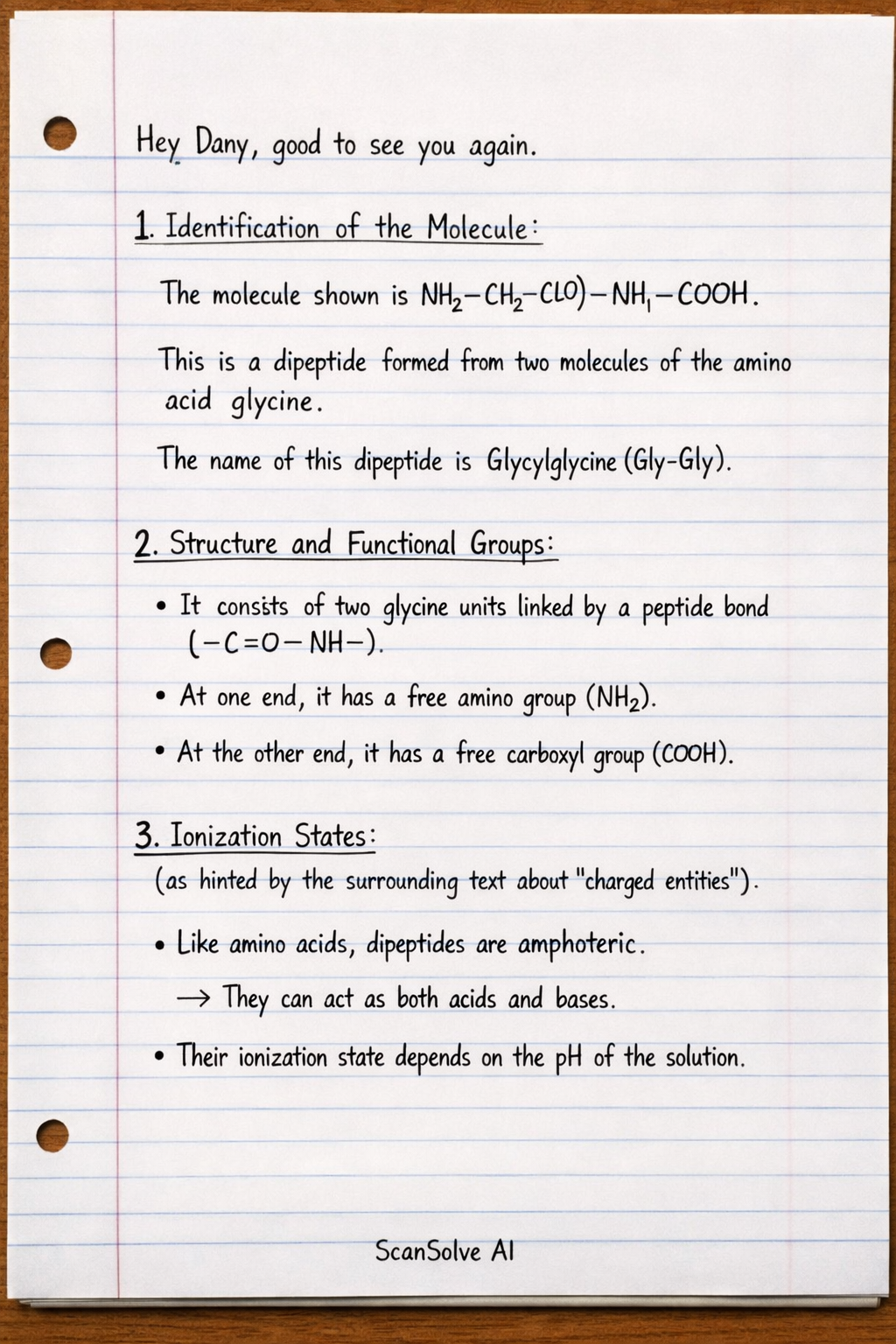
The molecule shown is .
This is a dipeptide formed from two molecules of the amino acid glycine.
The name of this dipeptide is Glycylglycine (Gly-Gly).
2. Structure and Functional Groups:
- It consists of two glycine units linked by a peptide bond (an amide linkage, ).
- At one end, it has a free amino group ().
- At the other end, it has a free carboxyl group ().
3. Ionization States (as hinted by the surrounding text about "charged entities"):
Like amino acids, dipeptides are amphoteric, meaning they can act as both acids and bases. Their ionization state depends on the pH of the solution.
-
In strongly acidic conditions (low pH): The free amino group () will be protonated to , and the carboxyl group () will remain un-ionized. The molecule will have a net positive charge.
-
At physiological pH (around 7, zwitterionic form): The free amino group () is protonated to , and the free carboxyl group () is deprotonated to . The molecule exists as a zwitterion, having both positive and negative charges, resulting in a net charge of zero.
-
In strongly basic conditions (high pH): Both the free amino group () and the free carboxyl group () will be deprotonated. The amino group remains , and the carboxyl group becomes . The molecule will have a net negative charge.
The peptide bond itself () is generally stable and does not ionize under typical physiological conditions.
Summary:
The molecule is Glycylglycine, a dipeptide. It contains an amino group, a carboxyl group, and a peptide bond. It can exist in different ionic forms depending on the pH, with the zwitterionic form being prevalent at neutral pH, where the amino group is protonated and the carboxyl group is deprotonated.
Still stuck on this one?
Ask a follow-up, and the answer starts from this question.
More Chemistry Questions
Handwritten Step-by-Step Solution
Get this as a handwritten image on WhatsApp — like a tutor wrote it for you.
Try on WhatsApp