
We read your photo as:
Explain osmosis and anaerobic respiration using the provided context, including a boiling experiment and cell importance.
ScanSolve AI Answer
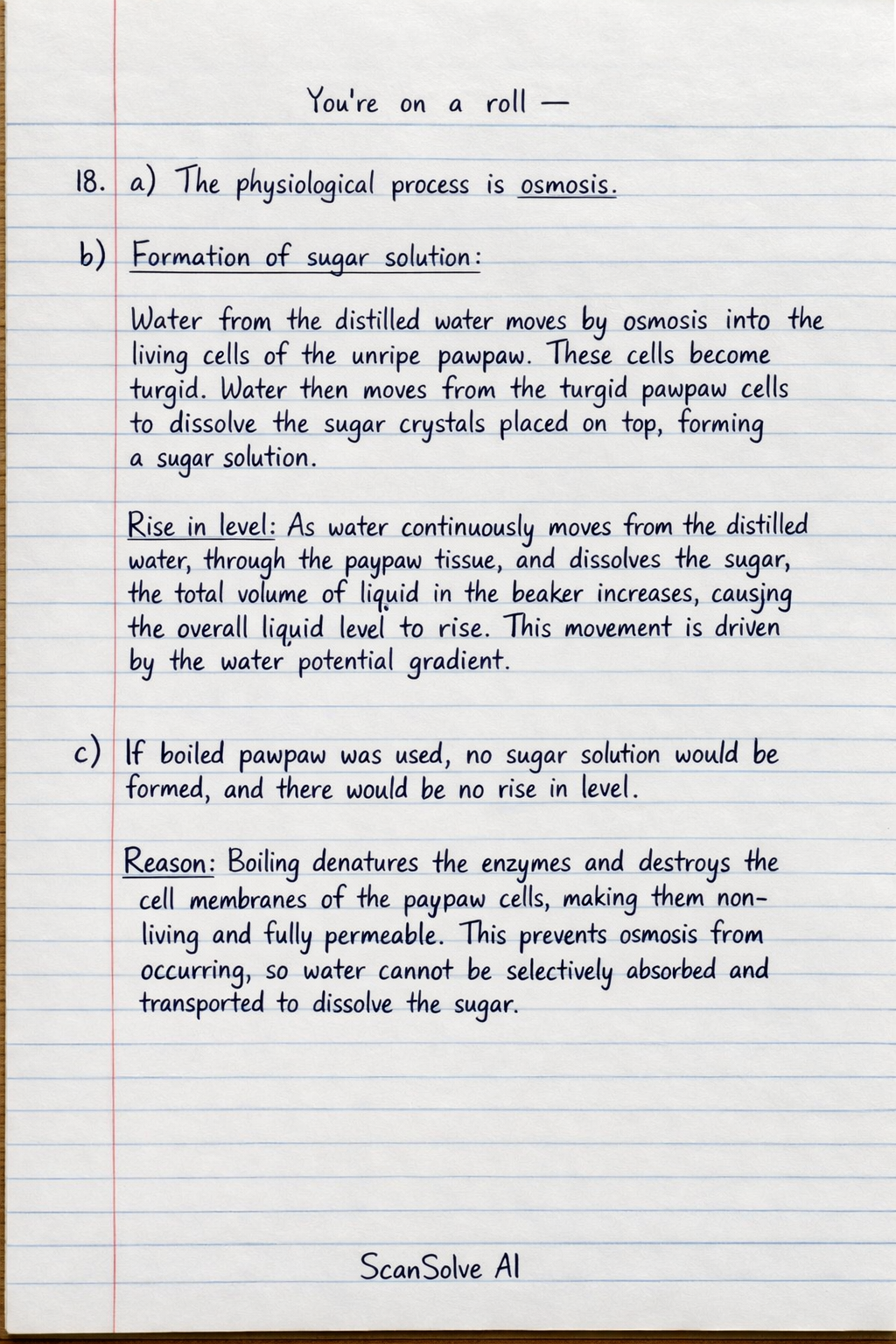
18. a) The physiological process is osmosis.
b)
- Formation of sugar solution: Water from the distilled water moves by osmosis into the living cells of the unripe pawpaw. These cells become turgid. Water then moves from the turgid pawpaw cells to dissolve the sugar crystals placed on top, forming a sugar solution.
- Rise in level: As water continuously moves from the distilled water, through the pawpaw tissue, and dissolves the sugar, the total volume of liquid in the beaker increases, causing the overall liquid level to rise. This movement is driven by the water potential gradient.
c) If boiled pawpaw was used, no sugar solution would be formed, and there would be no rise in level.
Reason: Boiling denatures the enzymes and destroys the cell membranes of the pawpaw cells, making them non-living and fully permeable. This prevents osmosis from occurring, so water cannot be selectively absorbed and transported to dissolve the sugar.
d) Two importances of osmosis:
- Absorption of water by plant roots from the soil.
- Maintenance of turgor pressure in plant cells, which provides support to herbaceous plants.
19. a) The above process is anaerobic respiration (or fermentation).
b) i) The chemical reaction represented by x is glycolysis.
b) ii) The part of the cell where the enzyme-controlled reaction x (glycolysis) takes place is the cytoplasm.
20.
-
Functions of Lysosomes:
- They contain digestive enzymes that break down worn-out organelles (autophagy).
- They digest foreign materials such as bacteria and viruses that enter the cell.
- They are involved in the breakdown of waste products and cellular debris.
-
Two ways flowering plants eliminate waste products:
- Transpiration: Waste products dissolved in water are lost as water vapor through stomata.
- Shedding of leaves, bark, or fruits: Waste products accumulate in these parts and are removed when they fall off.
Still stuck on this one?
Ask a follow-up, and the answer starts from this question.
More Biology Questions
Handwritten Step-by-Step Solution
Get this as a handwritten image on WhatsApp — like a tutor wrote it for you.
Try on WhatsApp