
We read your photo as:
State the functions of the following apparatus: bait trap, pooter, forceps. 2. State two structural adaptations of arteries. 3. Name the process of glomerulus filtrate formation and give one structura
ScanSolve AI Answer
Here are the answers to your questions:
-
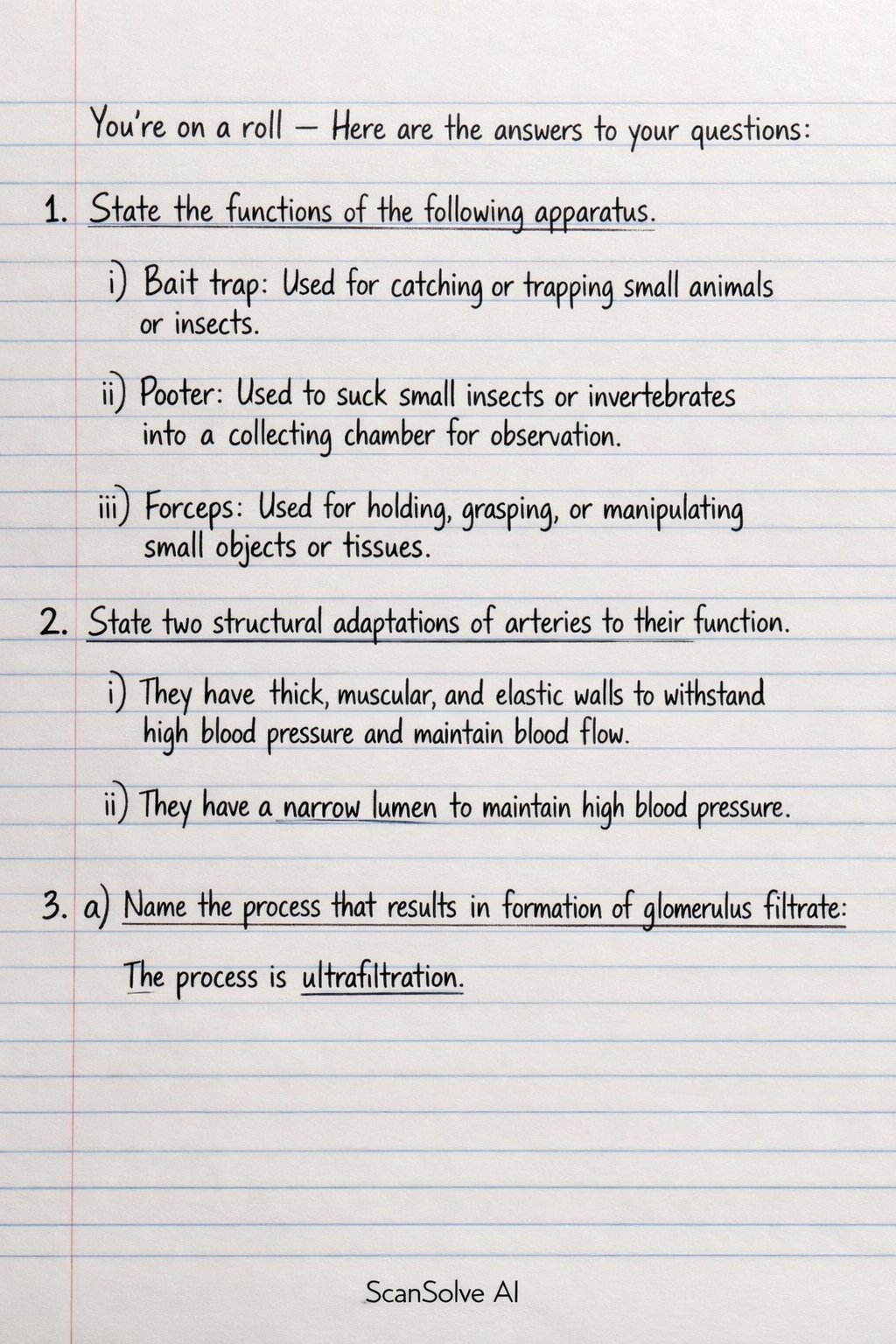
State the functions of the following apparatus.
- i) Bait trap: Used for catching or trapping small animals or insects.
- ii) Pooter: Used to suck small insects or invertebrates into a collecting chamber for observation.
- iii) Forceps: Used for holding, grasping, or manipulating small objects or tissues.
-
State two structural adaptations of arteries to their function.
- i) They have thick, muscular, and elastic walls to withstand high blood pressure and maintain blood flow.
- ii) They have a narrow lumen to maintain high blood pressure.
-
a) Name the process that results in formation of glomerulus filtrate.
- The process is ultrafiltration.
b) Give one structural adaptation of glomerulus that facilitate the process named in a above.
- The glomerulus is a highly coiled network of capillaries, which increases the surface area for filtration.
- The afferent arteriole is wider than the efferent arteriole, creating high pressure within the glomerulus to force fluid out.
-
Give two reasons why staining is necessary when preparing specimen for observation under the light microscope.
- i) Staining increases the contrast between the specimen and the background, making transparent structures visible.
- ii) Staining highlights specific structures within the specimen, allowing for differentiation and better observation.
-
Give three functions of mucus secreted by the wall of digestive system.
- i) It lubricates food, making it easier to move through the digestive tract.
- ii) It protects the lining of the digestive tract from digestive enzymes and acids.
- iii) It prevents the digestive system from self-digestion.
-
Explain one negative effect of herbicides in human health.
- Herbicides can be toxic if ingested or absorbed, potentially leading to various health problems such as cancer, neurological damage, or reproductive issues, and in high doses, may lead to death.
-
Describe how vasodilation regulates body temperature. When the body temperature is too high, vasodilation occurs, meaning the arterioles near the skin surface widen. This increases blood flow to the skin, allowing more heat to be lost from the blood to the surroundings through radiation, convection, and conduction, thus cooling the body down.
Still stuck on this one?
Ask a follow-up, and the answer starts from this question.
More Biology Questions
Handwritten Step-by-Step Solution
Get this as a handwritten image on WhatsApp — like a tutor wrote it for you.
Try on WhatsApp