
We read your photo as:
Explain the G0, G1, and G2 phases, Interphase, Karyokinesis, Mitosis, and Meiosis in the cell cycle.
ScanSolve AI Answer
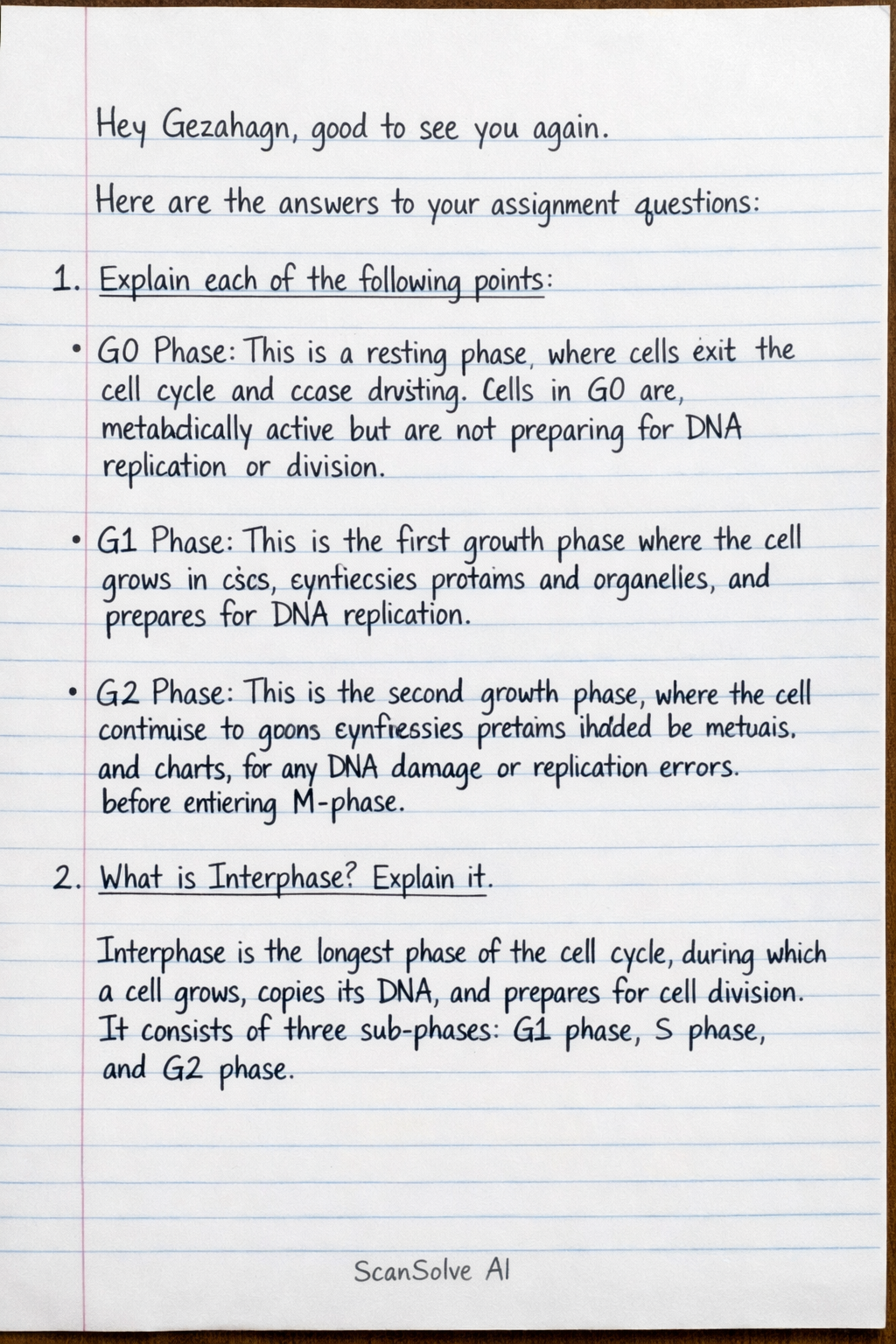
Here are the answers to your assignment questions:
-
Explain each of the following points:
- G0 Phase: This is a resting phase where cells exit the cell cycle and cease dividing. Cells in G0 are metabolically active but are not preparing for DNA replication or division.
- G1 Phase: This is the first growth phase where the cell grows in size, synthesizes proteins and organelles, and prepares for DNA replication. It is a critical checkpoint for cell division.
- G2 Phase: This is the second growth phase where the cell continues to grow, synthesizes proteins needed for mitosis, and checks for any DNA damage or replication errors before entering M-phase.
-
What is Interphase? Explain it. Interphase is the longest phase of the cell cycle, during which a cell grows, copies its DNA, and prepares for cell division. It consists of three sub-phases: G1 phase, S phase, and G2 phase.
-
Define Karyokinesis, Mitosis, and Meiosis.
- Karyokinesis: The division of the nucleus, typically followed by cytokinesis. It ensures that each daughter cell receives a complete set of chromosomes.
- Mitosis: A type of cell division that results in two daughter cells each having the same number and kind of chromosomes as the parent nucleus, typical of ordinary tissue growth.
- Meiosis: A type of cell division that reduces the number of chromosomes in the parent cell by half and produces four gamete cells. This process is essential for sexual reproduction.
-
What is M-Phase? M-phase, or the mitotic phase, is the stage of the cell cycle where the cell divides its copied DNA and cytoplasm to form two new daughter cells. It includes both nuclear division (mitosis or meiosis) and cytoplasmic division (cytokinesis).
-
Define Chiasmata. Chiasmata are the points where homologous chromosomes remain in contact and exchange genetic material (crossing over) during prophase I of meiosis. They are visible as X-shaped structures.
-
What is Cell Cycle? The cell cycle is the series of events that take place in a cell leading to its division and duplication. It involves cell growth, DNA replication, and cell division, ensuring the continuity of life.
-
What is S-Phase? Explain clearly. S-phase, or the synthesis phase, is the stage of the cell cycle where DNA replication occurs. During this phase, each chromosome is duplicated to form two identical sister chromatids, ensuring that each daughter cell receives a complete set of genetic material.
-
What are the phases of Mitosis? The phases of mitosis are:
- Prophase: Chromosomes condense and become visible, the nuclear envelope breaks down, and the spindle fibers begin to form.
- Metaphase: Chromosomes align at the metaphase plate (equator of the cell).
- Anaphase: Sister chromatids separate and move to opposite poles of the cell.
- Telophase: Chromosomes decondense, nuclear envelopes reform around the two sets of chromosomes, and the spindle fibers disappear.
-
How cytokinesis takes place in animal and plant cells?
- In animal cells, cytokinesis occurs by the formation of a cleavage furrow. A contractile ring of actin and myosin filaments forms just inside the plasma membrane, pinching the cell into two.
- In plant cells, cytokinesis involves the formation of a cell plate. Vesicles from the Golgi apparatus fuse in the middle of the cell, forming a new cell wall that divides the two daughter cells.
-
Write significance of Mitosis and Meiosis.
- Significance of Mitosis: Essential for growth, tissue repair, and asexual reproduction in many organisms. It produces two genetically identical daughter cells, maintaining the chromosome number.
- Significance of Meiosis: Crucial for sexual reproduction, producing genetically diverse gametes (sperm and egg cells) with half the number of chromosomes. It ensures genetic variation in offspring.
-
What is Mendelian Inheritance? Mendelian inheritance refers to the patterns of inheritance of traits determined by single genes with dominant and recessive alleles, as first described by Gregor Mendel. It explains how traits are passed from parents to offspring.
-
Basic terms of Genetics:
- Gene: A hereditary unit consisting of a specific sequence of DNA that codes for a particular protein or functional RNA molecule. It is a segment of DNA.
- Allele: A variant form of a gene. For example, a gene for eye color might have alleles for blue, brown, or green eyes.
- Genotype: The genetic make-up of an organism, referring to the specific combination of alleles it possesses for a particular trait (e.g., BB, Bb, bb).
- Phenotype: The observable physical trait or characteristic of an organism, resulting from the interaction of its genotype and the environment (e.g., eye colour).
- DNA: Deoxyribonucleic acid, the molecule of heredity that carries genetic instructions for the development, functioning, growth, and reproduction of all known organisms and many viruses.
Still stuck on this one?
Ask a follow-up, and the answer starts from this question.
More Biology Questions
Handwritten Step-by-Step Solution
Get this as a handwritten image on WhatsApp — like a tutor wrote it for you.
Try on WhatsApp