
We read your photo as:
Use at least 8 of these terms when explaining different stages in mitosis and meiosis: Chromosome, Chromatid, Centromere, Spindle fiber, Diploid, Haploid, Homologous pair, Crossing over, Nondisjunction, Cytokinesis, Cell plate, Cleavage furrow.
ScanSolve AI Answer
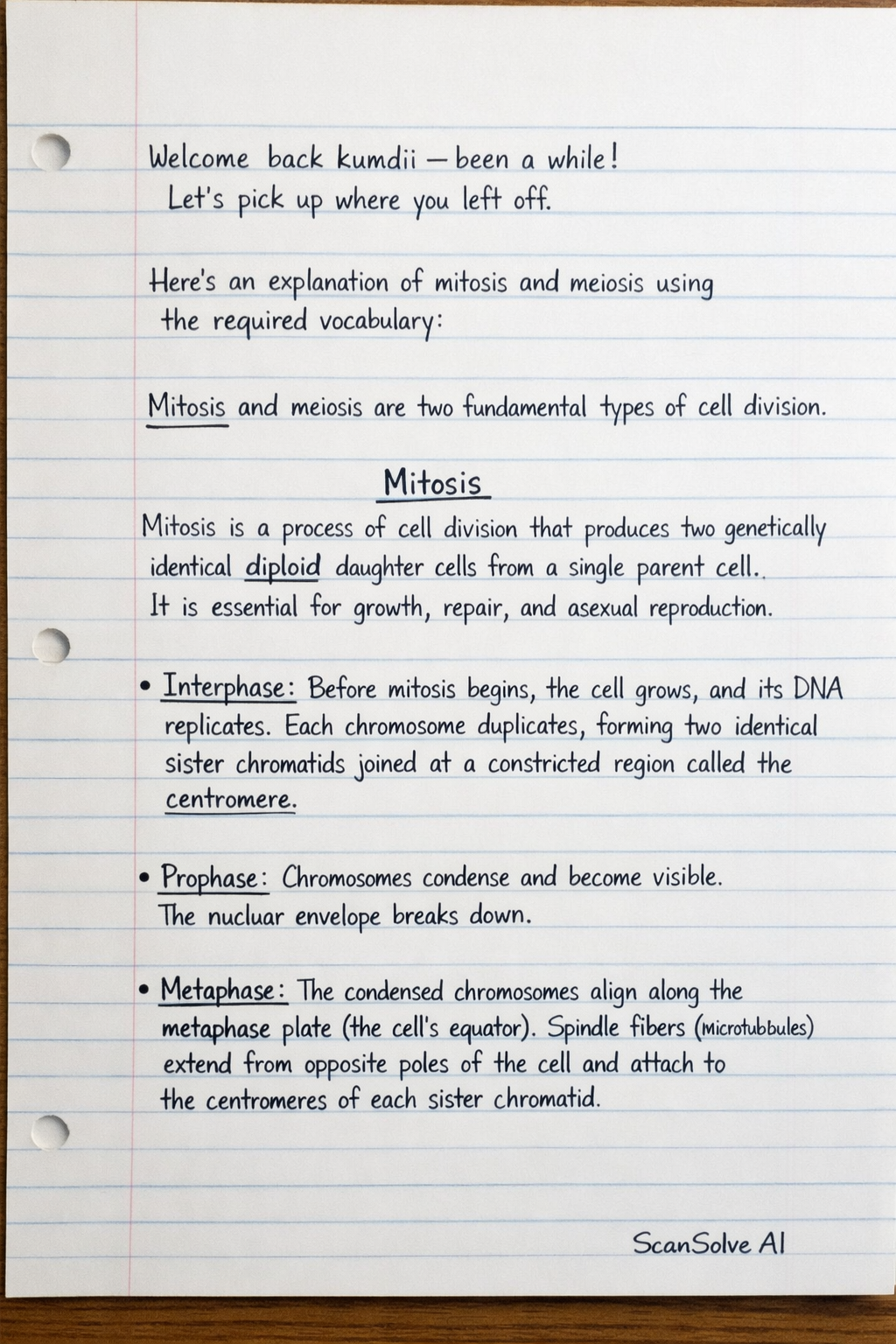
Here's an explanation of mitosis and meiosis using the required vocabulary:
Mitosis and meiosis are two fundamental types of cell division.
Mitosis
Mitosis is a process of cell division that produces two genetically identical diploid daughter cells from a single parent cell. It is essential for growth, repair, and asexual reproduction.
- Interphase: Before mitosis begins, the cell grows, and its DNA replicates. Each chromosome duplicates, forming two identical sister chromatids joined at a constricted region called the centromere.
- Prophase: Chromosomes condense and become visible. The nuclear envelope breaks down.
- Metaphase: The condensed chromosomes align along the metaphase plate (the cell's equator). Spindle fibers (microtubules) extend from opposite poles of the cell and attach to the centromeres of each sister chromatid.
- Anaphase: The sister chromatids separate at the centromere and are pulled apart by the shortening spindle fibers towards opposite poles of the cell. Each separated chromatid is now considered an individual chromosome.
- Telophase: New nuclear envelopes form around the two sets of chromosomes at each pole. The chromosomes begin to decondense.
- Cytokinesis: This is the final step, where the cytoplasm divides, resulting in two distinct daughter cells. In animal cells, a cleavage furrow forms and pinches the cell in two. In plant cells, a cell plate forms in the middle and grows outwards to create a new cell wall.
Meiosis
Meiosis is a two-part cell division process that produces four genetically distinct haploid daughter cells (gametes or spores) from a single diploid parent cell. It is crucial for sexual reproduction and genetic diversity.
-
Meiosis I (Reductional Division):
- Prophase I: Chromosomes condense, and homologous pairs of chromosomes (one from each parent) come together to form bivalents. Crossing over occurs, where genetic material is exchanged between non-sister chromatids of homologous chromosomes, leading to genetic recombination. Spindle fibers begin to form.
- Metaphase I: Homologous pairs align at the metaphase plate. Spindle fibers attach to the centromeres of each homologous chromosome.
- Anaphase I: Homologous chromosomes separate and move to opposite poles of the cell. Sister chromatids remain attached at their centromeres.
- Telophase I & Cytokinesis: New nuclei may form, and the cytoplasm divides, resulting in two haploid cells, each with chromosomes still consisting of two sister chromatids.
-
Meiosis II (Equational Division):
- Prophase II: Chromosomes condense again.
- Metaphase II: Chromosomes (each still composed of two sister chromatids) align at the metaphase plate. Spindle fibers attach to the centromeres.
- Anaphase II: Sister chromatids separate and move to opposite poles, similar to mitosis.
- Telophase II & Cytokinesis: New nuclei form around the separated chromosomes, and the cytoplasm divides. This results in four genetically distinct haploid daughter cells.
-
Nondisjunction: This is an error that can occur during meiosis (or mitosis) when chromosomes fail to separate properly. It can lead to daughter cells with an abnormal number of chromosomes.
Still stuck on this one?
Ask a follow-up, and the answer starts from this question.
More Biology Questions
Handwritten Step-by-Step Solution
Get this as a handwritten image on WhatsApp — like a tutor wrote it for you.
Try on WhatsApp