

This biology question covers important biological concepts and processes. The step-by-step explanation below helps you understand the underlying mechanisms and reasoning.
ScanSolve AI Answer
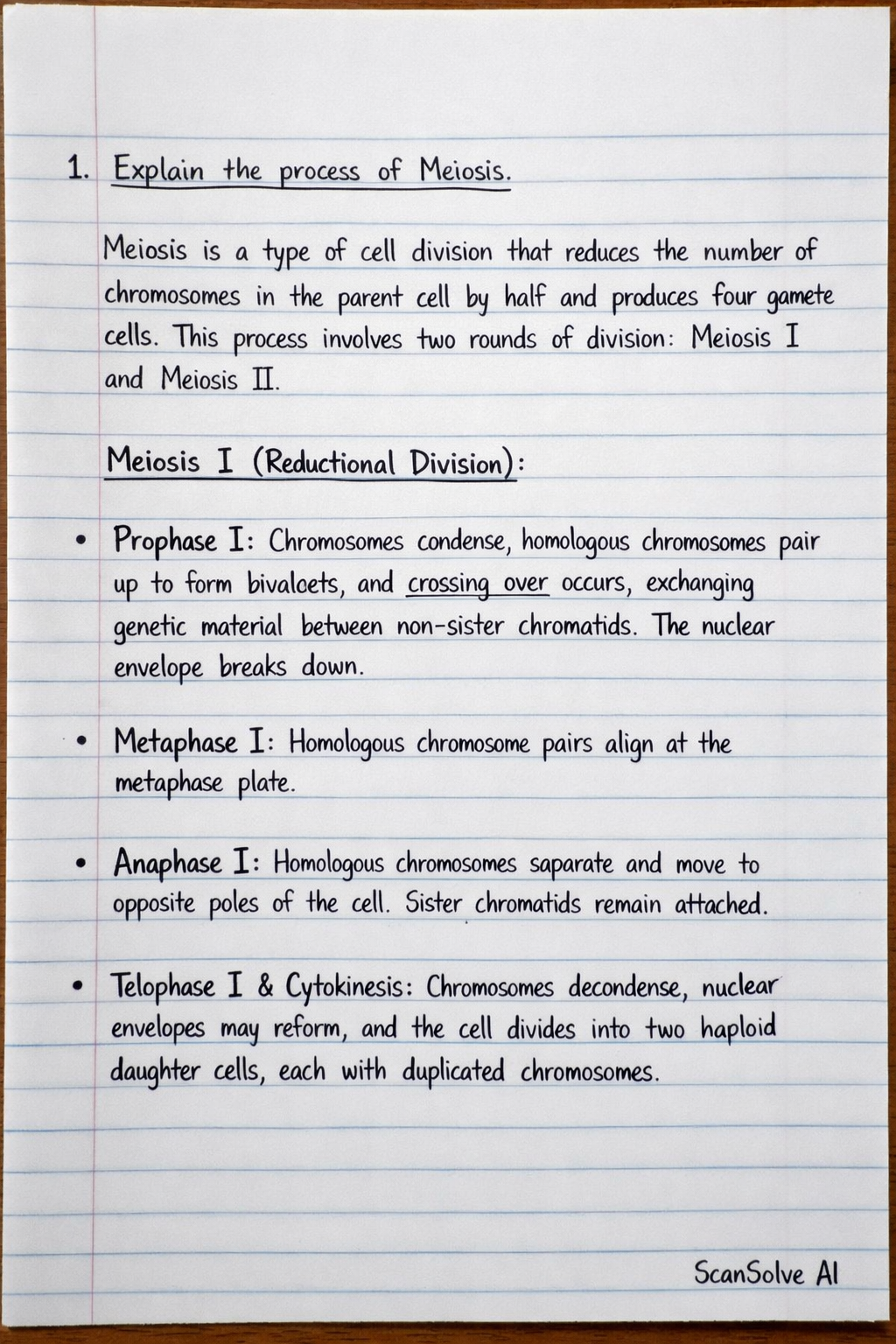
1. Explain the process of Meiosis. Meiosis is a type of cell division that reduces the number of chromosomes in the parent cell by half and produces four gamete cells. This process involves two rounds of division: Meiosis I and Meiosis II. Meiosis I (Reductional Division): Prophase I: Chromosomes condense, homologous chromosomes pair up to form bivalents, and crossing over* occurs, exchanging genetic material between non-sister chromatids. The nuclear envelope breaks down. Metaphase I:* Homologous chromosome pairs align at the metaphase plate. Anaphase I:* Homologous chromosomes separate and move to opposite poles of the cell. Sister chromatids remain attached. Telophase I & Cytokinesis:* Chromosomes decondense, nuclear envelopes may reform, and the cell divides into two haploid daughter cells, each with duplicated chromosomes. Meiosis II (Equational Division): Prophase II:* Chromosomes condense again, and the nuclear envelope breaks down (if reformed). Metaphase II:* Sister chromatids align at the metaphase plate in each of the two cells. Anaphase II:* Sister chromatids separate and move to opposite poles, becoming individual chromosomes. Telophase II & Cytokinesis:* Chromosomes decondense, nuclear envelopes reform, and each cell divides, resulting in a total of four haploid daughter cells, each with unduplicated chromosomes. (Note: A diagram would typically illustrate the chromosome movements and changes in ploidy during each stage.) 2. Explain how meiosis makes one cell distinct from another. Meiosis generates genetic variation among the resulting gametes primarily through two mechanisms: crossing over and independent assortment. Crossing over occurs during Prophase I, where homologous chromosomes exchange segments of DNA, creating new combinations of alleles on chromatids. Independent assortment happens during Metaphase I, as homologous chromosome pairs align randomly at the metaphase plate, meaning the maternal and paternal chromosomes are distributed into daughter cells independently of other pairs. These processes ensure that each of the four haploid gametes produced is genetically unique. 3. Explain the difference between genotype and phenotype. A genotype* refers to the specific set of alleles an individual possesses for a particular gene or set of genes. It represents the genetic makeup of an organism. A phenotype* is the observable physical or biochemical characteristics of an organism, which are a result of the interaction between its genotype and the environment. For example, having the genotype 'Bb' for eye color (where B is brown, b is blue) might result in a brown eye phenotype. 4. List five (5) conditions that occur as a result of issues during meiosis. Issues during meiosis, such as nondisjunction (failure of chromosomes to separate properly), can lead to an abnormal number of chromosomes in gametes, resulting in various genetic conditions. 1. Down syndrome (Trisomy 21) 2. Klinefelter syndrome (XXY) 3. Turner syndrome (XO) 4. Patau syndrome (Trisomy 13) 5. Edwards syndrome (Trisomy 18)