

This biology question covers important biological concepts and processes. The step-by-step explanation below helps you understand the underlying mechanisms and reasoning.
ScanSolve AI Answer
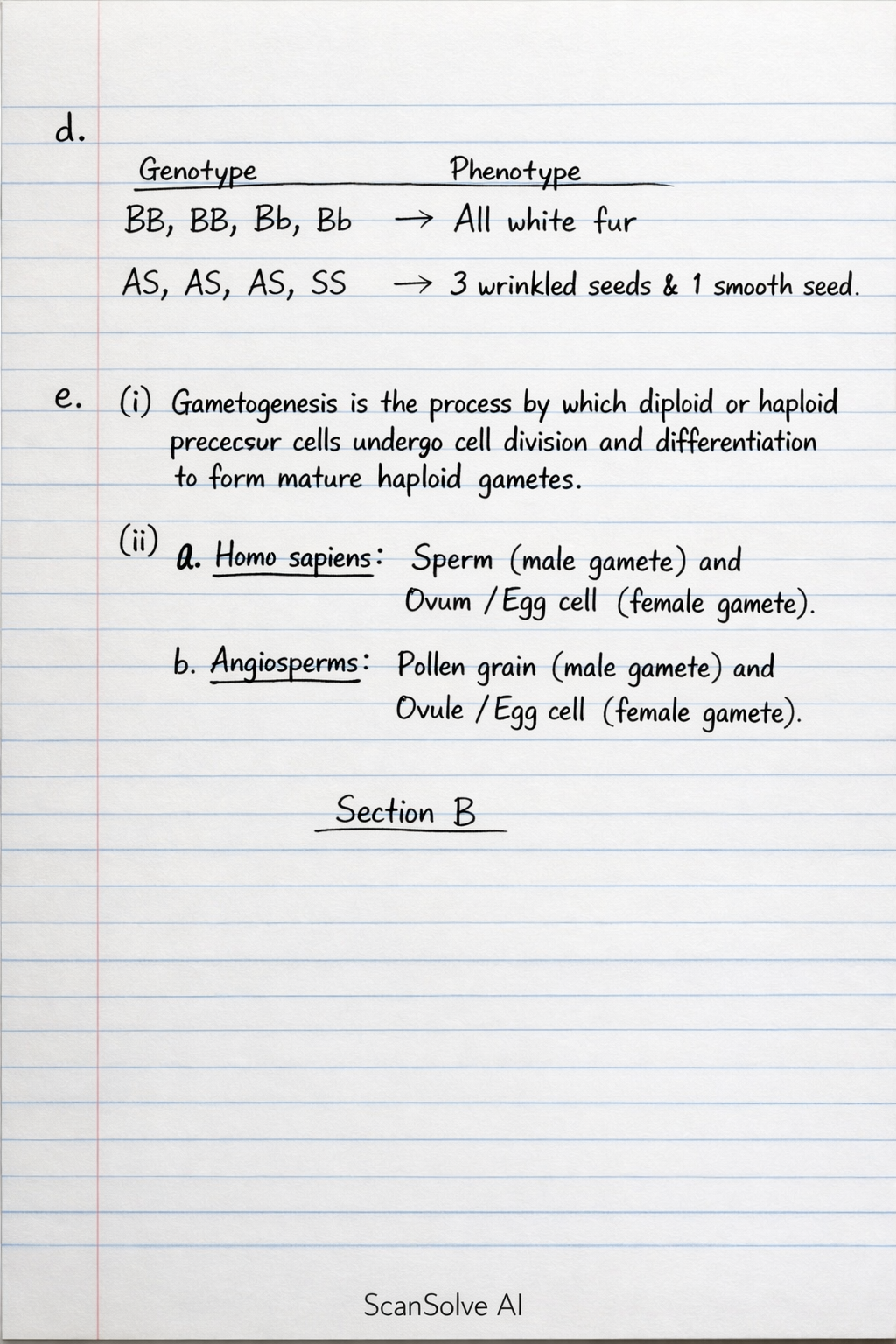
d. | Genotype | Phenotype | | :----------------- | :-------------------------------------- | | BB, BB, Bb, Bb | All white fur | | AS, AS, AS, SS | 3-wrinkled seeds and 1 smooth seed | e. i) Gametogenesis is the process by which diploid or haploid precursor cells undergo cell division and differentiation to form mature haploid gametes. ii) α. Homo sapiens: Sperm (male gamete) and Ovum/Egg cell (female gamete). β. Angiosperms: Pollen grain (male gamete) and Ovule/Egg cell (female gamete). Section B 5. a) i) Eukaryotic cells are generally larger than prokaryotic cells because they possess membrane-bound organelles that compartmentalize cellular functions, allowing for greater complexity and efficiency. This internal organization supports a larger cell volume. ii) Termites are social insects because they live in organized colonies with a distinct caste system, where individuals have specialized roles (e.g., workers, soldiers, reproductives) and cooperate in tasks such as foraging, nest building, and caring for the young. iii) Tilapia cannot survive out of freshwater because their gills and osmoregulation systems are adapted to maintain water balance in a freshwater environment. They would lose too much water in saltwater due to osmosis or dehydrate rapidly on land. b) i) To destarch a leaf, the plant is placed in a dark environment for a period, typically 24-48 hours. This ensures that any starch already present in the leaves is used up through respiration, and no new starch is produced via photosynthesis. ii) Three adaptations of the leaf for photosynthesis are: • Broad, flat lamina: Provides a large surface area to absorb maximum sunlight. • Thinness: Allows for rapid diffusion of gases (carbon dioxide) and light penetration to photosynthetic cells. • Presence of stomata: Pores on the leaf surface that regulate the exchange of gases (carbon dioxide intake, oxygen release) and water vapor. c) i) Heterozygous refers to an individual having two different alleles for a particular gene (e.g., Aa). Co-dominance is a genetic phenomenon where both alleles in a heterozygous individual are fully and equally expressed in the phenotype, resulting in a distinct phenotype that shows characteristics of both alleles. ii) One activity that occurs in the cell in each of the following stages: i. Interphase: DNA replication (synthesis of new DNA). ii. Metaphase: Chromosomes align at the metaphase plate. iii. Prophase: Chromatin condenses into visible chromosomes. iv. Anaphase: Sister chromatids separate and move to opposite poles. d) Gene replication in bacteria (prokaryotes) begins at a single origin of replication on the circular chromosome. DNA helicase unwinds the DNA, creating replication forks that move bidirectionally. DNA polymerase then synthesizes new complementary strands, using the original strands as templates, until the entire circular chromosome is duplicated. e) | Adult | Two food nutrients | One end-product | | :---- | :----------------- | :--------------- | | Adult | Carbohydrates, Proteins | Glucose |