

This biology question covers important biological concepts and processes. The step-by-step explanation below helps you understand the underlying mechanisms and reasoning.
ScanSolve AI Answer
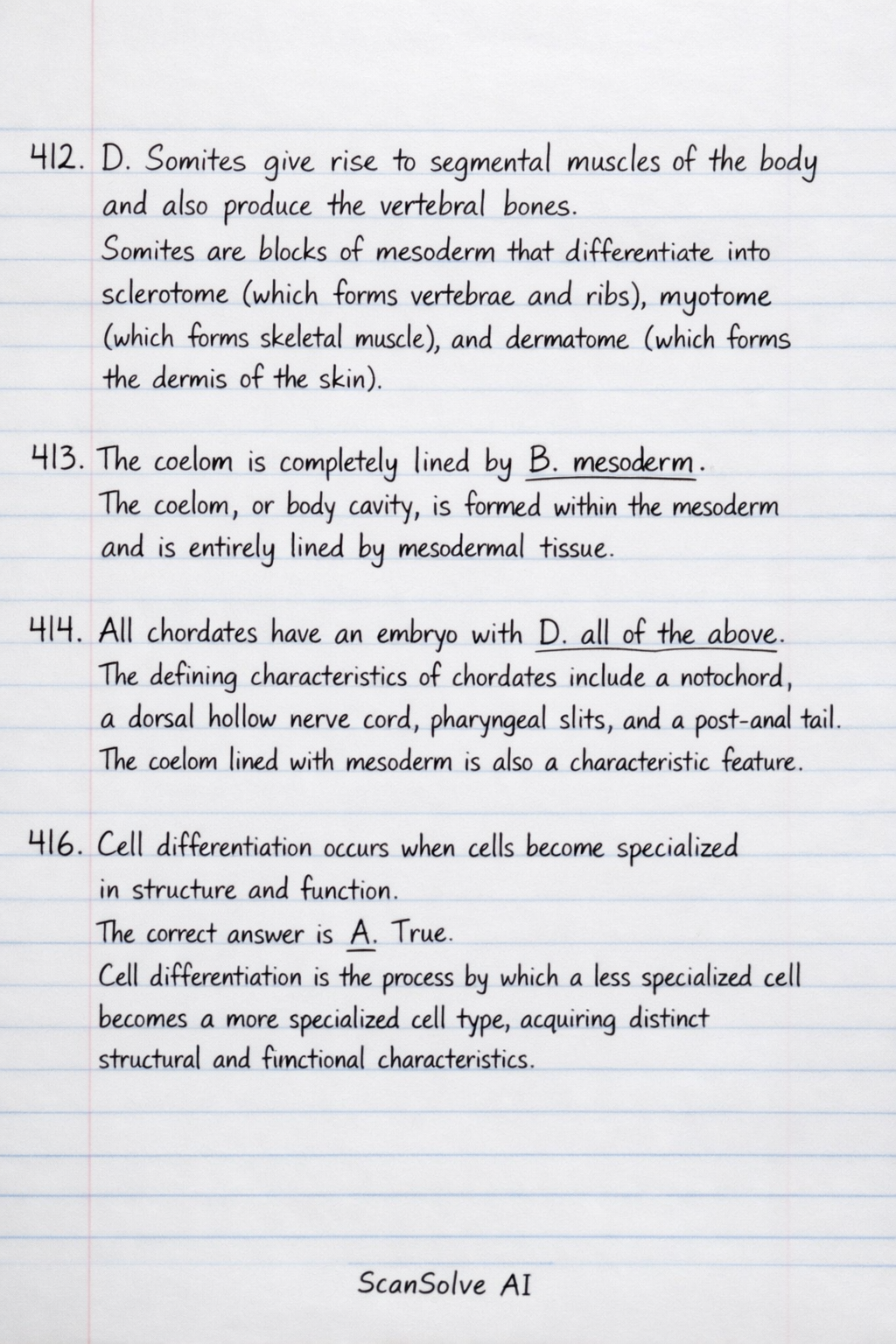
here are the answers to your questions: 412. D. Somites give(s) rise to segmental muscles of the body and also produce(s) the vertebral bones. Somites are blocks of mesoderm that differentiate into sclerotome (which forms vertebrae and ribs), myotome (which forms skeletal muscle), and dermatome (which forms the dermis of the skin). 413. The coelom is completely lined by B. mesoderm. The coelom, or body cavity, is formed within the mesoderm and is entirely lined by mesodermal tissue. 414. All chordates have an embryo with D. all of the above. The defining characteristics of chordates include a notochord, a dorsal hollow nerve cord, pharyngeal slits, and a post-anal tail. The coelom lined with mesoderm is also a characteristic feature. 416. Cell differentiation occurs when cells become specialized in structure and function. The correct answer is A. True. Cell differentiation is the process by which a less specialized cell becomes a more specialized cell type, acquiring distinct structural and functional characteristics. 417. Differentiation and morphogenesis account for specialization of tissues and formation of organs and determine the shape of the organism. The correct answer is A. True. Differentiation leads to specialized cells, while morphogenesis is the process that gives an organism its shape and form through the organization of these cells into tissues and organs. 418. It is believed that induction stops after neural tube formation. The correct answer is B. False. Embryonic induction, where one group of cells influences the development of another, is a continuous process throughout embryonic development, not just limited to neural tube formation. 419. Direct contact or the production of a chemical acts as a signal that activates certain A. signals in neighboring cells and brings about development of particular structures. This describes cell-cell communication and induction, where external signals activate internal signaling pathways or gene expression within target cells, leading to developmental changes. 420. In the chick, the B. Chorion lies next to the shell and carries on gas exchange. The chorion is the outermost extraembryonic membrane in a chick embryo. It fuses with the allantois to form the chorioallantoic membrane, which is highly vascularized and serves as the primary site for gas exchange with the external environment through the shell. What's next? Send 'em!