
We read your photo as:
What are the answers to the following questions: 1. What do goblet cells produce? 2. What is the anticoagulant in leech salivary glands? 3. Which phylum shows metameric segmentation and clitellum? 4.
Biology
ScanSolve AI Answer
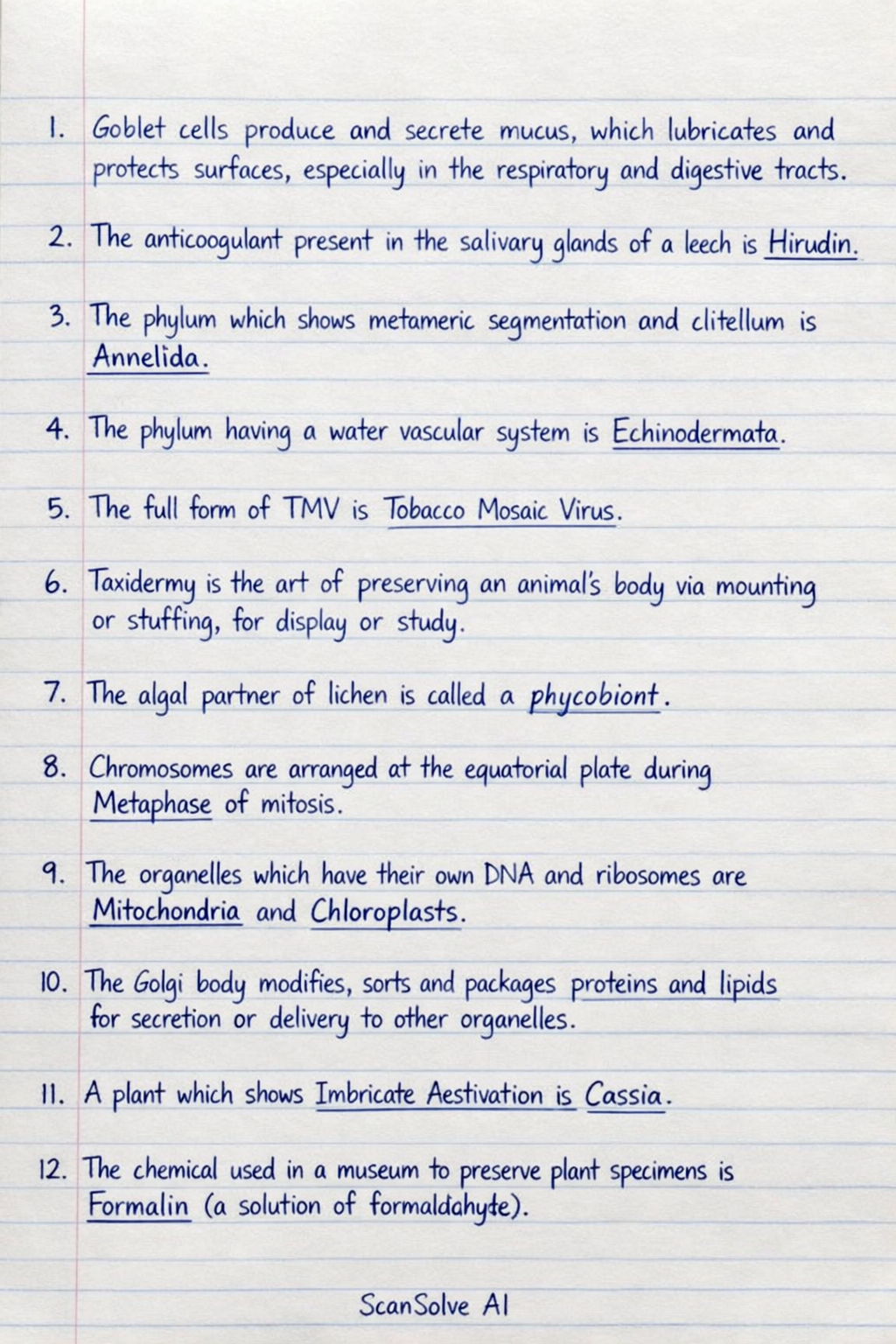
- Goblet cells produce and secrete mucus, which lubricates and protects surfaces, especially in the respiratory and digestive tracts.
- The anticoagulant present in the salivary glands of a leech is Hirudin.
- The phylum which shows metameric segmentation and clitellum is Annelida.
- The phylum having a water vascular system is Echinodermata.
- The full form of TMV is Tobacco Mosaic Virus.
- Taxidermy is the art of preserving an animal's body via mounting or stuffing, for display or study.
- The algal partner of lichen is called a phycobiont.
- Chromosomes are arranged at the equatorial plate during Metaphase of mitosis.
- The organelles which have their own DNA and ribosomes are Mitochondria and Chloroplasts.
- The Golgi body modifies, sorts, and packages proteins and lipids for secretion or delivery to other organelles.
- A plant which shows Imbricate Aestivation is Cassia.
- The chemical used in a museum to preserve plant specimens is Formalin (a solution of formaldehyde).
- Microvilli increase the surface area for absorption in cells, particularly in the small intestine.
- Bacteria – Prokaryotes, Yeast – Eukaryotes.
- A parthenocarpic fruit is a fruit that develops without fertilization of the ovules, resulting in seedless fruits.
- The chemical used in a museum to preserve plant specimens is Formalin (a solution of formaldehyde).
- Bile emulsifies fats in the small intestine, aiding in their digestion and absorption.
- Ureotelism is the excretion of nitrogenous waste primarily in the form of urea.
- Xylem transports water and dissolved minerals from the roots to the rest of the plant.
- The full form of WHO is World Health Organization.
- Meristematic tissue is plant tissue consisting of actively dividing cells, responsible for growth.
- There are 80 bones present in the axial skeleton.
- An asymmetrical flower is a flower that cannot be divided into two equal halves by any plane passing through its center.
- Sarcoplasm is the cytoplasm of a muscle cell.
- Homologous chromosomes are pairs of chromosomes (one from each parent) that are similar in length, gene position, and centromere location.
- The full form of ATP is Adenosine Triphosphate.
- Chyme is the semi-fluid mass of partly digested food that passes from the stomach to the small intestine.
- The full form of ADP is Adenosine Diphosphate.
- Taxidermy is the art of preserving an animal's body via mounting or stuffing, for display or study.
- Red bone marrow produces red blood cells, white blood cells, and platelets (hematopoiesis).
Was this helpful?
Still stuck on this one?
Ask a follow-up, and the answer starts from this question.
Got a different question?Ask your own question
More Biology Questions
QSI1CTION B (20 marks) (Answer all Questions) A bladder containing an attached single invaginated…QAnswer the following questions about microscopy, cell biology, and common aquatic and terrestrial…QWhat are the answers to these biology questions?QWhat are the answers to the following biology questions about animal body plans and classification?QA. Write the name of the phylum of following animals: Leech, prawn, starfish, earthworm, Euglena. d…
Handwritten Step-by-Step Solution
Get this as a handwritten image on WhatsApp — like a tutor wrote it for you.
Try on WhatsApp