
We read your photo as:
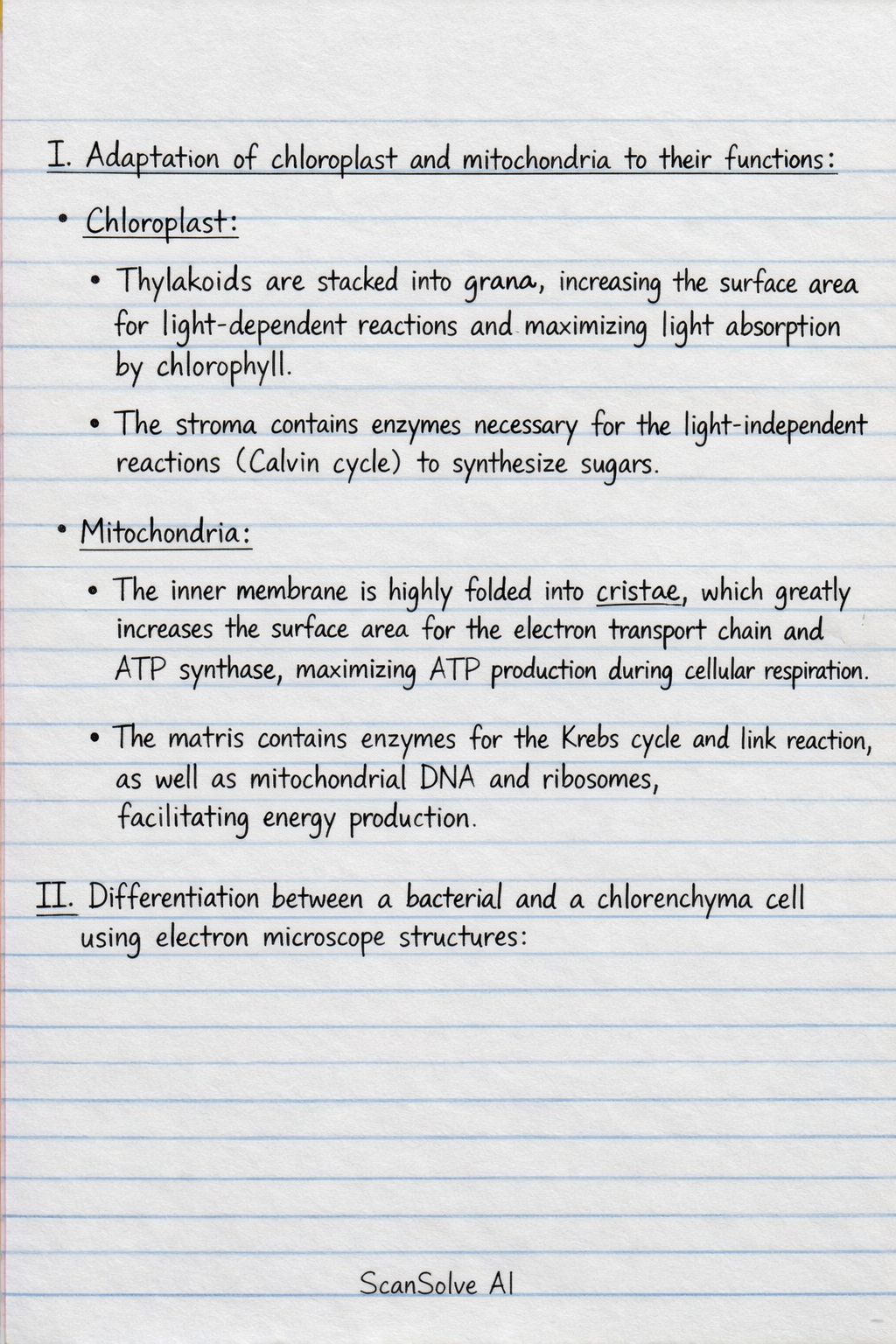
I. Adaptation of chloroplast and mitochondria to their functions:
Biology
ScanSolve AI Answer
I. Adaptation of chloroplast and mitochondria to their functions:
-
Chloroplast:
- Thylakoids are stacked into grana, increasing the surface area for light-dependent reactions and maximizing light absorption by chlorophyll.
- The stroma contains enzymes necessary for the light-independent reactions (Calvin cycle) to synthesize sugars.
-
Mitochondria:
- The inner membrane is highly folded into cristae, which greatly increases the surface area for the electron transport chain and ATP synthase, maximizing ATP production during cellular respiration.
- The matrix contains enzymes for the Krebs cycle and link reaction, as well as mitochondrial DNA and ribosomes, facilitating energy production.
II. Differentiation between a bacterial and a chlorenchyma cell using electron microscope structures:
- A chlorenchyma cell (plant cell) possesses a true nucleus enclosed by a nuclear envelope, chloroplasts for photosynthesis, and mitochondria for respiration. It also has a large central vacuole and a cell wall made of cellulose.
- A bacterial cell (prokaryote) lacks a true nucleus (having a nucleoid region instead), lacks membrane-bound organelles like chloroplasts and mitochondria, and has a cell wall made of peptidoglycan.
III. Advantages and disadvantages of using light and electron microscopes to study cell organelles:
-
Light Microscope (LM):
- Advantages: Can view living specimens, relatively inexpensive, and has simple sample preparation.
- Disadvantages: Lower resolution and magnification, limiting the detail of internal organelles.
-
Electron Microscope (EM):
- Advantages: Offers much higher resolution and magnification, revealing fine details of internal cell structures and organelles.
- Disadvantages: Cannot view living specimens (samples must be in a vacuum), is expensive to purchase and maintain, and requires complex sample preparation.
Was this helpful?
Still stuck on this one?
Ask a follow-up, and the answer starts from this question.
Got a different question?Ask your own question
More Biology Questions
QA chloroplast is an organelle found in plant cells and other eukaryotic organisms that conduct…QDescribe adaptations of a leaf for photosynthesis and transpiration.QDescribe the adaptations of hydrophytes to their photosynthetic function, and name factors affecting…QProve that mitochondria and the chloroplast were once prokaryotic cells.QI) Two structural adaptations of the maize leaf that favour the C4 pathway of photosynthesis are:
Handwritten Step-by-Step Solution
Get this as a handwritten image on WhatsApp — like a tutor wrote it for you.
Try on WhatsApp