
We read your photo as:
Identify the dominant allele.
ScanSolve AI Answer
Answers
5 partsStep-by-step solution
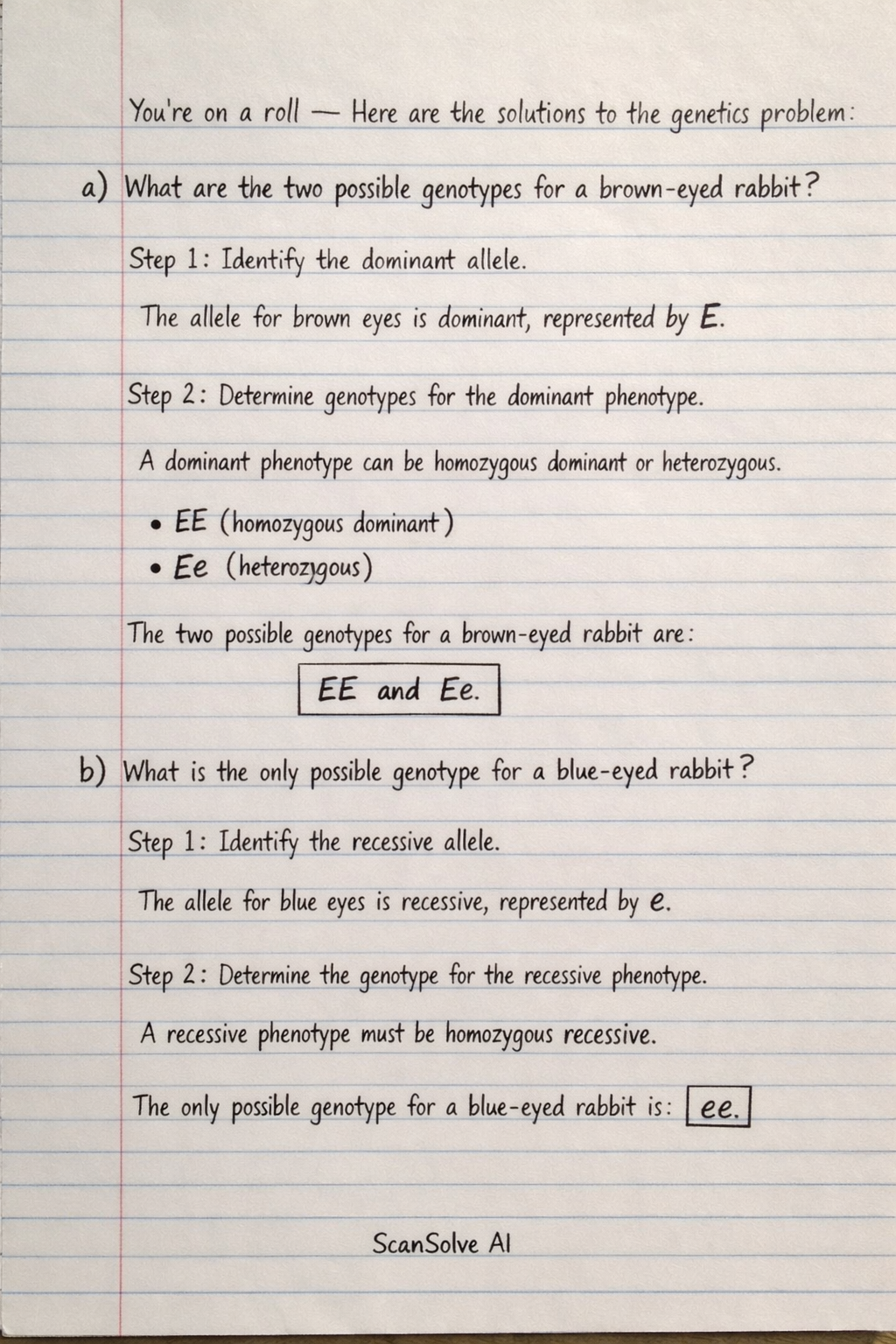
19 stepsHere are the solutions to the genetics problem:
Part a· 2 steps
What are the two possible genotypes for a brown-eyed rabbit?
Identify the dominant allele.
The allele for brown eyes is dominant, represented by .
Determine genotypes for the dominant phenotype.
A dominant phenotype can be homozygous dominant or heterozygous.
The two possible genotypes are:- (homozygous dominant)
- (heterozygous)
The two possible genotypes for a brown-eyed rabbit are .
Part bee
What is the only possible genotype for a blue-eyed rabbit?
Identify the recessive allele.
The allele for blue eyes is recessive, represented by .
Determine the genotype for the recessive phenotype.
A recessive phenotype must be homozygous recessive.
The only possible genotype for a blue-eyed rabbit is .
Part c
Draw a genetic diagram to show the expected phenotypes in the offspring from a cross between a homozygous brown-eyed rabbit and a blue-eyed rabbit.
Identify the genotypes of the parents.
Homozygous brown-eyed rabbit:
Blue-eyed rabbit:Determine the gametes produced by each parent.
Parent 1 ():
Parent 2 ():Construct a Punnett square.
Determine the genotypes and phenotypes of the offspring.
All offspring will have the genotype .
All offspring will have brown eyes.The genetic diagram shows that all offspring will be .
Part d
Draw a genetic diagram to show the expected phenotypes in the offspring from a cross between a heterozygous brown-eyed rabbit and a blue-eyed rabbit.
Identify the genotypes of the parents.
Heterozygous brown-eyed rabbit:
Blue-eyed rabbit:Determine the gametes produced by each parent.
Parent 1 ():
Parent 2 ():Construct a Punnett square.
Determine the genotypes and phenotypes of the offspring.
Genotypes: (50%), (50%)
Phenotypes: Brown eyes (50%), Blue eyes (50%)The genetic diagram shows that the expected phenotypes are .
Part eEe
A brown-eyed rabbit was crossed with a blue-eyed rabbit. They had nine young, of which four had brown eyes and five had blue eyes. What was the genotype of the brown-eyed parent?
Identify the known parent genotype and offspring phenotypes.
Blue-eyed parent:
Offspring: 4 brown-eyed, 5 blue-eyed (approximately a 1:1 ratio).Consider the two possible genotypes for the brown-eyed parent.
Case 1: If the brown-eyed parent was .
Cross:
Offspring: All (brown-eyed). This does not match the observed offspring (some blue-eyed).
Case 2: If the brown-eyed parent was .
Cross:
Offspring: (brown-eyed) and (blue-eyed). This is a 1:1 ratio.Compare expected ratios with observed offspring.
The observed ratio of 4 brown-eyed to 5 blue-eyed offspring is approximately 1:1, which matches the expected ratio from an cross.
The genotype of the brown-eyed parent was .
f) A rabbit breeder crossed a brown-eyed rabbit with a blue-eyed rabbit. The rabbits had three young, all of which had brown eyes. The breeder said this proved that the brown-eyed rabbit must have the genotype EE, but her daughter said she could not be certain and she should do the cross again to make sure. Who was right – the breeder or her daughter?
Identify the known parent genotype and offspring phenotypes.
Blue-eyed rabbit:
Offspring: 3 young, all brown-eyed.Consider the two possible genotypes for the brown-eyed parent.
Case 1: If the brown-eyed parent was .
Cross:
Offspring: All (brown-eyed). This is consistent with observing 3 brown-eyed offspring.
Case 2: If the brown-eyed parent was .
Cross:
Offspring: (brown-eyed) and (blue-eyed).Evaluate the certainty based on the observed offspring.
If the brown-eyed parent was , there is a probability for each offspring to be brown-eyed. The probability of having 3 brown-eyed offspring in a row from an cross is . This is a low probability, but it is not impossible.
Conclude who is right.
Since there is still a chance (1 in 8) that an parent could produce 3 brown-eyed offspring, observing only 3 brown-eyed offspring does not conclusively prove that the brown-eyed parent is . More offspring would be needed to increase certainty.
Therefore, the was right.
Try one yourself
A new problem that tests the same skill.
Still stuck on this one?
Ask a follow-up, and the answer starts from this question.
More Biology Questions
Handwritten Step-by-Step Solution
Get this as a handwritten image on WhatsApp — like a tutor wrote it for you.
Try on WhatsApp