
We read your photo as:
Please identify the nerve injured based on the symptoms described and the common surgical complication. Also, explain the "total separation of the shoulder" injury, including the specific ligaments in
ScanSolve AI Answer
Answer
Here are the solutions to the questions:
Question 61:
The correct answer is C.
The patient's symptoms of a drooping left shoulder, weakness in turning her head to the right, and impaired abduction of her left upper limb are characteristic of injury to the spinal accessory nerve (CN XI). This nerve innervates the sternocleidomastoid muscle (responsible for turning the head to the opposite side) and the trapezius muscle (responsible for elevating and rotating the scapula, which is essential for full shoulder abduction and preventing shoulder droop). Radical neck surgery often involves dissection in the posterior triangle of the neck, where the spinal accessory nerve is vulnerable to injury.
Question 62:
The correct answer is D.
"Total separation of the shoulder" typically refers to an acromioclavicular (AC) joint separation. This injury involves the tearing of ligaments that stabilize the AC joint, which is the articulation between the acromion of the scapula and the clavicle. The acromioclavicular ligament directly connects these two bones and is always involved in an AC separation. In more severe separations, the coracoclavicular ligaments are also torn.
Try one yourself
A new problem that tests the same skill.
Still stuck on this one?
Ask a follow-up, and the answer starts from this question.
More Biology Questions
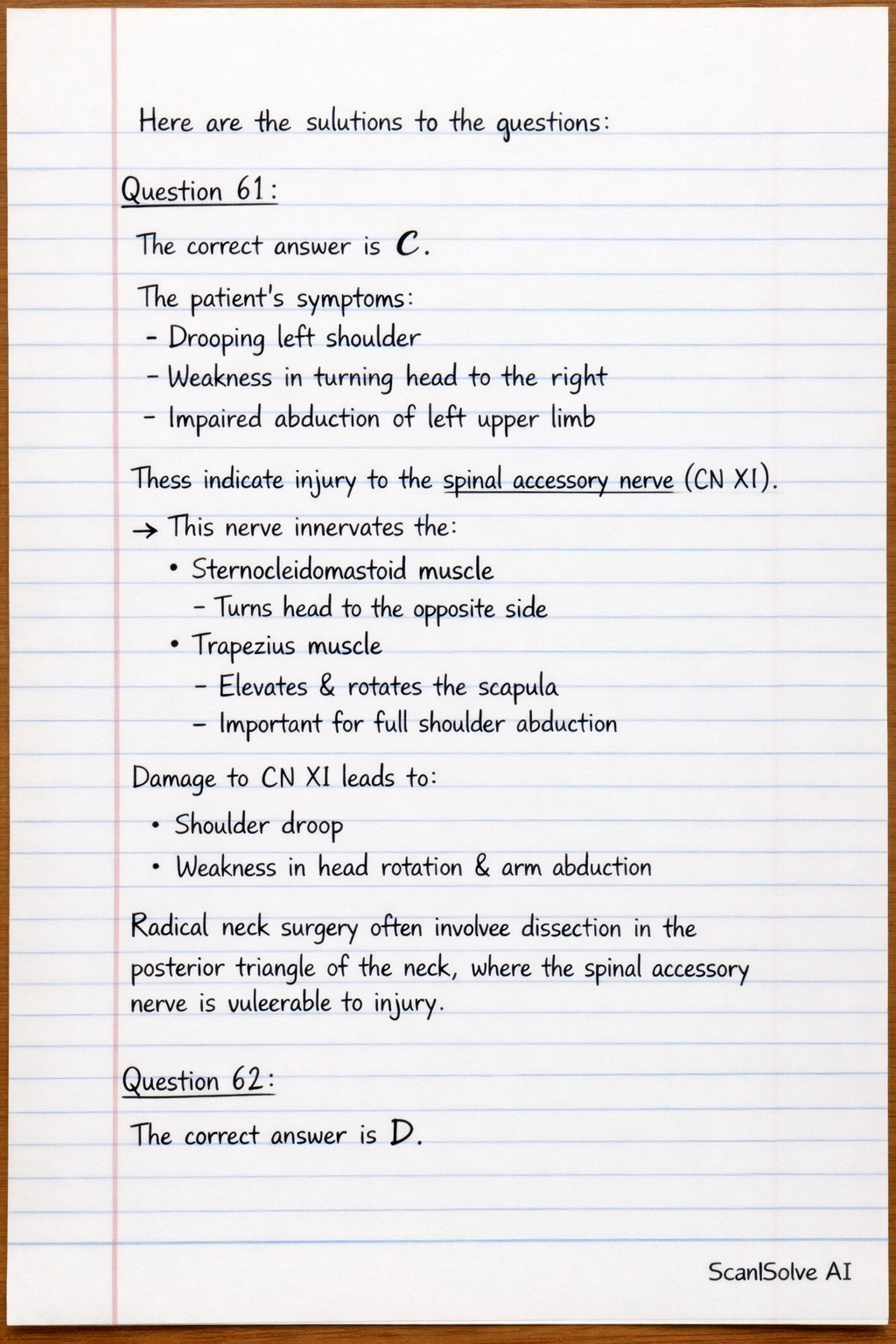
Handwritten Step-by-Step Solution
Get this as a handwritten image on WhatsApp — like a tutor wrote it for you.
Try on WhatsApp