
We read your photo as:
Identify the organelles and processes involved in photosynthesis and cellular respiration, and the storage and structural carbohydrates in organisms.
Biology
ScanSolve AI Answer
Step-by-step solution
8 stepsAnswer question 11 i).
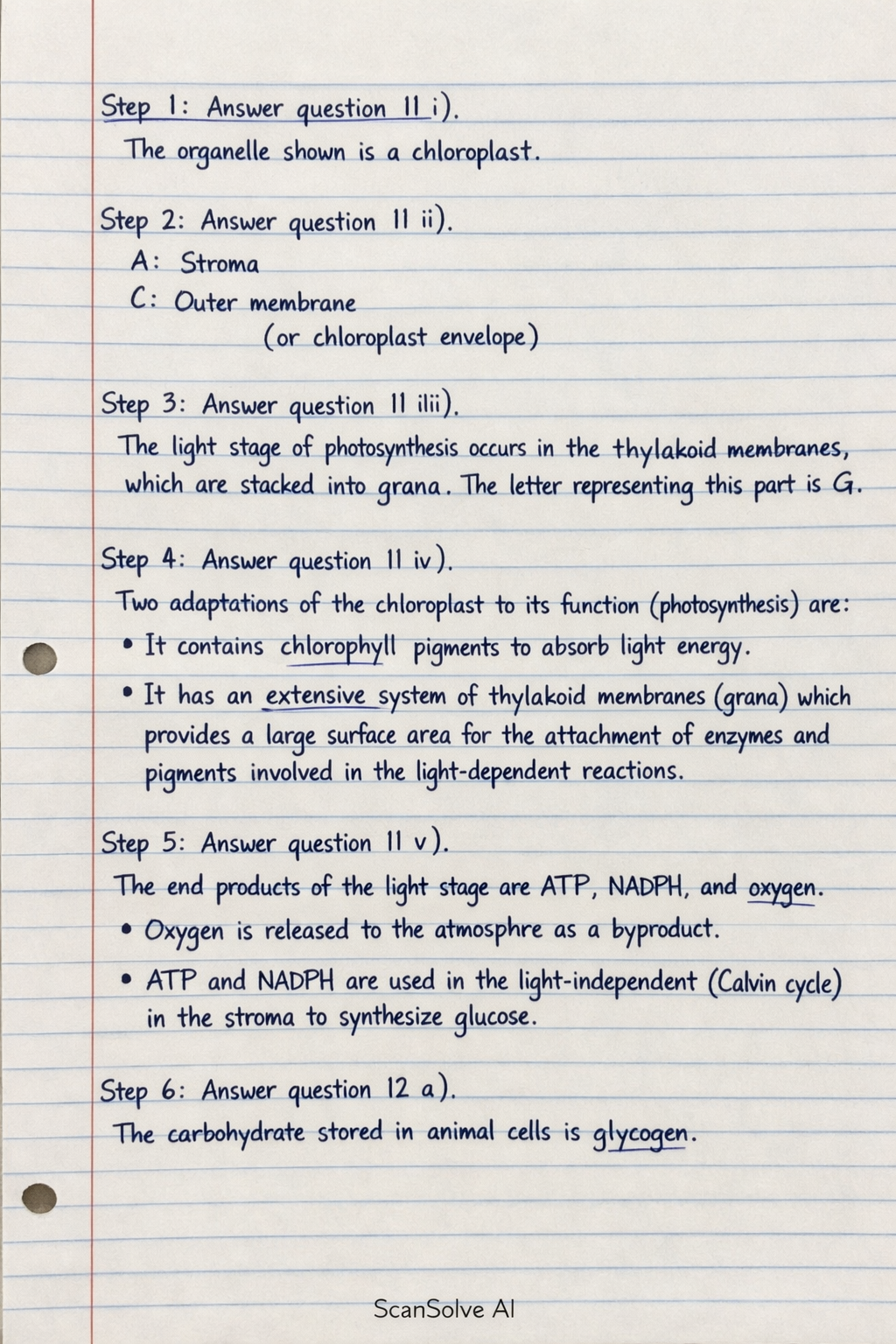
The organelle shown is a chloroplast.
Answer question 11 ii).
- A: Stroma
- C: Outer membrane (or chloroplast envelope)
Answer question 11 iii).
The light stage of photosynthesis occurs in the thylakoid membranes, which are stacked into grana. The letter representing this part is G.
Answer question 11 iv).
Two adaptations of the chloroplast to its function (photosynthesis) are:
- It contains chlorophyll pigments to absorb light energy.
- It has an extensive system of thylakoid membranes (grana) which provides a large surface area for the attachment of enzymes and pigments involved in the light-dependent reactions.
Answer question 11 v).
The end products of the light stage are ATP, NADPH, and oxygen.
- Oxygen is released to the atmosphere as a byproduct.
- ATP and NADPH are used in the light-independent stage (Calvin cycle) in the stroma to synthesize glucose.
Answer question 12 a).
The carbohydrate stored in animal cells is glycogen.
Answer question 12 b).
The carbohydrate that makes up plant cell walls is cellulose.
Answer question 13 a).
- Process I: This process involves the joining of two monosaccharides to form a disaccharide with the removal of a water molecule. This is a condensation reaction (or dehydration synthesis).
- Process II: This process involves the breaking down of a disaccharide into two monosaccharides by the addition of a water molecule. This is hydrolysis.
Was this helpful?
Still stuck on this one?
Ask a follow-up, and the answer starts from this question.
Got a different question?Ask your own question
More Biology Questions
QIdentify the correct term for each of the following biological concepts: 8. Organelles with…QIdentify and explain the biological processes and conditions described, including osmosis…QIdentify the mitochondrion and its parts, explain cellular respiration, and differentiate between…QPlease provide a detailed explanation of the process of cellular respiration, including the main…QStudy the diagram of some organelles below. a) Identify the organelle marked A. b) Give three…
Browse by topic:Biochemistry
Handwritten Step-by-Step Solution
Get this as a handwritten image on WhatsApp — like a tutor wrote it for you.
Try on WhatsApp