
We read your photo as:
Identify the mitochondrion and its parts, explain cellular respiration, and differentiate between aerobic and anaerobic respiration.
ScanSolve AI Answer
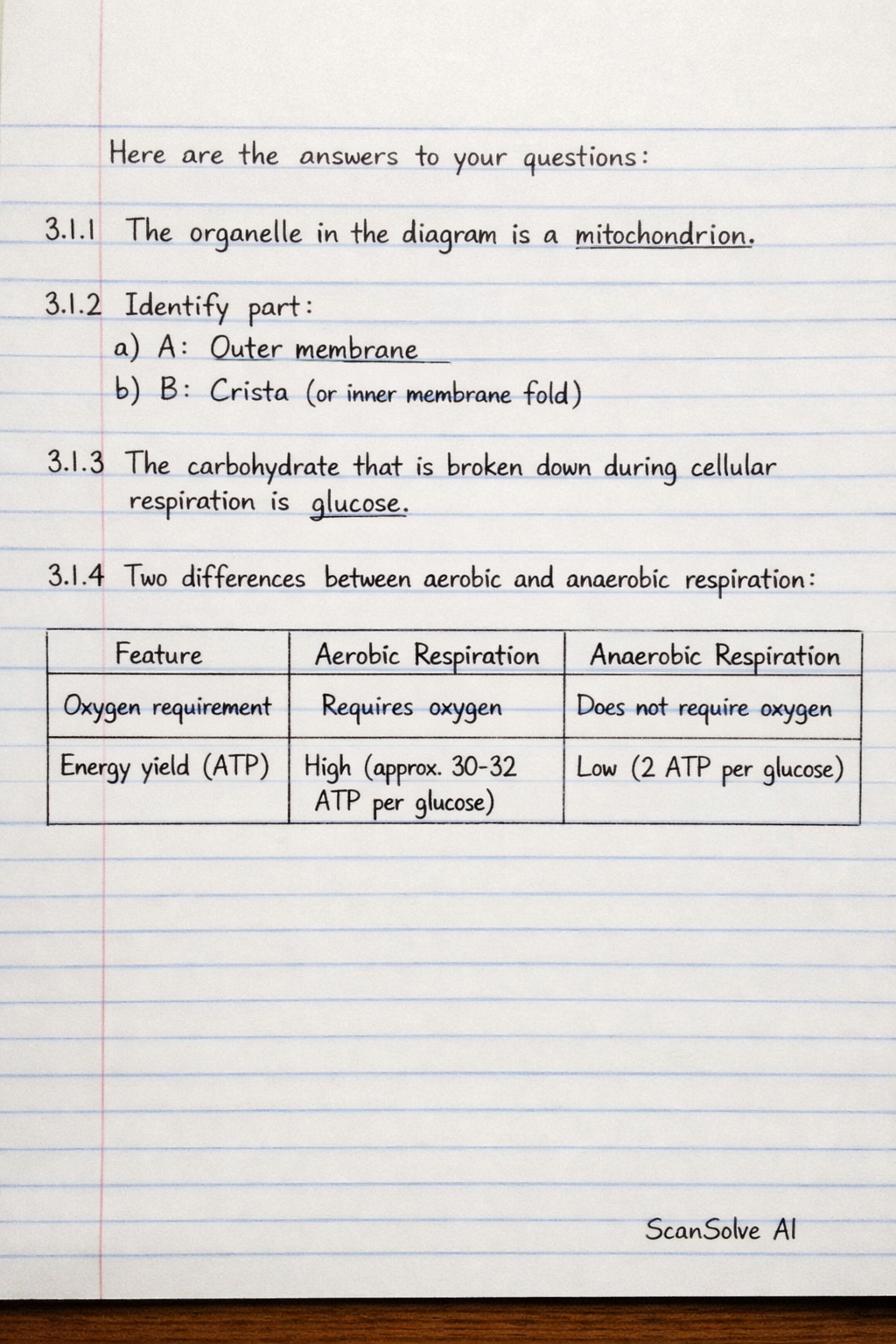
Here are the answers to your questions:
3.1.1 The organelle in the diagram is a mitochondrion.
3.1.2 Identify part:
*a) A: Outer membrane
*b) B: Crista (or inner membrane fold)
3.1.3 The carbohydrate that is broken down during cellular respiration is glucose.
3.1.4 Two differences between aerobic and anaerobic respiration:
| Feature | Aerobic Respiration | Anaerobic Respiration |
|---|---|---|
| Oxygen requirement | Requires oxygen | Does not require oxygen |
| Energy yield (ATP) | High (approximately 30-32 ATP per glucose) | Low (2 ATP per glucose) |
3.1.5 The Krebs cycle (or citric acid cycle) occurs in the mitochondrial matrix. During this cycle, acetyl-CoA (derived from pyruvate) combines with a 4-carbon molecule to form a 6-carbon molecule. Through a series of reactions, carbon dioxide is released, and energy-carrying molecules such as ATP, NADH, and FADH2 are produced. The 4-carbon molecule is regenerated to continue the cycle, and the NADH and FADH2 proceed to the electron transport chain to generate more ATP.
Still stuck on this one?
Ask a follow-up, and the answer starts from this question.
More Biology Questions
Handwritten Step-by-Step Solution
Get this as a handwritten image on WhatsApp — like a tutor wrote it for you.
Try on WhatsApp