
We read your photo as:
Identify the type of parasites shown in the image and discuss their economic impact on livestock and environmental impact on gold extraction in Ghana.
ScanSolve AI Answer
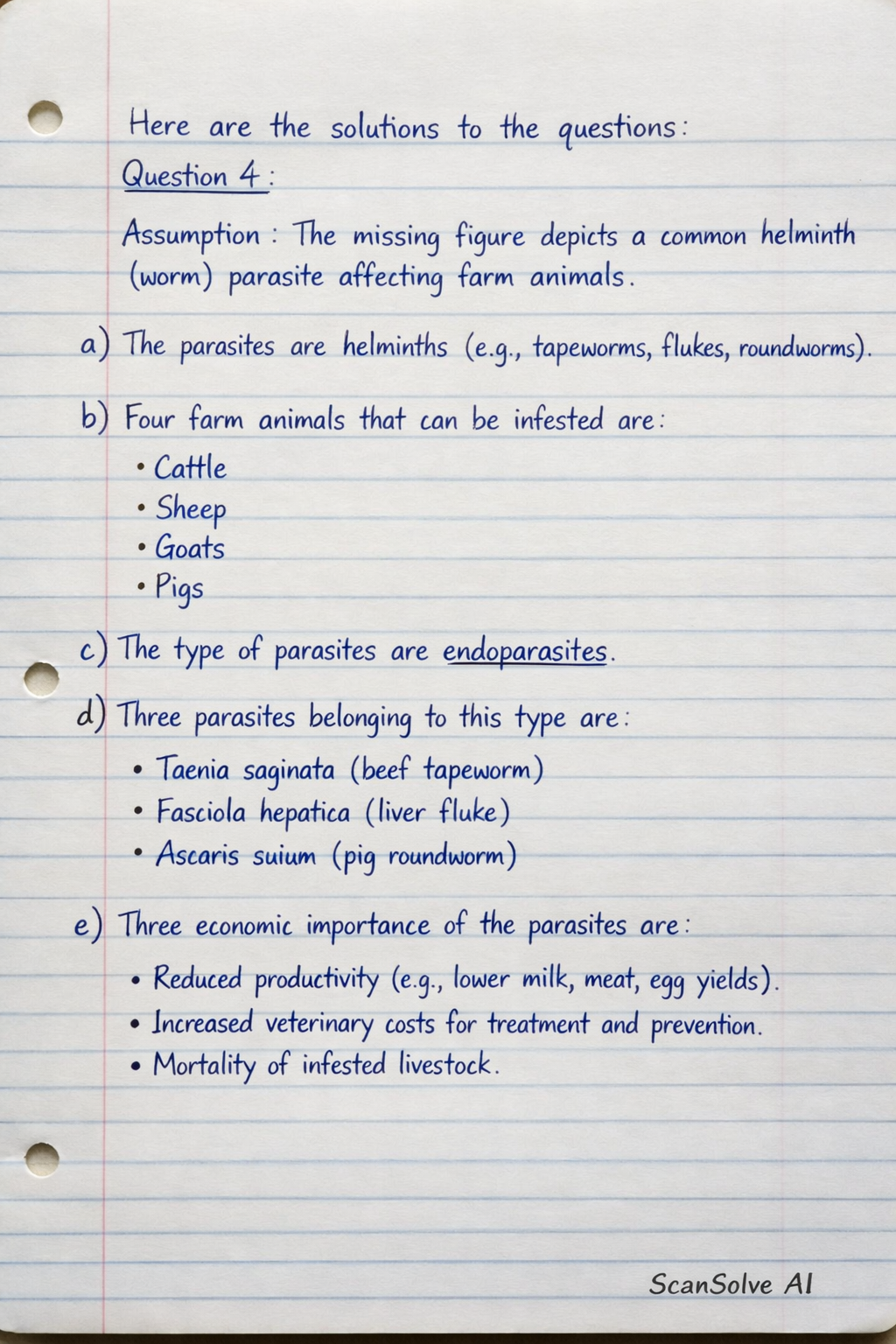
Here are the solutions to the questions:
Question 4:
Assumption: The missing figure depicts a common helminth (worm) parasite affecting farm animals.
a) The parasites are helminths (e.g., tapeworms, flukes, roundworms).
b) Four farm animals that can be infested are:
- Cattle
- Sheep
- Goats
- Pigs
c) The type of parasites are endoparasites.
d) Three parasites belonging to this type are:
- Taenia saginata (beef tapeworm)
- Fasciola hepatica (liver fluke)
- Ascaris suum (pig roundworm)
e) Three economic importance of the parasites are:
- Reduced productivity (e.g., lower milk, meat, egg yields).
- Increased veterinary costs for treatment and prevention.
- Mortality of infested livestock.
Question 5:
a) Four measures to minimize the negative impact of gold extraction on the Ghanaian environment:
- Conduct thorough Environmental Impact Assessments (EIA) before operations.
- Implement effective reclamation and rehabilitation programs for mined-out areas.
- Ensure responsible waste management, especially for tailings and mercury.
- Promote and enforce the use of environmentally friendly extraction methods, such as mercury-free techniques.
b) Four importance of cover cropping in crop production:
- Prevents soil erosion by protecting the soil surface from wind and rain.
- Adds organic matter to the soil, improving its fertility and structure.
- Suppresses weeds, reducing the need for herbicides.
- Improves soil water retention and infiltration.
c) Two uses of each of the following:
i) Metals:
- Construction (e.g., steel in buildings and bridges).
- Electrical wiring (e.g., copper in cables). ii) Non-metals: - Fertilizers (e.g., nitrogen and phosphorus compounds). - Fuel (e.g., carbon in coal, hydrogen in rocket fuel).
Question 6:
a)
i) An atom is the smallest unit of matter that retains an element's chemical identity. It consists of a nucleus containing protons and neutrons, surrounded by electrons.
ii) An atom has 11 electrons.
) The electronic configuration of the atom (Sodium, Na) is:
or in shell notation: 2, 8, 1.
) The element will form an ionic bond with chlorine.
) Two reasons for this type of chemical bond are:
- Sodium (a metal) has one valence electron and tends to lose it to achieve a stable electron configuration.
- Chlorine (a non-metal) has seven valence electrons and tends to gain one electron to achieve a stable electron configuration.
b)
i) Food poisoning is an illness caused by consuming food contaminated with harmful bacteria, viruses, parasites, or toxins.
ii) Two causes of food poisoning are:
- Improper food handling: This includes not washing hands before preparing food, or cross-contamination between raw and cooked foods.
- Inadequate cooking: Food not cooked to a sufficiently high temperature to kill harmful pathogens present within it.
c) Two methods of soil conservation are:
- Contour plowing: Plowing across the slope of a hill rather than up and down, which helps to slow water runoff and reduce erosion.
- Terracing: Creating level platforms or steps on slopes to prevent rapid water flow and soil loss.
d)
i) Light energy is a form of electromagnetic radiation that is visible to the human eye. It travels in waves and can be perceived as brightness and color.
ii) Two ways in which light energy is useful to living organisms:
- Photosynthesis: Plants use light energy
Still stuck on this one?
Ask a follow-up, and the answer starts from this question.
More Biology Questions
Handwritten Step-by-Step Solution
Get this as a handwritten image on WhatsApp — like a tutor wrote it for you.
Try on WhatsApp