
We read your photo as:
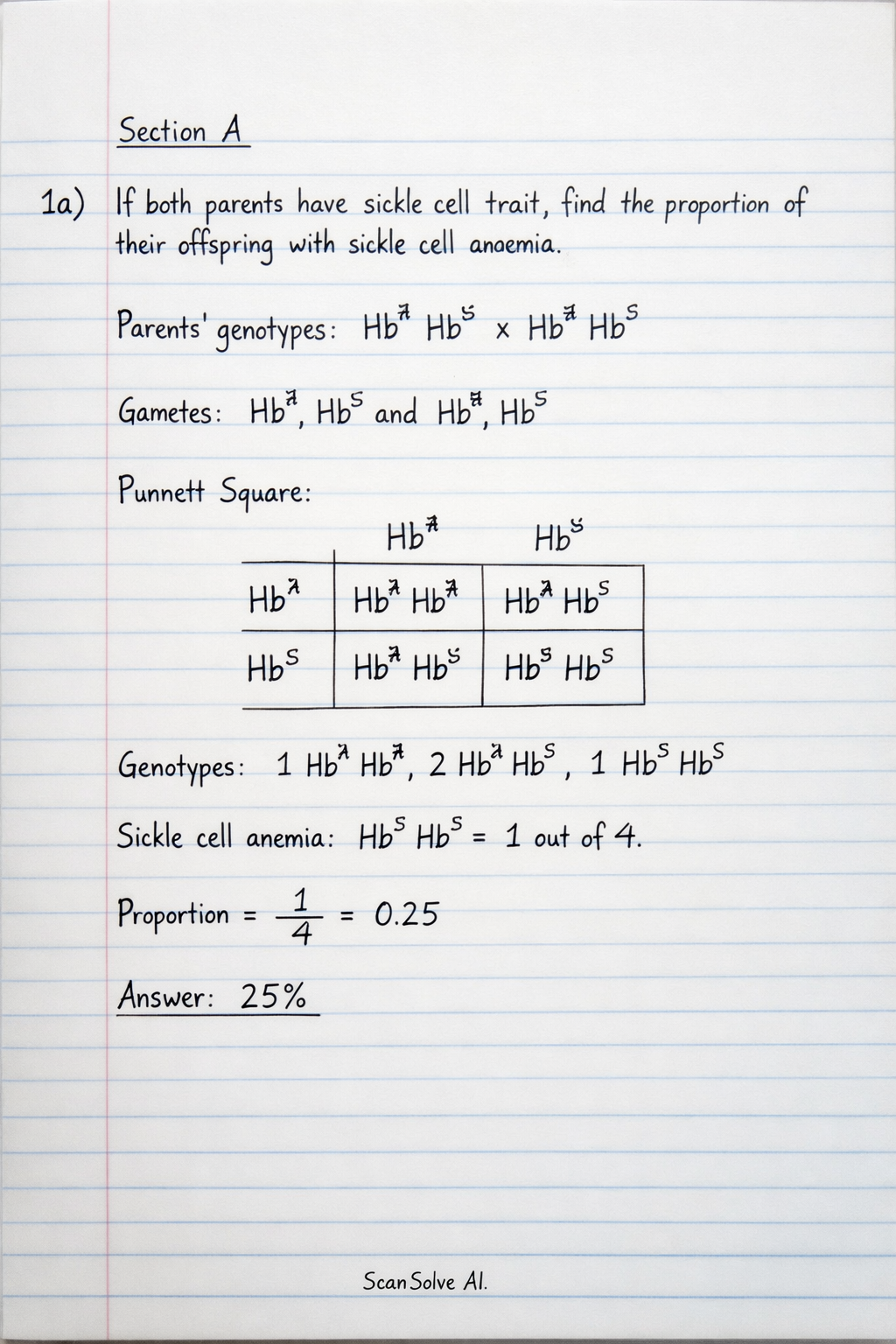
If both parents have sickle cell trait, work out the proportion of their offspring that have sickle cell anaemia.
ScanSolve AI Answer
Here are the answers to your questions:
Section A
-
Sickle cell anemia is a disease in which people produce abnormal haemoglobin in their red blood cells. Letter represents the gene for normal haemoglobin while letter represents the gene for abnormal haemoglobin. Heterozygous individuals are said to have cell trait.
-
a) If both parents have sickle cell trait, work out the proportion of their offspring that have sickle cell anaemia. (5mks)
- Parents' genotypes:
- Gametes: from each parent.
- Punnett Square:
- Offspring genotypes:
- : Normal
- : Sickle cell trait (carrier)
- : Sickle cell anaemia
- The proportion of offspring with sickle cell anaemia is .
-
b) Explain why sickle cell trait is more prevalent in tropical countries than temperate countries. (2mks) Individuals with the sickle cell trait () have increased resistance to malaria. Malaria is a widespread disease in tropical regions, so carrying the sickle cell trait provides a survival advantage in these areas, leading to its higher prevalence.
-
c) Name any other disease caused by gene mutation. (1mk) Colour blindness (or Cystic fibrosis, Hemophilia, Huntington's disease).
-
-
The figure shown below represents of mammalian structure. Use it to answer the questions that follow.
-
a) Name parts labelled A and C. (2mks)
- A: Afferent arteriole
- C: Proximal convoluted tubule
-
b) (i) State structural difference between Part A and B. (1mk) Part A (afferent arteriole) has a wider diameter than Part B (efferent arteriole).
-
c) State one adaptation of part D to its function. (1mk) Part D (Loop of Henle) is long, which increases the surface area and time for the reabsorption of water and salts, contributing to the concentration of urine.
-
d) Name two materials found in B and absent in D. (2mks)
- i) Blood cells (e.g., red blood cells, white blood cells)
- ii) Large plasma proteins (e.g., albumin)
-
Still stuck on this one?
Ask a follow-up, and the answer starts from this question.
More Biology Questions
Handwritten Step-by-Step Solution
Get this as a handwritten image on WhatsApp — like a tutor wrote it for you.
Try on WhatsApp