
We read your photo as:
Importance of cellular rest and the "power house" of the cell.
ScanSolve AI Answer
Step-by-step solution
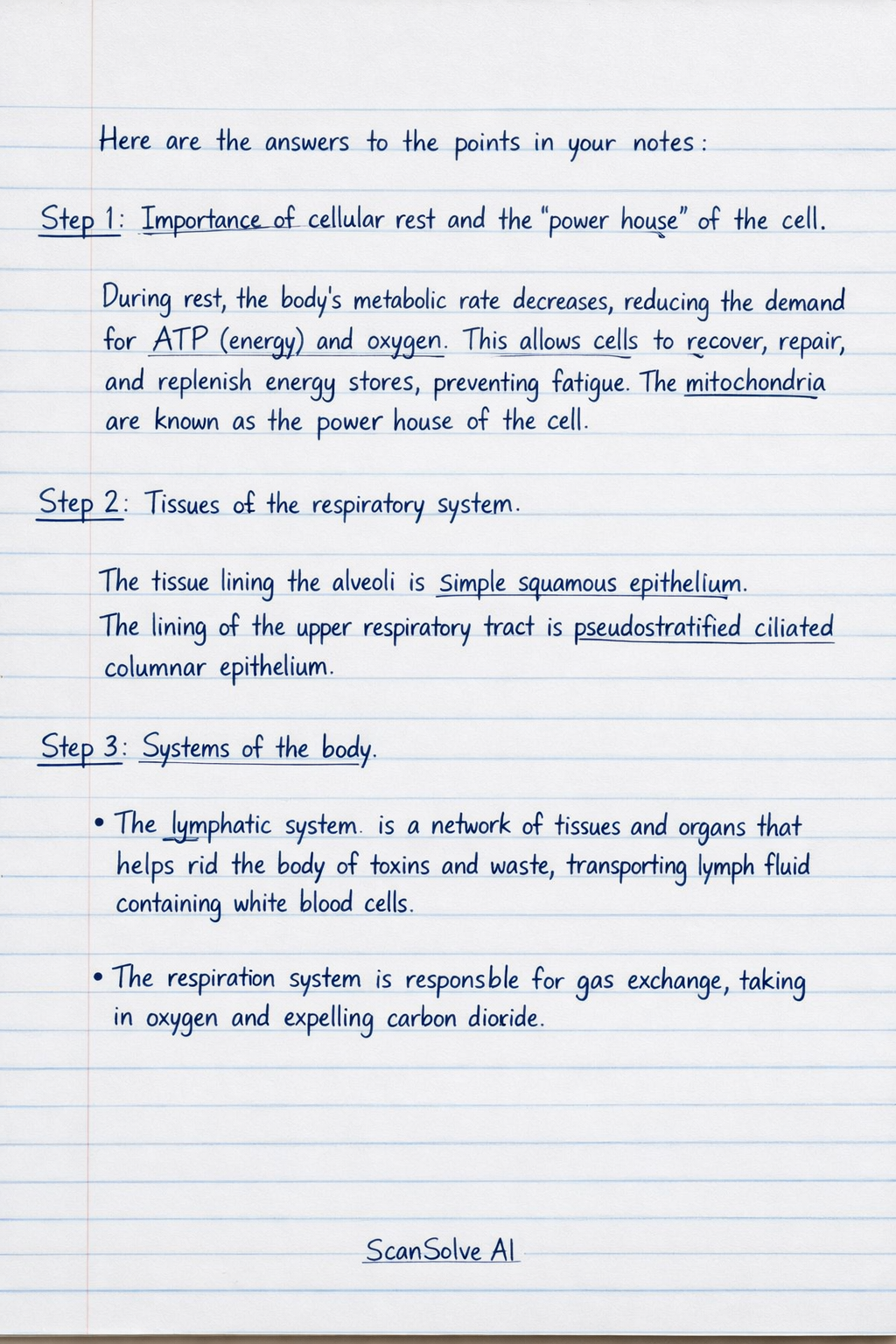
7 stepsHere are the answers to the points in your notes:
Importance of cellular rest and the "power house" of the cell.
During rest, the body's metabolic rate decreases, reducing the demand for ATP (energy) and oxygen. This allows cells to recover, repair, and replenish energy stores, preventing fatigue. The mitochondria are known as the powerhouse of the cell.
Tissues of the respiratory system.
The tissue lining the alveoli is simple squamous epithelium. The lining of the upper respiratory tract is pseudostratified ciliated columnar epithelium.
Systems of the body.
- The lymphatic system is a network of tissues and organs that helps rid the body of toxins and waste, transporting lymph fluid containing white blood cells.
- The respiration system is responsible for gas exchange, taking in oxygen and expelling carbon dioxide.
Cellular adaptation.
Cellular adaptation refers to reversible changes cells undergo in response to environmental changes, allowing them to survive and maintain function. Types include atrophy (decrease in cell size), hypertrophy (increase in cell size), hyperplasia (increase in cell number), metaplasia (change from one cell type to another), and dysplasia (abnormal cell growth).
Reason for increased heart rate.
Heart rate increases to compensate for higher metabolic demands (e.g., during exercise), decreased oxygen supply, or conditions like blood loss. A faster heart rate pumps more blood, delivering more oxygen and nutrients to tissues and removing waste products more efficiently.
Respiratory Physiology
Type I and Type II pneumocytes.
(Assuming "lymphocytes" was a mistake for "pneumocytes" in the context of "Respiratory Physiology").- Type I pneumocytes (alveolar cells) are thin, flat cells that form the alveolar wall, facilitating gas exchange.
- Type II pneumocytes (septal cells) are cuboidal cells that produce and secrete pulmonary surfactant, which reduces surface tension in the alveoli and prevents their collapse.
Respiration terms.
- External respiration is the exchange of gases between the alveoli of the lungs and the blood.
- Internal respiration is the exchange of gases between the blood in the capillaries and the tissue cells.
- Ventilation is the process of moving air into and out of the lungs (breathing).
Still stuck on this one?
Ask a follow-up, and the answer starts from this question.
More Biology Questions
Handwritten Step-by-Step Solution
Get this as a handwritten image on WhatsApp — like a tutor wrote it for you.
Try on WhatsApp