
We read your photo as:
In a multiple choice test covering human heart structure, plasma vs tissue fluid, and plant excretory products, what are the correct answers and justifications?
ScanSolve AI Answer
Answer
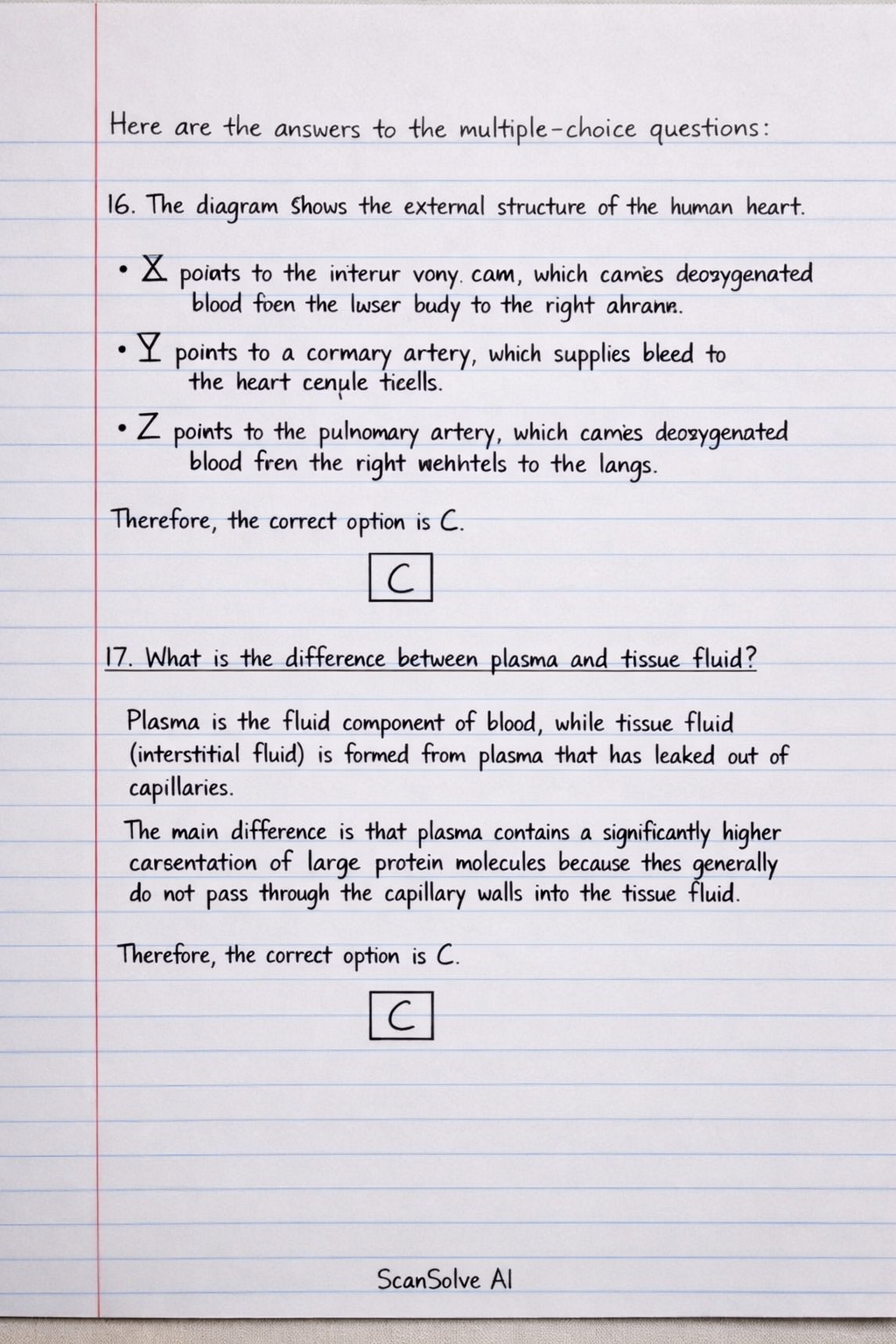
Here are the answers to the multiple-choice questions:
16. The diagram shows the external structure of the human heart.
- X points to the inferior vena cava, which carries deoxygenated blood from the lower body to the right atrium.
- Y points to a coronary artery, which supplies blood to the heart muscle itself.
- Z points to the pulmonary artery, which carries deoxygenated blood from the right ventricle to the lungs.
Therefore, the correct option is C.
17. What is the difference between plasma and tissue fluid?
Plasma is the fluid component of blood, while tissue fluid (interstitial fluid) is formed from plasma that has leaked out of capillaries. The main difference is that plasma contains a significantly higher concentration of large protein molecules because these generally do not pass through the capillary walls into the tissue fluid.
Therefore, the correct option is C.
18. Which of the following is not an excretory product of plants?
- Carbon dioxide is an excretory product of respiration in plants.
- Latex is a secondary metabolite that can be excreted or stored.
- Oxygen is a byproduct of photosynthesis, released by plants.
- Urea is a nitrogenous waste product primarily found in animals, not plants. Plants do not excrete urea.
Therefore, the correct option is D.
19. The diagram shows part of a nephron (Bowman's capsule and glomerulus). Y points to the filtrate entering the renal tubule. Which of the following is not found in the filtrate Y?
During glomerular filtration, small molecules like glucose, mineral ions, and urea pass from the blood into Bowman's capsule to form the filtrate. Large molecules such as proteins are normally retained in the blood and do not pass into the filtrate.
Therefore, the correct option is C.
20. Which of the following is not an endocrine gland?
- The hypothalamus is a region of the brain that produces hormones, making it a neuroendocrine organ. However, it is structurally part of the central nervous system, not a discrete gland in the same anatomical sense as the pituitary or thyroid.
- The pancreas is a mixed gland, having both exocrine (digestive enzymes) and endocrine (insulin, glucagon) functions.
- The pituitary gland is a major endocrine gland.
- The thyroid gland is an endocrine gland.
While the hypothalamus has significant endocrine functions, it is fundamentally a part of the brain and is often distinguished as a neuroendocrine organ rather than a standalone "gland" like the others.
Therefore, the correct option is A.
Try one yourself
A new problem that tests the same skill.
Still stuck on this one?
Ask a follow-up, and the answer starts from this question.
More Biology Questions
Handwritten Step-by-Step Solution
Get this as a handwritten image on WhatsApp — like a tutor wrote it for you.
Try on WhatsApp