
We read your photo as:
In Rosa alba, red flowered plants (RR) crossed with white-flowered plants (WW) produce offspring with pink flowers. Explain this phenomenon and determine the expected genotypic and phenotypic ratios i
ScanSolve AI Answer
Answers
6 partsSECTION C (30 MARKS)
9.
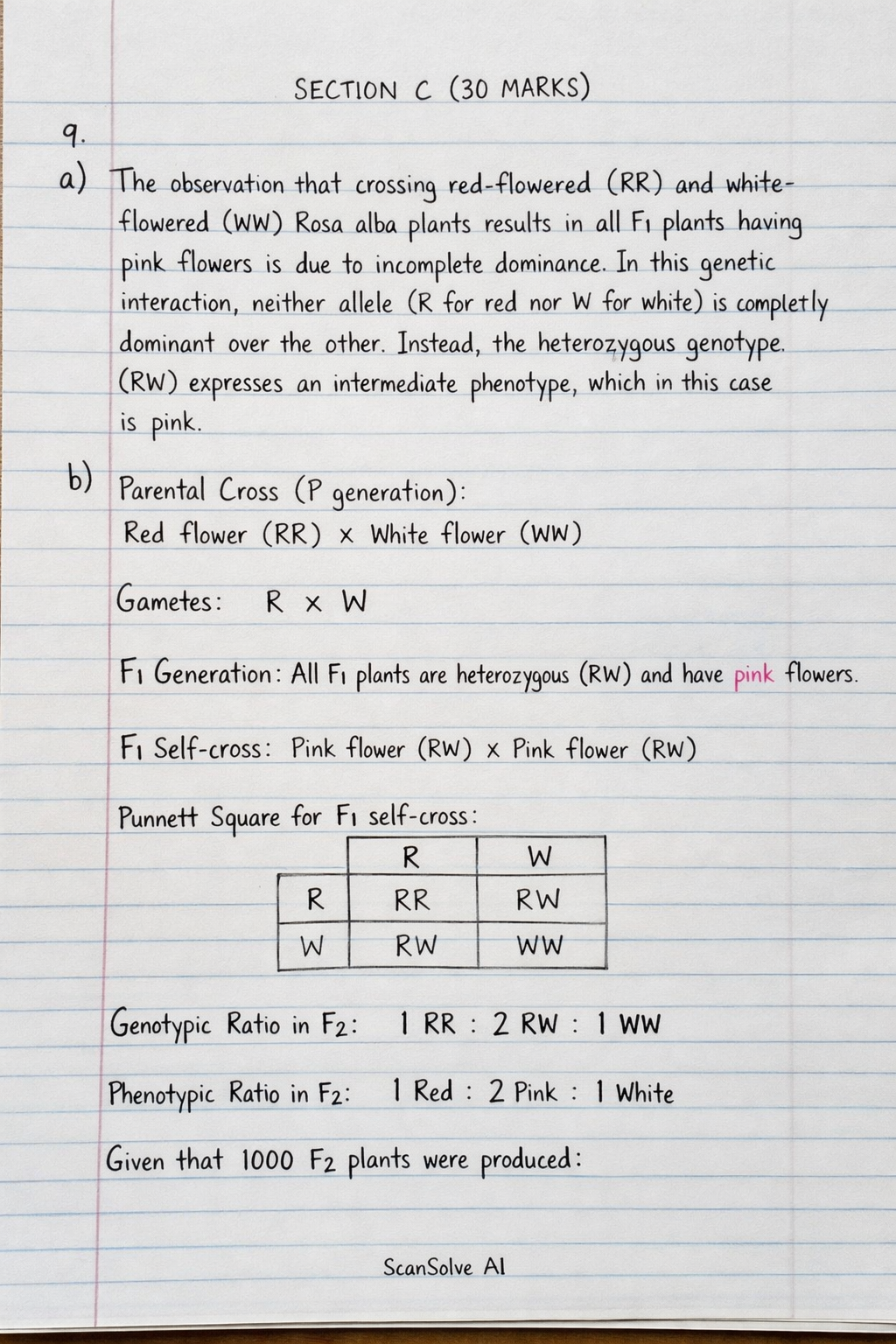
a) The observation that crossing red-flowered (RR) and white-flowered (WW) Rosa alba plants results in all F1 plants having pink flowers is due to incomplete dominance. In this genetic interaction, neither allele (R for red nor W for white) is completely dominant over the other. Instead, the heterozygous genotype (RW) expresses an intermediate phenotype, which in this case is pink.
b)
Parental Cross (P generation):
Red flower (RR) White flower (WW)
Gametes:
R W
F1 Generation:
All F1 plants are heterozygous (RW) and have pink flowers.
F1 Self-cross:
Pink flower (RW) Pink flower (RW)
Punnett Square for F1 self-cross:
Genotypic Ratio in F2:
1 RR : 2 RW : 1 WW
Phenotypic Ratio in F2:
1 Red : 2 Pink : 1 White
Given that 1000 F2 plants were produced:
i) Number of Red flowers:
ii) Number of Pink flowers:
iii) Number of White flowers:
c)
The probability of getting:
i) Red flowers:
ii) Pink flowers:
iii) White flowers:
10.
Poor waste disposal creates significant problems in the environment due to several reasons:
- Environmental Pollution: Improperly disposed waste contaminates soil, water bodies (rivers, lakes, oceans), and air. Toxic chemicals from landfills can leach into groundwater, and burning waste releases harmful pollutants and greenhouse gases into the atmosphere.
- Health Hazards: Accumulation of waste provides breeding grounds for disease vectors like flies, mosquitoes, and rodents, which can transmit diseases such as malaria, dengue, and cholera. Direct contact with waste can also cause infections and injuries.
- Aesthetic Degradation: Piles of garbage and litter spoil the natural beauty of landscapes, urban areas, and tourist sites, leading to an unpleasant and unhygienic environment.
- Blockage of Drainage Systems: Solid waste, especially plastics, can clog sewers and drainage systems, leading to localized flooding during heavy rains. This can damage property and create stagnant water bodies, further increasing disease risks.
- Harm to Wildlife: Animals, particularly marine life, can ingest or become entangled in plastic waste, leading to injury, starvation, or death. Toxic substances from waste can also accumulate in the food chain, affecting ecosystems.
- Greenhouse Gas Emissions: Organic waste in landfills decomposes anaerobically, producing methane, a potent greenhouse gas that contributes significantly to climate change and global warming.
Try one yourself
A new problem that tests the same skill.
Still stuck on this one?
Ask a follow-up, and the answer starts from this question.
More Biology Questions
Handwritten Step-by-Step Solution
Get this as a handwritten image on WhatsApp — like a tutor wrote it for you.
Try on WhatsApp