
We read your photo as:
What are the genotype of F1 generation, phenotypic ratio in F2 generation and genetic explanation for the absence of red and white in F1 generation given parent plants are pure red and pure white with
ScanSolve AI Answer
Answers
2 partsStep-by-step solution
13 stepsHere are the solutions to the genetics problems:
Part 13· 7 steps
- a) Work out the genotype of F1 generation.
Identify the parental genotypes.
Pure red plant: $$RR$$ Pure white plant: $$WW$$Determine the gametes produced by each parent.
Red parent gametes: $$R$$ White parent gametes: $$W$$Combine the gametes to find the F1 genotype.
$$ R \times W \implies RW $$ The genotype of the F1 generation is $\boxed{RW}$.- b) If 200 plants from F1 generation were selfed, what would be the phenotypic ratio in the F2 generation?
Identify the cross for the F2 generation (selfing F1).
$$ RW \times RW $$Use a Punnett square to determine the genotypes and phenotypes of the F2 generation.
| Gametes | R | W | | :------ | :- | :- | | **R** | RR | RW | | **W** | RW | WW |Determine the genotypic ratio.
$$ 1 RR : 2 RW : 1 WW $$Determine the phenotypic ratio based on incomplete dominance (RR = Red, RW = Pink, WW = White).
$$ 1 \text{ Red} : 2 \text{ Pink} : 1 \text{ White} $$ The phenotypic ratio in the F2 generation is $\boxed{1 \text{ Red} : 2 \text{ Pink} : 1 \text{ White}}$.- c) What is the genetic explanation for the absence of plants with red and white in the F1 generation? The genetic explanation is incomplete dominance. Neither the allele for red color () nor the allele for white color () is completely dominant over the other. When both alleles are present in the heterozygous state (), they produce an intermediate phenotype, which is pink flowers, rather than either red or white.
Part 14
-
a) Identify the recessive character. Give a reason. The recessive character is white flowers. Reason: When plants with red flowers are crossed and produce offspring with both red and white flowers (in an approximate 3:1 ratio of red to white, i.e., 120:41), it indicates that the white trait was masked in the parent generation. This is characteristic of a recessive trait, which only expresses itself when two copies of the recessive allele are present (homozygous recessive).
-
b) Determine the genotypes of the parent plants that give rise to the plants with red and white flowers.
Based on the 3:1 phenotypic ratio (120 Red
41 White), this indicates a cross between two heterozygous parents where one allele is dominant over the other.
Let represent the dominant allele for red flowers and represent the recessive allele for white flowers.
For white flowers () to appear in the offspring, both parents must carry the recessive allele ().
Since the parents are described as "red flowers" and produce white offspring, they must be heterozygous red.
The genotypes of the parent plants are (heterozygous red).- c) If the white flowers were selfed, what would be the genotypes of their offspring?
Identify the genotype of white flowers.
Since white is the recessive character, its genotype is .
Perform the self-cross.
$$ rr \times rr $$Determine the genotypes of the offspring.
All offspring will inherit an $r$ allele from each parent.
The genotypes of their offspring would be $\boxed{all \ rr}$ (homozygous recessive).
Try one yourself
A new problem that tests the same skill.
Still stuck on this one?
Ask a follow-up, and the answer starts from this question.
More Biology Questions
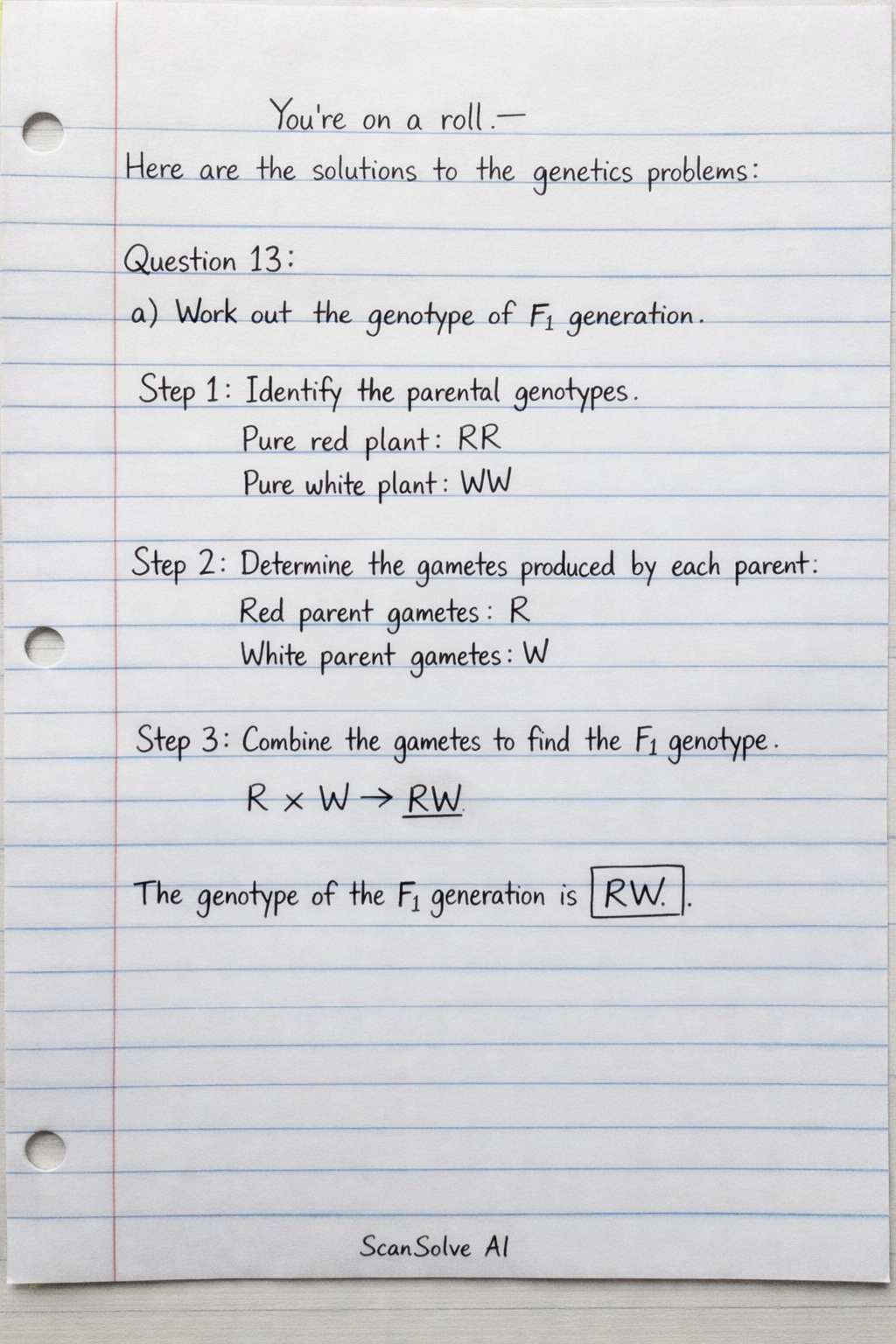
Handwritten Step-by-Step Solution
Get this as a handwritten image on WhatsApp — like a tutor wrote it for you.
Try on WhatsApp