
We read your photo as:
In short-horned cattle, the allele for white coat and the allele for red coat are codominant. A cross between a red bull and a white cow. Show your working. Use R to represent red allele and W to represent white allele.
ScanSolve AI Answer
Step-by-step solution
4 stepsHere's the breakdown of the genetics problem and the photosynthesis questions:
Part 19· 4 steps
Genetics Problem
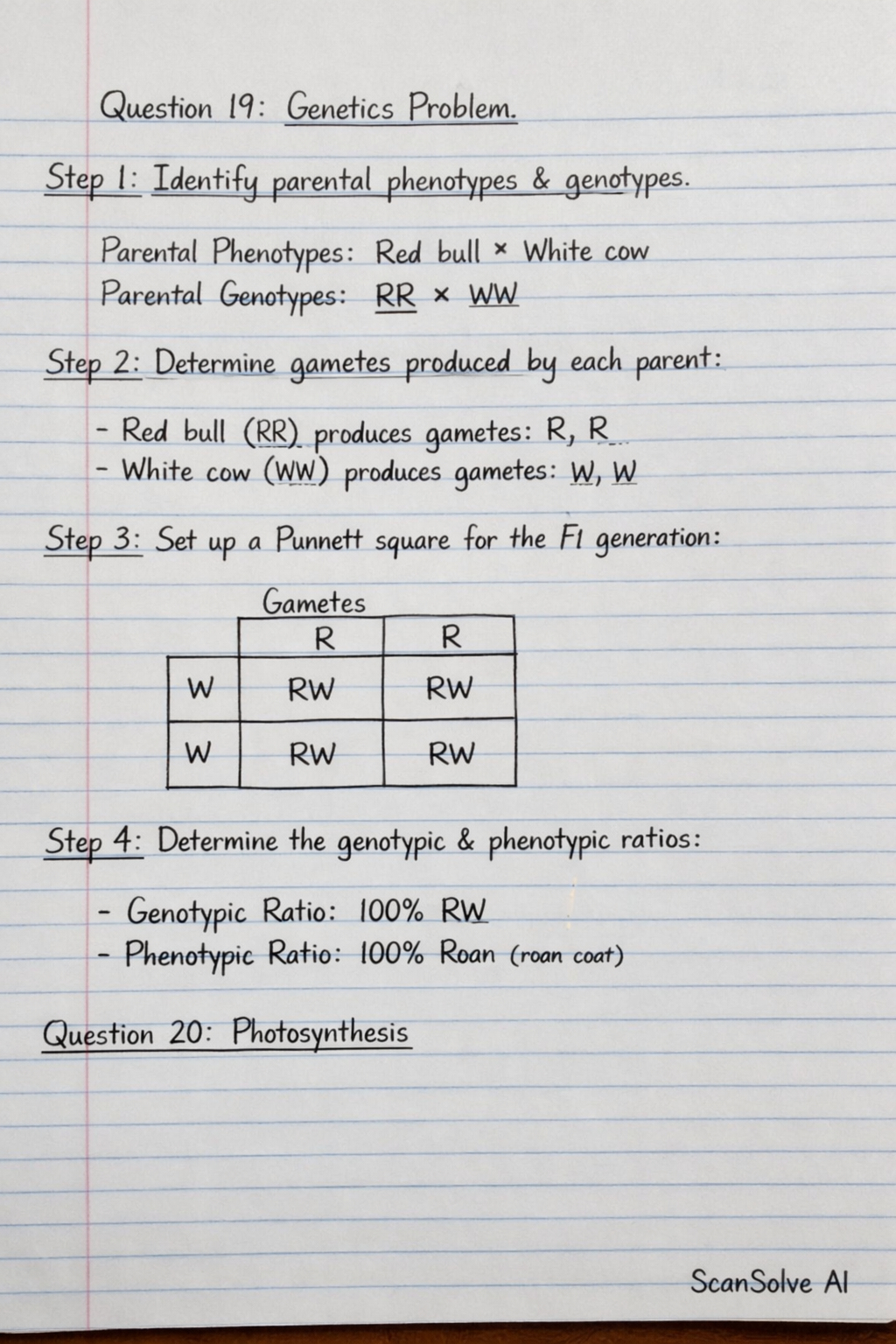
Identify parental phenotypes and genotypes.
In short-horned cattle, red (R) and white (W) alleles are codominant. This means both alleles are expressed equally in the heterozygote.
- Parental Phenotypes: Red bull White cow
- Parental Genotypes:
Determine the gametes produced by each parent.
- Red bull (RR) produces gametes: R, R
- White cow (WW) produces gametes: W, W
Construct a Punnett square to show the F1 generation.
Determine the genotypic and phenotypic ratios of the F1 generation.
- Genotypic Ratio: All offspring have the genotype RW.
- 100% RW
- Phenotypic Ratio: Since R and W are codominant, RW results in a roan coat (a mixture of red and white hairs).
- 100% Roan
- Genotypic Ratio: All offspring have the genotype RW.
Part 20
Photosynthesis
Part a
"Without photosynthesis life on earth can stop. Give reasons."
Life on Earth depends on photosynthesis because it is the primary process that converts light energy into chemical energy, producing glucose (food) for plants and, subsequently, for all other organisms in the food chain. Additionally, photosynthesis releases oxygen into the atmosphere, which is essential for the respiration of most living organisms, including humans and animals. Without these two vital products, most life forms would not be able to survive.
Part b
"Photosynthesis occurs in leaves more than in roots. Give reasons."
Photosynthesis occurs predominantly in leaves because leaves are specifically adapted for this process. They contain chloroplasts with chlorophyll, the pigment that absorbs light energy. Leaves have a broad, flat surface to maximize light absorption and stomata for efficient gas exchange (taking in carbon dioxide and releasing oxygen). Roots, on the other hand, are typically underground, lack chlorophyll, and are primarily specialized for absorbing water and minerals, not for photosynthesis.
Still stuck on this one?
Ask a follow-up, and the answer starts from this question.
More Biology Questions
Handwritten Step-by-Step Solution
Get this as a handwritten image on WhatsApp — like a tutor wrote it for you.
Try on WhatsApp